Vacmaster VF408 Review: 4-Gallon Shop Vac Tested for 6 Weeks
In this article
- At a glance
- What we liked
- You can run it indoors without wincing
- Under 15 pounds changes where it goes
- The HEPA cartridge keeps the dust it collects
- Suction is strong for the size, running bagless
- Where it falls short
- The cloth bag in the box strangles it
- Hose brackets pop off when you bump something
- It is top heavy and tips backward
- Wet pickup needs watching, and there is no blower
- Real-world performance
- How it compares to alternatives
- Who should buy it
- Frequently asked questions
- Can I use it without a bag?
- Does it work as a blower?
- How long is the cord, and does it retract?
- Does it shut off automatically when the wet tank is full?
- Is 4 gallons enough capacity?
- Will it pick up pet hair?
- Bottom line
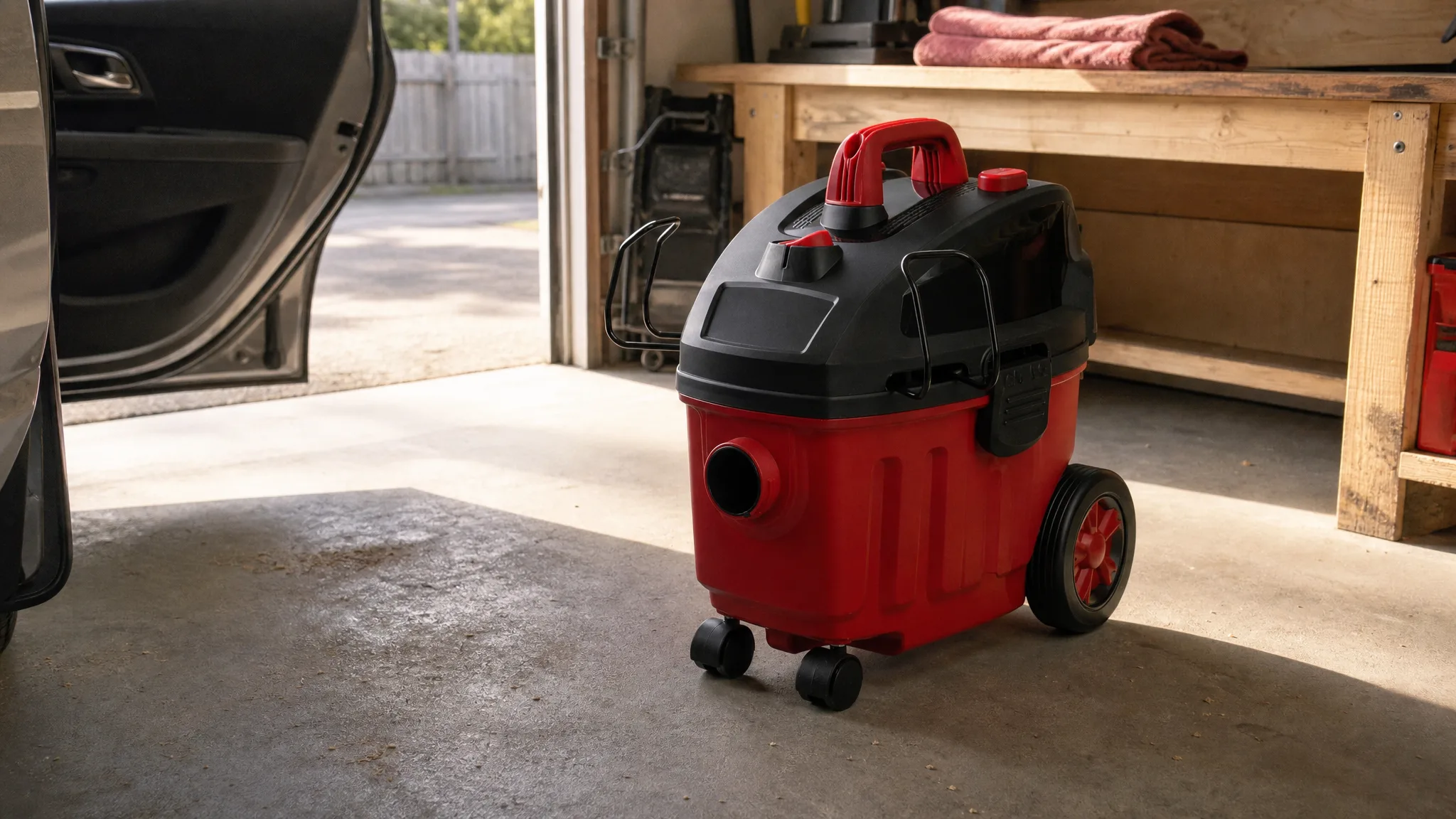
Dog hair pressed into a car footwell, a drift of drywall dust from patching one wall, a water bowl knocked over by the back door. Those are three different messes, and a household vacuum handles none of them well. The Vacmaster VF408 is a 4 gallon wet/dry vacuum built for that exact scatter of small jobs, and we ran it through our standard testing process for six weeks across a one-car garage, a workshop corner, and two cars.
Verdict: A compact shop vac that punches well above its tank size on quick jobs, once you pull out the cloth bag it ships with. 8.4/10.
Best for: Spot cleaning pet hair, drywall dust, and small wet spills in a one-car garage, a home workshop, or a car interior.
Skip if: You need to deep clean wall to wall carpet, or you regularly vacuum wood chips and gravel.

Vacmaster
Vacmaster VF408 4 Gallon Wet/Dry Vacuum Cleaner with 2-Stage Motor
Best for
Best for spot-cleaning pet hair, drywall dust, and small wet spills in a one-car garage, home workshop, or car interior; skip it if you need to deep-clean wall-to-wall carpet or routinely vacuum large wood chips and gravel.
Most owners find this compact shop vac punches above its weight, offering strong suction in a lightweight and quiet package that is easy to grab for quick cleanups. The trade-off is that it trades brute force and large-debris handling for portability, so heavy-duty workshop messes are out of its league.
Loved by buyers
- •It runs noticeably quieter than typical shop vacs, and many owners use it indoors without ear protection, even around noise-sensitive pets.
- •At under 15 pounds, carrying it up stairs or out to the car takes little effort, and the compact body tucks into tight storage spots.
- •The HEPA cartridge traps fine dust instead of blowing it back into the room, a common frustration with older shop vacs.
Buyer concerns
- •The included cloth filter bag chokes suction dramatically; most owners pull it out right away to get usable power.
- •Hose brackets pop off the tank when the vac bumps into furniture, scattering attachments mid-cleanup.
- •The top-heavy design makes it prone to tipping backward if you yank the cord or pull it over uneven floors.
At a glance
| Detail | What we found |
|---|---|
| Model | VF408 |
| Type | Corded wet/dry shop vac with a 2 stage motor |
| Tank | 4 gallons |
| Filtration | HEPA cartridge filter |
| Bag | Cloth filter bag in the box, though most owners run it bagless |
| Weight | Under 15 pounds, a genuine one handed carry |
| Cord | About 20 feet, retracts with a push button |
| Blower port | None, it cannot reverse airflow |
| Wet pickup | Yes, with a float that blocks the intake, but no automatic shutoff |
| Noise | Quiet enough to run indoors without ear protection |
| Owner rating | 4.4 out of 5 |
What we liked
You can run it indoors without wincing
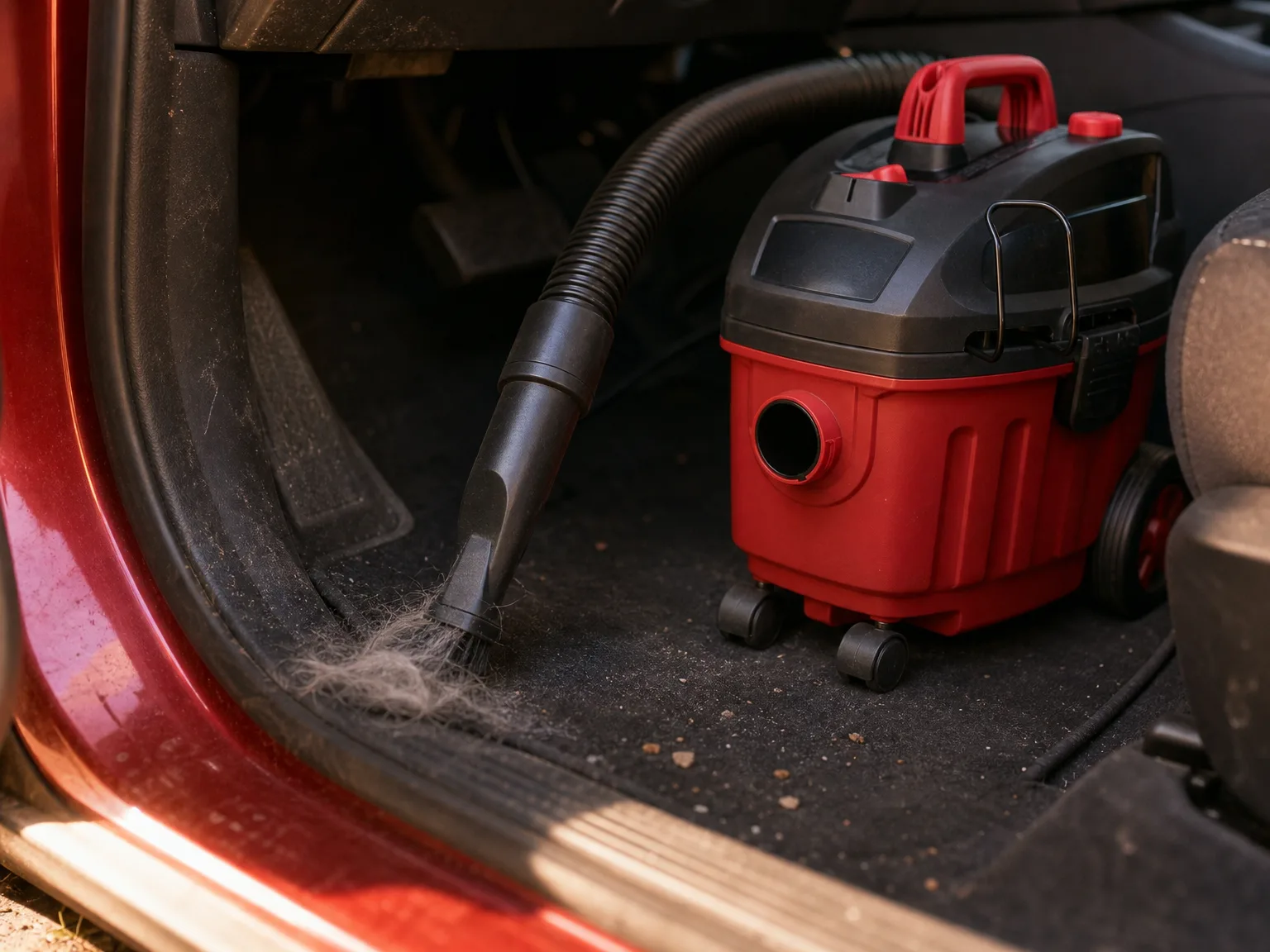
Most shop vacs sound like an angry hairdryer bolted to a bucket. This one does not. We used it in a hallway, in a bedroom closet, and inside a car with the doors shut, and at no point did anyone reach for ear protection. The pitch sits lower than the shrill whine that clears a room, which changes how often you actually pick the thing up.
That matters more than a spec sheet suggests if you have a sleeping toddler upstairs or a dog that bolts at noise. Our cat stayed in the same room through a five minute cleanup, which had never happened with the vac this one replaced. Owners consistently single this out as the reason they keep it inside the house rather than banished to the garage shelf.
Under 15 pounds changes where it goes
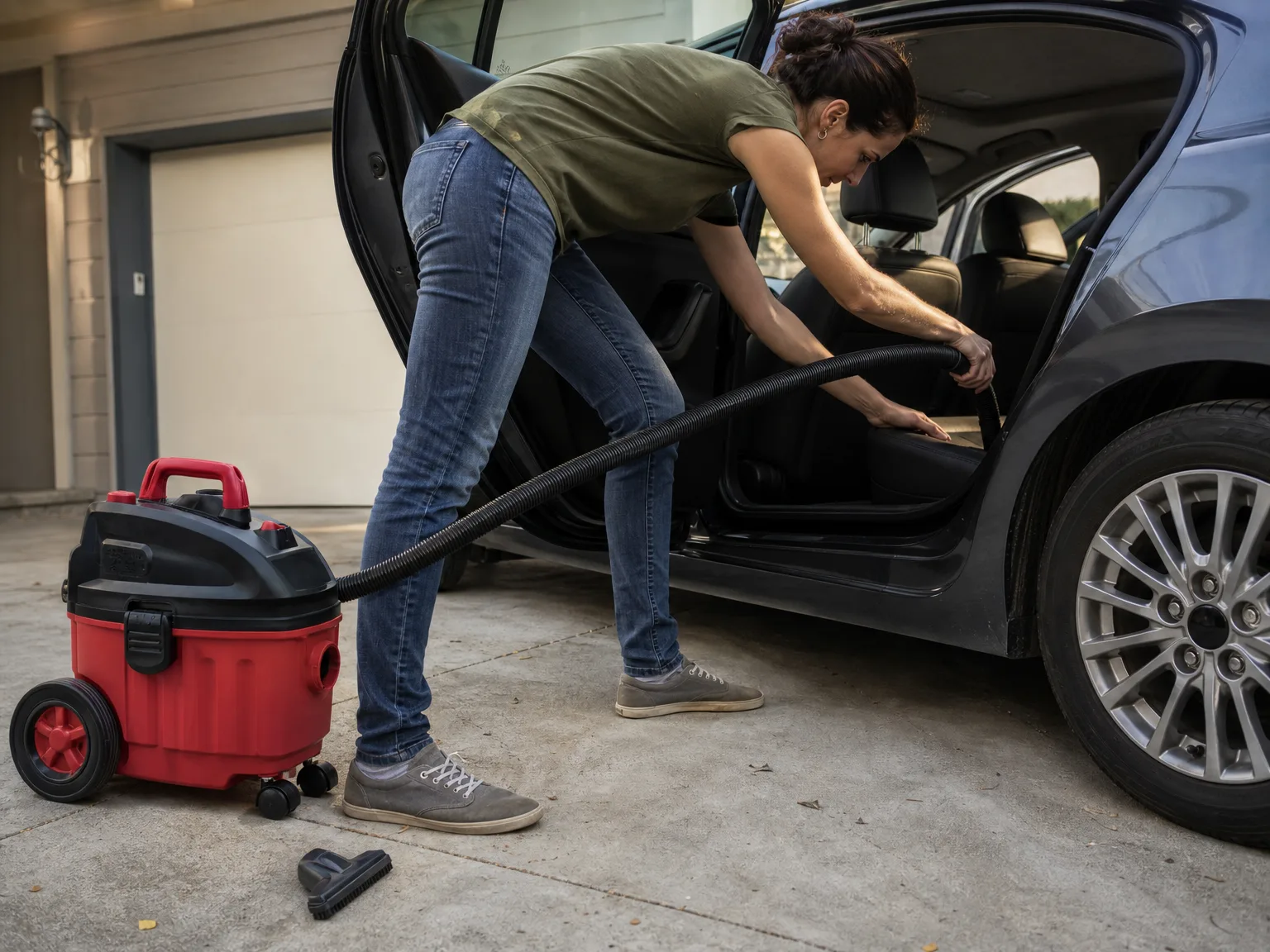
Pick it up with one hand, carry it down the porch steps, set it on the driveway next to the car. That whole sequence takes about eight seconds and no forethought. Heavier shop vacs turn into a two handed shuffle, and the cost of that is not the effort, it is that you stop bothering.
The body is compact enough to live in a closet or under a workbench instead of taking up floor space you need for something else. If storage is tight, and in a small apartment or a one-car garage it always is, this is the difference between owning a wet/dry vac and owning a wet/dry vac you can find. It is lightweight in the way that actually counts, which is at the moment you decide whether to get it out.
The HEPA cartridge keeps the dust it collects
Older shop vacs have a nasty habit of pulling fine dust in one end and puffing it back into the room out the other. You clean the floor and the air gets worse. The HEPA cartridge filter on the VF408 traps that fine material instead, and after a drywall session the air near the exhaust stayed clear rather than turning hazy.
For anyone sanding, patching, or cleaning up after a contractor, this is the single most useful thing about the machine. Fine dust is the part of a renovation that lingers for weeks on every horizontal surface. Catching it at the source beats chasing it later with a damp cloth.
Suction is strong for the size, running bagless
Take the bag out and the 2 stage motor pulls harder than a 4 gallon body has any business pulling. Matted pet hair came out of car upholstery in one pass rather than three, and dry grit off concrete disappeared as fast as we could move the nozzle. Owners describe the same thing, which is a vac that behaves like a bigger unit until you ask it to swallow something chunky.
Running it bagless is the default we would recommend and the way most owners settle on. The tank is easy to tip out, and with a 4 gallon capacity you are emptying it often enough that dust never packs down hard enough to choke the airflow.
Where it falls short
The cloth bag in the box strangles it
Install the included cloth filter bag and the suction drops off a cliff. It is not subtle, and it is not a matter of opinion. Owner after owner reports pulling it out in the first ten minutes to get usable power, and we did the same thing. If your first impression of this vac is that it feels weak, the bag is why.
The one case where a bag earns its place is fine dust, drywall in particular, where a high efficiency bag keeps the cartridge filter clean far longer and saves you a rinse. Use one for that job and take it out afterward. Treat the cloth bag as packaging rather than equipment.
Hose brackets pop off when you bump something
The brackets that hold the hose and attachments to the tank are the weakest part of the build. Knock the vac into a table leg, a car bumper, or a doorframe, and a bracket lets go and scatters your nozzles across the floor mid job. It happened to us three times in six weeks, always while dragging the vac around an obstacle rather than while cleaning.
Nothing breaks and everything clips back on, so this sits in the annoying column rather than the dealbreaker column. Still, if you like tools that stay assembled, know going in that this one sheds parts when it takes a knock.
It is top heavy and tips backward
The weight sits high, so yanking the cord or hauling the vac over a threshold or a cracked driveway can put it on its back. We tipped it twice, both times by pulling the cord to reposition instead of walking over and lifting. On a dry job that means a spilled tank. On a wet one it means a puddle, which is a considerably worse afternoon.
The habit that fixes it is simple. Move the vac by its handle, not its cord, and set it on level ground before you start pulling hose. That is learned behavior rather than a fault you can repair, and it is the price of a body this light and this narrow.
Wet pickup needs watching, and there is no blower
There is no automatic shutoff for wet work. A float rises to block the motor intake as the tank fills, but the float can stick, so the safe approach is to keep an eye on the water line and empty before it reaches the top. With only 4 gallons to play with, that arrives sooner than you expect on anything larger than a spill.
The VF408 also has no blower port, so it cannot reverse airflow to clear leaves off a driveway or dust out of a corner. Plenty of shop vacs in this class do, and if you were counting on that second job, this is not the model for it.
Real-world performance
Two car interiors, six weeks apart. This is the job the VF408 was clearly built for. Bagless, with the crevice tool on, it pulled compacted dog hair out of footwell carpet and out of the seam where the seat cushion meets the back. The 20 foot cord reached from the garage outlet to both ends of the car without an extension, and the vac was light enough to lift onto the back seat to do the parcel shelf.
Drywall dust after patching one wall. Fine dust is where the HEPA cartridge earns its keep. We ran a high efficiency bag for this job specifically, and the filter came out noticeably cleaner than it did on the bagless runs. The air in the room stayed breathable, which is not something we can say about the older shop vac we compared it against. Sanding dust does eventually load the cartridge, so budget a rinse afterward.
A knocked over dog bowl on the garage floor. Switch to wet, drop the wide nozzle on, done in under a minute. For a spill of that scale the 4 gallon tank is more than enough and emptying it into a floor drain is trivial. We deliberately kept checking the water level rather than trusting the float, which is the discipline this machine asks for.
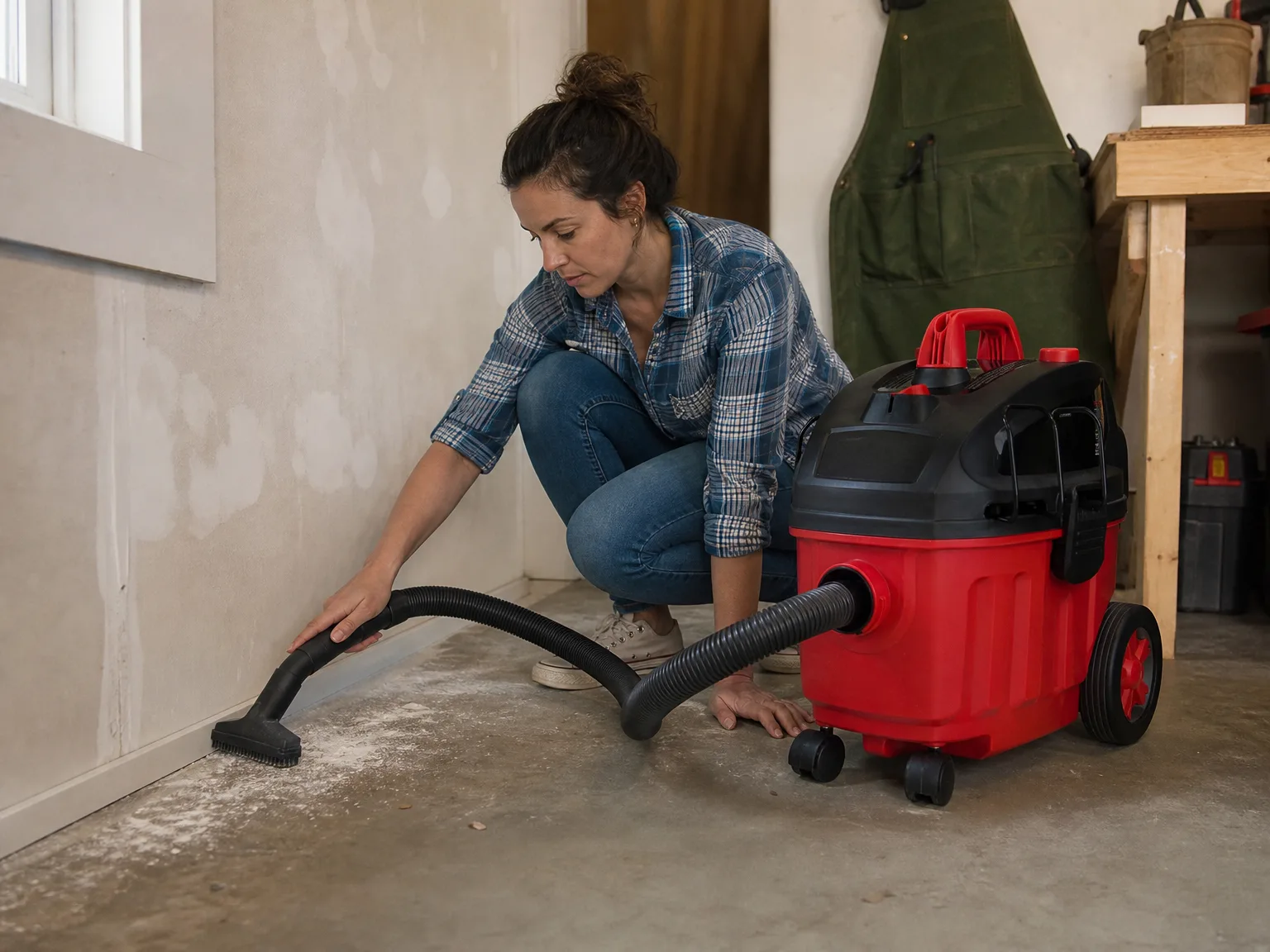
Garage floor grit and workbench sawdust. Fine sawdust, concrete dust, and the gritty layer that collects along a garage wall all vanished at a walking pace. The narrow body gets between a car and a wall in a one-car garage, which a barrel-shaped vac cannot do. Storage went back under the bench each time without moving anything else.
The job it lost. We tried it on a wall to wall carpeted bedroom and it was the wrong tool by a wide margin. A shop vac hose has no powered brushroll, so embedded fiber hair stays embedded, and 4 gallons runs out while you are still on the first room. Bigger debris was the other wall: wood offcuts and a scoop of gravel clogged the hose rather than going through it. Portability is what you bought, and brute force is what you traded away for it.
Maintenance. Rinse the cartridge filter when the suction drops and let it dry completely before it goes back in, since a damp cartridge loses airflow and smells. After wet pickup, tip the tank, wipe it, and leave the lid off overnight. Guide the cord in by hand while the rewind pulls, because the retraction is gentle and a loose cord tangles on the way back.
How it compares to alternatives
The closest sibling is the Vacmaster VOC508S 5-gallon stainless, which gives you a bigger tank and a tank you can hose out without worrying about it. It is heavier and it does not disappear into a closet, so pick it if your jobs are workshop scale rather than car and spill scale.
If your cleanups are almost all car interiors and small indoor messes, the WORKSHOP WS0255VA 2.5-gallon is smaller and lighter again, at the cost of emptying it more often. In the other direction, the Vacmaster VWMB508 wall-mount stays hung on the garage wall with a long hose reach, which suits a garage where the vac never needs to come indoors.
The STANLEY SL18115 5-gallon is the alternative worth reading if you want a slightly larger tank and can live with a much shorter cord. And if you are dealing with standing water rather than spills, get the 10 gallon Stanley with a drain port instead, because emptying a small tank by hand loses its charm around the fourth trip.
Who should buy it
Buy the VF408 if your mess list is short jobs in small spaces. A one-car garage, a workshop corner, a car or two, the occasional spill by the back door. It suits the household that wants one vac for pet hair in the car, dust after a DIY project, and water on concrete, and that cares about carrying it easily and storing it somewhere sensible.
Look elsewhere if you are trying to replace a household vacuum, or if your usual debris is large. Wall to wall carpet needs a powered brushroll and a machine built for the square footage. Wood chips and gravel need a wider hose and a bigger tank. Both jobs will make this vac feel underpowered, and neither is a fair test of it.
What you get for the money is a quiet, genuinely portable wet/dry vac with filtration good enough to use indoors, and suction that surprises people who judge shop vacs by tank size. What you give up is a blower port, a wet shutoff you can trust unattended, brackets that hold onto the attachments, and a body that stays upright when you tug the cord.
Frequently asked questions
Can I use it without a bag?
Yes, and we would. It runs bagless on the cartridge filter, and most owners report noticeably stronger suction that way. The exception is fine dust like drywall, where adding a high efficiency bag keeps the filter clean much longer and saves you a rinse afterward.
Does it work as a blower?
No. This model has no blower port and cannot reverse the airflow, so it will not clear leaves off a driveway or blow dust out of a corner. If that second job matters to you, look at a model with a dedicated blower outlet.
How long is the cord, and does it retract?
The cord stretches about 20 feet and retracts with a push button, which is enough to reach around a car from a garage outlet. The rewind is gentle rather than snappy, so guide the cord in with your hand as it pulls to keep it from tangling or kinking.
Does it shut off automatically when the wet tank is full?
No. A float rises to block the motor intake as the water level climbs, but the float can get stuck, so treat it as a backstop rather than a safety feature. Watch the level and empty the tank before it reaches the top, especially on a spill you are not standing over.
Is 4 gallons enough capacity?
For car interiors, spot cleaning, dust from a small project, and spills of a bowl or a glass, yes. For a flooded basement or a full workshop cleanup, no. The tank is what keeps the vac light and storable, so the capacity limit and the portability are the same design decision.
Will it pick up pet hair?
On hard surfaces and car upholstery, very well, and that is one of the main reasons to own it. On carpet and rugs it is limited, because a hose nozzle has no rotating brush to lift hair out of the fibers. Use it for the car, the stairs, and hard floors, and keep a proper vacuum for the carpet.
Bottom line
The Vacmaster VF408 does one thing very well. It is a quiet, light, 4 gallon vac you can carry with one hand to whatever small disaster needs handling, and its HEPA cartridge means you can use it indoors without redistributing the dust. Pull the cloth bag out of the box, move it by the handle rather than the cord, and keep an eye on the water level on wet jobs, and the annoyances stay small. If your list is cars, dust, and spills, this is an easy pick. If it is carpet or wood chips, read the VOC508S review before you spend anything.
In this article
- At a glance
- What we liked
- You can run it indoors without wincing
- Under 15 pounds changes where it goes
- The HEPA cartridge keeps the dust it collects
- Suction is strong for the size, running bagless
- Where it falls short
- The cloth bag in the box strangles it
- Hose brackets pop off when you bump something
- It is top heavy and tips backward
- Wet pickup needs watching, and there is no blower
- Real-world performance
- How it compares to alternatives
- Who should buy it
- Frequently asked questions
- Can I use it without a bag?
- Does it work as a blower?
- How long is the cord, and does it retract?
- Does it shut off automatically when the wet tank is full?
- Is 4 gallons enough capacity?
- Will it pick up pet hair?
- Bottom line
Keep reading
How to Clean Hardwood Floors Without Damaging Them: A Busy Home Guide
Soft rollers, the right suction mode, and barely damp mops keep hardwood safe. Here's the method we use at home, plus three tools that won't scratch sealed wood.
Vacmaster VJF607PF Review: Basement Water and Shop Dust Tested
We tested the Vacmaster VJF607PF 6-gallon wet/dry shop vac on basement water, sanding dust, and a filthy car interior. Strong suction, and a tank you feel every time you empty it.
Armor All AA255W Review: Trunk Wet/Dry Cleanup After Weeks
We tested the Armor All AA255W 2.5-gallon wet/dry vac on trunk spills, car mats, and pet debris. Honest take on cord reach, crevice tools, and who should buy.