Armor All VO405P Review: Car and RV Cleanups Tested for 5 Weeks
In this article
- At a glance
- What we liked
- The suction does not read as a 4 gallon machine
- You can carry it up a flight of stairs without planning ahead
- It disappears into a closet
- Wet, dry, and blowing all work off one machine
- Where it falls short
- The stiff hose tips the whole vac over
- The plastic clips on the lid feel like the first thing to break
- Fifteen feet of cord is not enough, and the tank fills fast
- It is as loud as any shop vac
- Real-world performance
- How it compares to alternatives
- Who should buy it
- Frequently asked questions
- How long are the power cord and hose?
- Is it loud?
- Can it handle both wet and dry messes?
- Does it work as a blower?
- Is 4 gallons enough capacity?
- Will the plastic clips break?
- Can I use it inside a small apartment?
- Bottom line
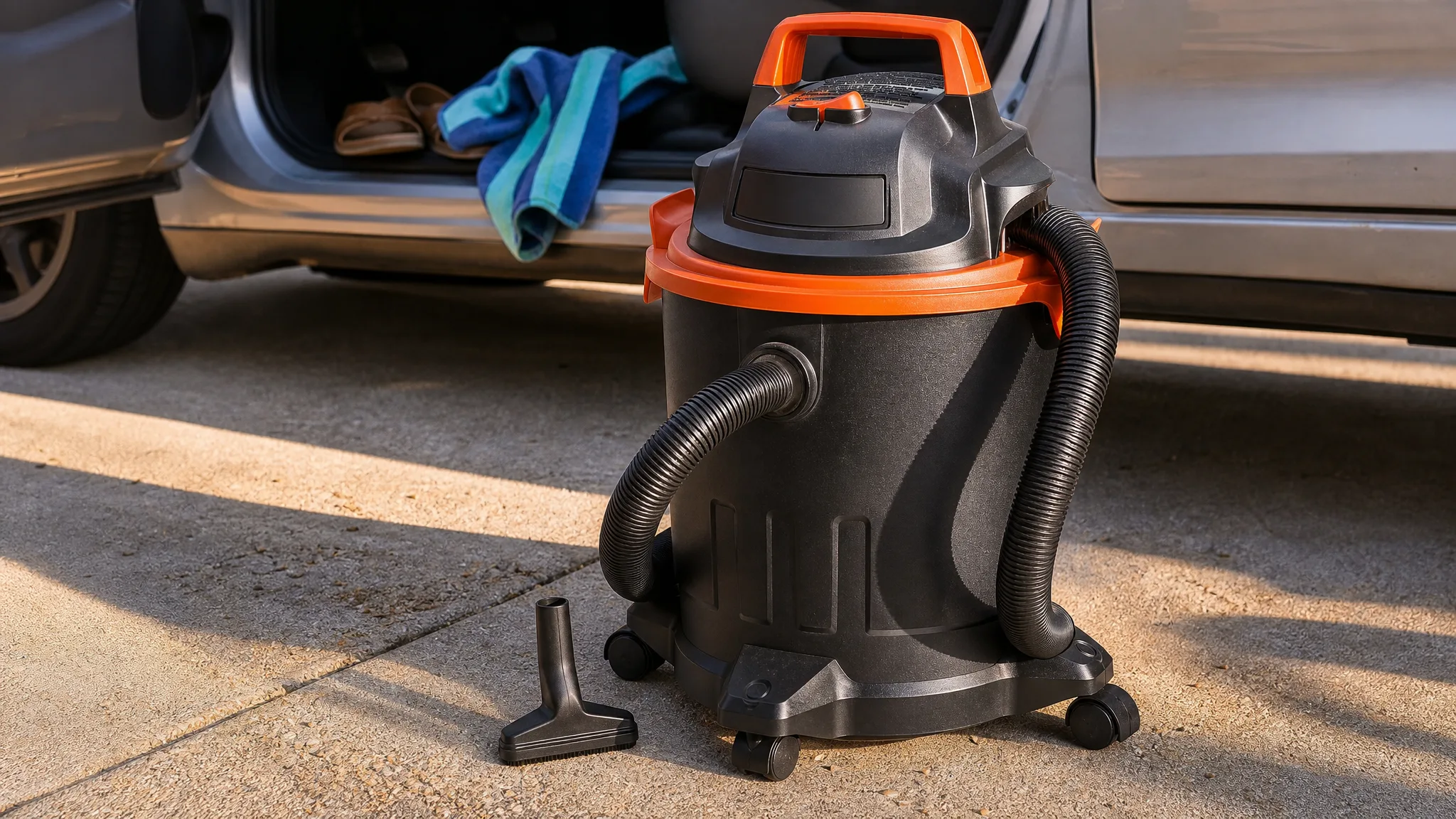
Sand ground into a car floor mat after a beach weekend. Crumbs packed into the seam where a booster seat sits. Water spreading under an RV sink at seven in the morning. None of those are jobs for the vacuum in your hall closet, and none of them justify a 16 gallon barrel that needs a garage you might not have. The Armor All VO405P is a 4 gallon wet/dry vacuum aimed straight at that middle ground, and we put it through our standard testing process for five weeks across two cars, a travel trailer, and a one bedroom apartment.
Verdict: Suction and portability well beyond what a 4 gallon body suggests, held back by a stiff hose and a cord that keeps you tethered. 8.2/10.
Best for: Quick cleanups in cars, RVs, or small apartments where storage is tight and heavy lifting is a pain.
Skip if: You need a large capacity vac for heavy duty workshop messes, or you want cordless freedom for all day cleaning.
Armor All
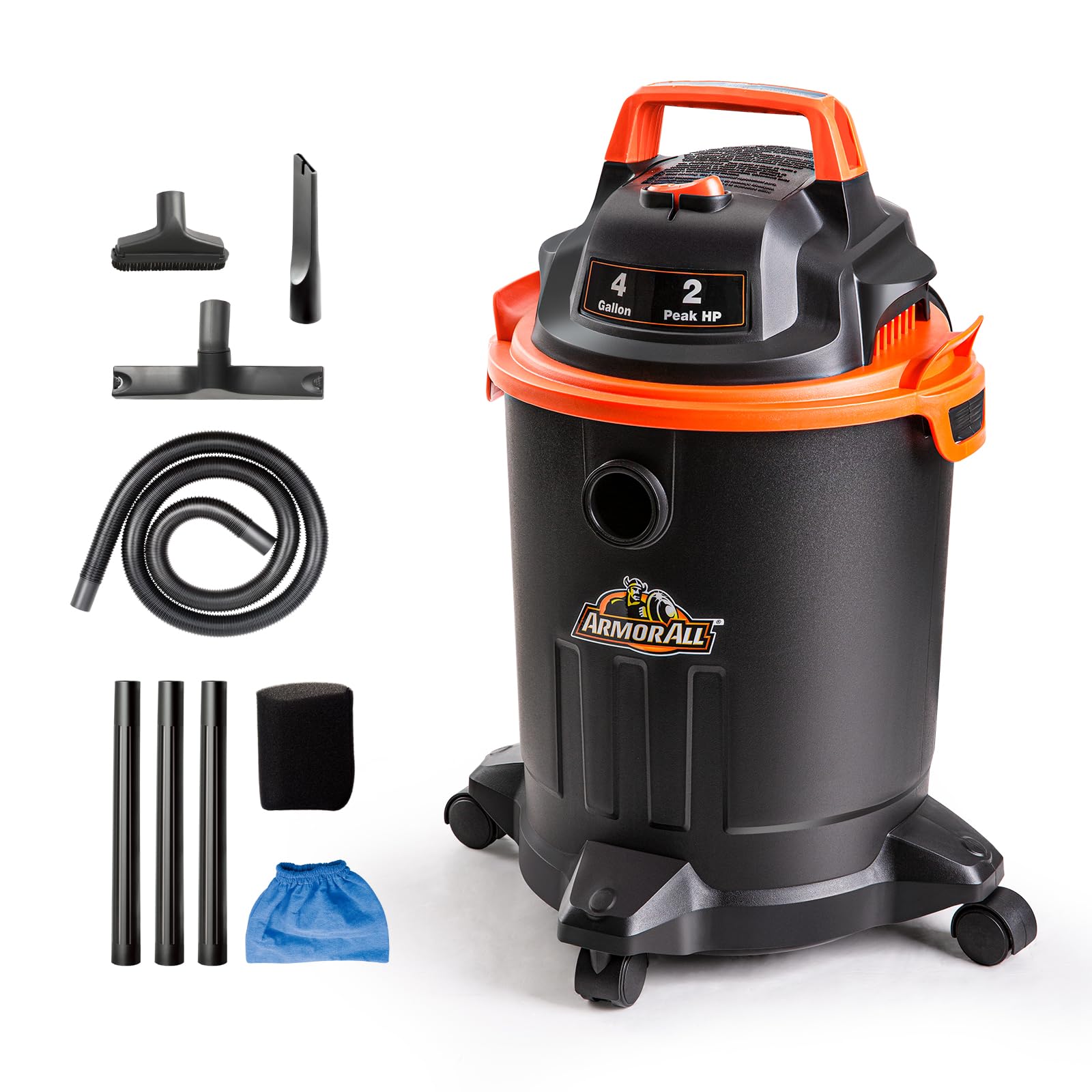
Armor All VO405P 0901 4 Gallon Wet/Dry Vac 2.0 Peak HP Shop Vacuum with Nozzles & Brush,Black/Orange
Best for
Best for quick cleanups in cars, RVs, or small apartments where storage is tight and heavy lifting is a pain. Skip it if you need a large-capacity vac for heavy-duty workshop messes or all-day cordless cleaning.
This compact vac punches above its weight in suction and ease of carry for small-job wet/dry pickup. The trade-off is a stiff hose that tips the unit if pulled and limited capacity that fills fast.
Loved by buyers
- •Suction that rivals larger shop vacs, even for nooks and crannies
- •Light enough to carry room to room or up stairs without strain
- •Small footprint for easy closet storage
Buyer concerns
- •The plastic clips that lock the top are flimsy and may break
- •The stiff hose makes the vac prone to tipping if you tug it
- •Short 15-ft power cord demands an extension cord for bigger spaces
At a glance
| Detail | What we found |
|---|---|
| Model | VO405P (0901) |
| Type | Corded wet/dry shop vac |
| Motor | Rated at 2.0 peak horsepower by the manufacturer |
| Tank | 4 gallons |
| Hose | 6 feet, stiff enough to drag the canister toward you |
| Cord | 15 feet, no rewind |
| Blower mode | Yes, the airflow reverses out a blower port |
| Wet pickup | Yes, same suction as dry |
| Included tools | Nozzles and a brush |
| Noise | As loud as a standard shop vac, worth ear protection on long jobs |
| Storage | Small enough for a closet shelf or an RV bay |
| Owner rating | 4.4 out of 5 |
What we liked
The suction does not read as a 4 gallon machine
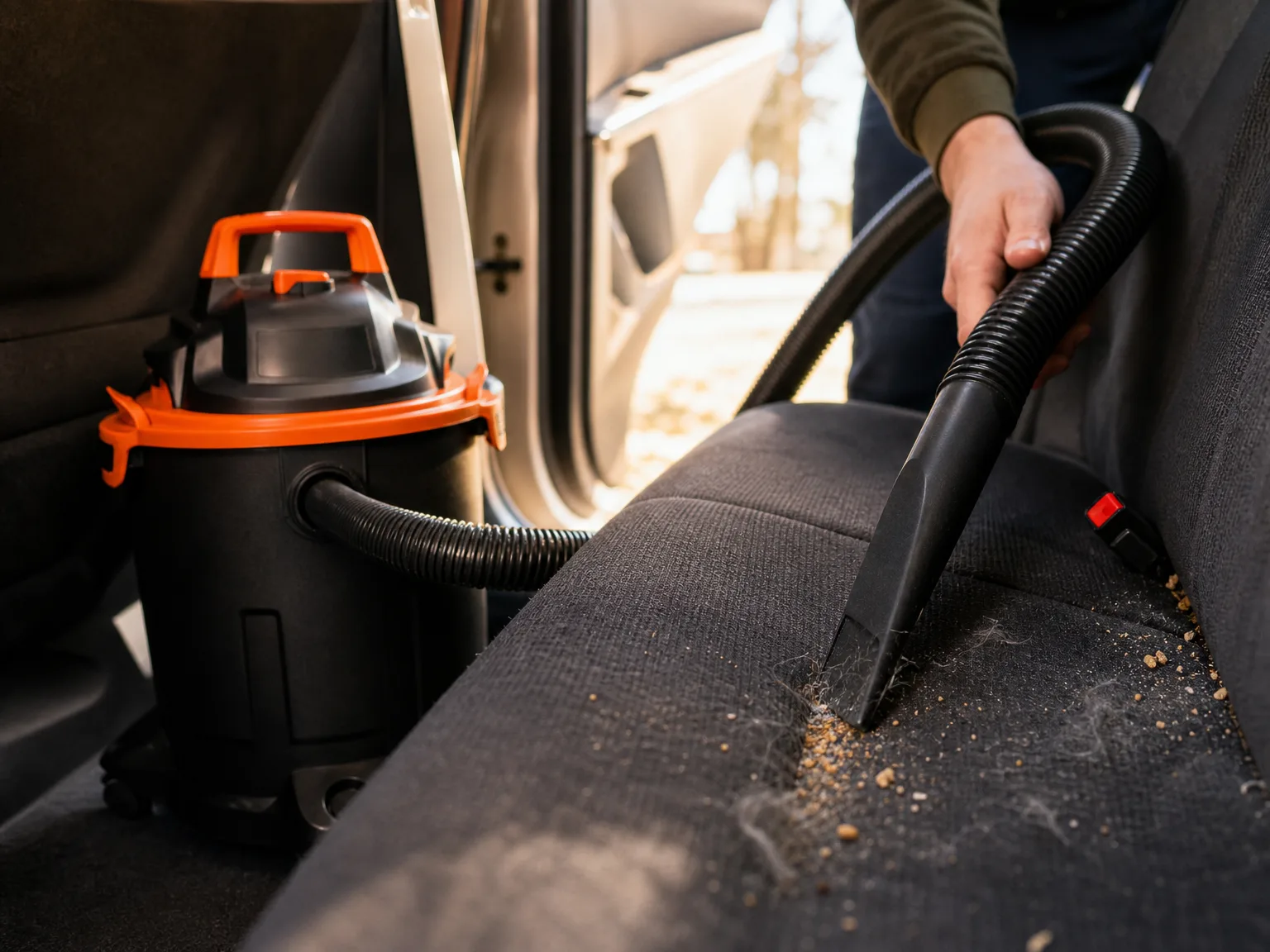
Plug it in and the first pass tells you most of what you need to know. Sand that had been ground into a rubber floor mat for a week came up in one sweep, not three. Dry oat cereal wedged into the crack between a seat cushion and the seat back went with a single poke of the crevice nozzle. This is the thing owners talk about most, and it holds up: the machine pulls like something a size or two larger.
Nooks are where that shows. A wide floor head on a big shop vac is useless in a footwell, but a narrow nozzle backed by real airflow reaches into a seat rail and empties it. We spent five weeks looking for a job in this class the VO405P could not finish and only found two, both of which come down to tank size rather than power.
You can carry it up a flight of stairs without planning ahead
Weight is the quiet reason a vacuum gets used or ignored. Pick this one up by the handle, walk it out to the driveway, carry it back to a second floor apartment, and none of that requires a second hand or a rest halfway. A heavier tank turns every cleanup into a decision, and the decision is usually no.
That mattered most in the travel trailer, where the vac had to come out of a storage bay, get lifted over a step, and go back afterward. Doing that once is fine with almost any machine. Doing it every weekend is where a lightweight body stops being a spec and starts being the reason the floor is clean.
It disappears into a closet
The footprint is small enough to sit on a closet shelf next to the folded towels, or in the bottom of a pantry, or under an RV dinette bench. In our test apartment it went into a hall closet with the hose coiled around the tank and did not force anything else out. Storage anxiety is a real constraint in a small place, and most wet/dry vacs solve their capacity problem by ignoring it.
Two practical notes from living with it. The tools are small and loose, so give them a zip bag or they migrate. And the tank is short enough to fit in a car trunk alongside a stroller, which is what makes roadside cleanups plausible at all.
Wet, dry, and blowing all work off one machine
Switch it to wet and the suction feels the same as it does on dry debris. A knocked over water glass, a leaking supply line under a washing machine, a puddle by the RV door after rain: all of them went in without hesitation or a change in tone from the motor. There is no separate wet setting to fumble with, which is one less thing to get wrong at seven in the morning.
Blower mode is the bonus most people forget they bought. Reverse the airflow and it clears grass clippings off a patio, dust out of a garage corner, or leaves off the step of a trailer. It is not a leaf blower and it will not clear a driveway, but for a small patio it saves getting a second tool out.
Where it falls short
The stiff hose tips the whole vac over
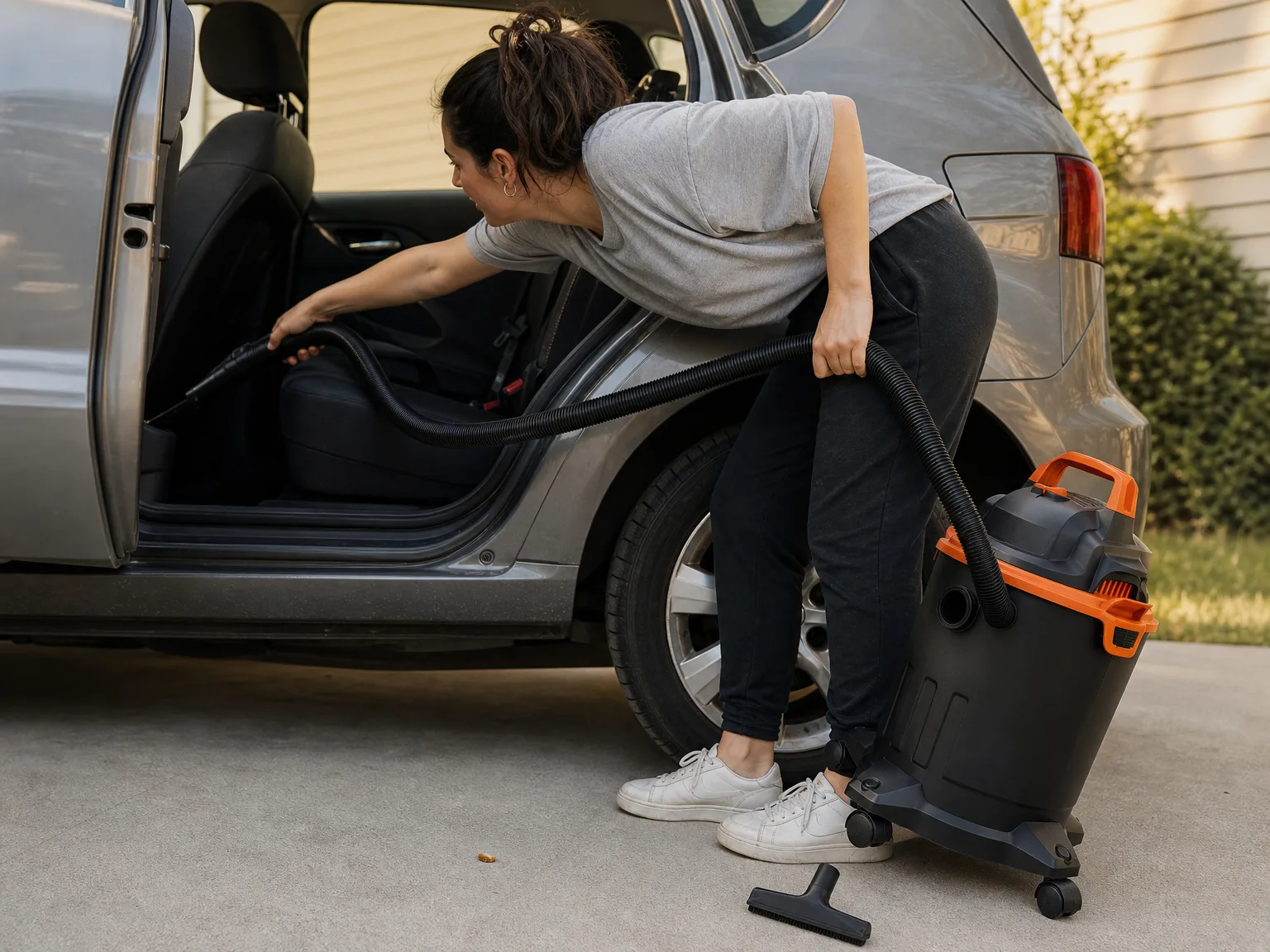
This is the flaw you will meet on day one. The hose has very little give, so when you stretch it toward the far side of a back seat, the canister does not stay put. It leans, then it goes over. We tipped it four times in five weeks, every single time by pulling the hose instead of walking back and moving the vac.
On a dry job the cost is a pause and a re-seated lid. On a wet job it is a puddle you now have to clean up with the tool that made it. The habit that fixes it is boring and effective: reposition the canister every few feet rather than asking the hose to bridge the gap. Six feet of hose is not much reach to begin with, so you will be moving it anyway.
The plastic clips on the lid feel like the first thing to break
Two plastic latches hold the motor head onto the tank, and they are the least confident part of the build. They flex more than you want when you unclip them, and owners report them snapping. Ours survived five weeks of daily unclipping, but the tank has to come open every time you empty it, which on a 4 gallon body is often.
Nothing about this makes the vac unusable, and there is no clever fix. Undo the latches with your thumb rather than levering them with a fingernail, and do not carry the machine by the motor head when the tank is full. Treat them gently and they will probably outlast your interest in the vac.
Fifteen feet of cord is not enough, and the tank fills fast
The cord is 15 feet with no rewind. That reaches one car in a driveway from a garage outlet, and it does not reach the second one. It does not reach across a two car garage, and in an apartment it usually means unplugging in the kitchen and replugging in the hall. An extension cord stops being optional the moment your space is larger than a single room, so budget for one.
Capacity is the other ceiling. Four gallons is generous for spills and car interiors and short of the mark for anything sustained. A full sweep of a garage floor or the aftermath of a real workshop session will have you emptying mid job, and the emptying involves those plastic clips again. Portability bought you the small tank, and this is the invoice.
It is as loud as any shop vac
No surprise here, but worth saying plainly because the size invites the wrong expectation. This sounds like a shop vac, not like a household stick vacuum. Short bursts are fine. A twenty minute session in a garage is loud enough that ear protection is a reasonable call, and it is not the machine to run at nap time in a small apartment with thin walls.
If quiet matters more to you than raw pull, that is a genuine reason to look elsewhere in this category rather than a detail to talk yourself out of. Noise is the one trade-off nobody gets used to.
Real-world performance
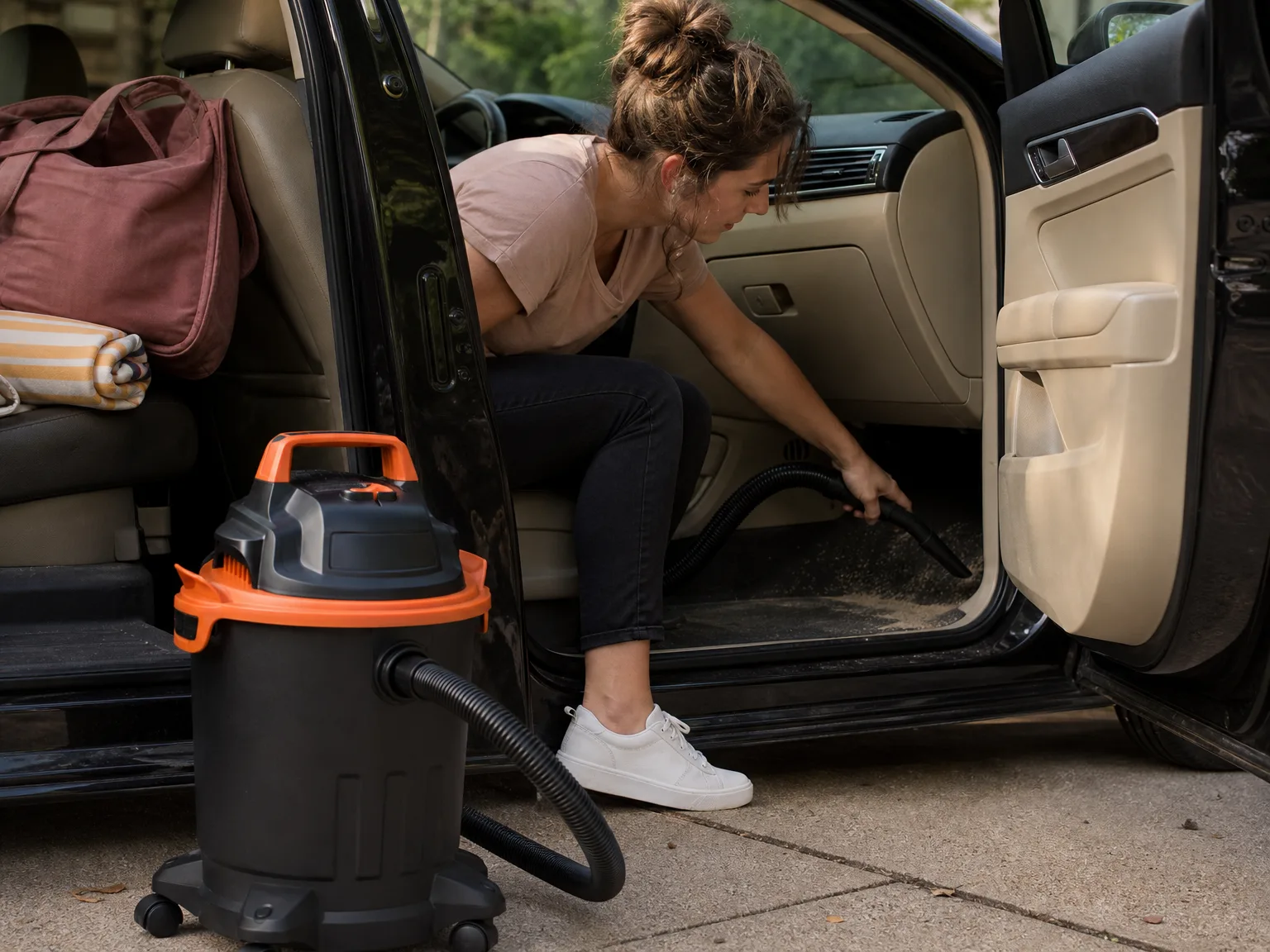
Two cars after a beach weekend. This is the job the VO405P was designed around and it handled it easily. Sand out of the mats, sand out of the seat rails, sand out of the trunk liner, all with the narrow nozzle and no second pass. The 15 foot cord covered the first car from the garage outlet. The second car needed an extension, which set the pattern for the rest of the test.
Cat hair on car upholstery and a stair runner. On fabric seats and hard surfaces it lifted pet hair convincingly, and the brush tool helped loosen what had worked its way into the weave. On the carpeted stair runner it was fair rather than good. A hose nozzle has no powered brushroll, so hair that is properly embedded in pile stays embedded. Use it for the car and the stairs' hard edges, and keep a proper vacuum for the rugs.
A leaking washing machine hose. Roughly two gallons of water across a laundry room floor at an inconvenient hour. Nozzle on, switch to wet, done in a few minutes with tank capacity to spare. Emptying it was the slower half of the job, since a 4 gallon tank of water is heavy enough that you want a floor drain or a tub nearby rather than a sink.
A travel trailer, floor to bunk. Small spaces are the format this machine understands. It cleaned the trailer floor, the dinette cushions, and the gaps around the bunk without ever needing more than the short hose, because in a trailer nothing is more than six feet away. It went back into the storage bay afterward without moving anything else, which is the part a full size shop vac cannot do.
The job it lost. We pointed it at a garage cleanout with drywall offcuts, wood chips, and a season of leaf litter. Wrong tool. The tank filled twice before the floor looked different, the short hose meant constant repositioning, and the noise over that stretch was tiring. It never struggled for suction. It ran out of room, over and over.
Maintenance. Empty it more often than feels necessary, because a packed tank chokes airflow and you will blame the motor. After wet pickup, tip the tank, wipe it dry, and leave the lid off overnight so it does not develop a smell. Rinse the filter when suction fades and let it dry completely before it goes back in. Coil the cord loosely rather than tight around the body, since there is no rewind to keep it tidy for you.
How it compares to alternatives
The closest match in feel is the WORKSHOP WS0255VA 2.5-gallon, which is smaller again and even easier to stash, at the cost of emptying it noticeably more often. Pick that one if your cleanups are almost entirely car interiors. Pick the Armor All if spills and RV floors are also on the list, because the extra gallon and a half is the difference between one trip to the drain and three.
Going up in size, the STANLEY SL18115 5-gallon gives you more tank with a cord that is shorter still, so it suits a fixed spot in a garage rather than a machine you carry around. If your real problem is standing water, the 10 gallon Stanley with a drain port is a better answer, since emptying a small tank by hand loses its appeal around the fourth trip.
Two cordless options are worth a look if the 15 foot cord is what bothers you most. The ReliaRoads RCSV-20 runs on DEWALT 20V batteries and handles wet messes without an outlet nearby, and the ONAVOT cordless car vacuum is the small handheld answer for people whose entire use case is the inside of a car. If you are cleaning a driveway where no outlet exists, get one of those instead.
Who should buy it
Buy the VO405P if your mess list is short, frequent, and spread across small spaces. Two cars, an RV or a boat, an apartment where the closet is already full, a laundry room that floods once a year. It suits the household that wants one machine for sand, crumbs, pet hair on upholstery, and water on a floor, and that values carrying it easily over having a big tank.
Look elsewhere if you are equipping a workshop. Sustained cleanups, bulky debris, and long sessions all run into the same wall, which is 4 gallons and 15 feet of cord. A cordless model makes more sense if your cleaning happens away from outlets, and a quieter household vacuum makes more sense if carpet is your main surface.
What you get for the money is a genuinely portable wet/dry vac with suction that embarrasses machines twice its size, wet and dry pickup off one switch, a blower mode you will use more than you expect, and a body that fits where you actually have room. What you give up is reach, capacity, quiet, and a lid mechanism you can be rough with.
Frequently asked questions
How long are the power cord and hose?
The cord is 15 feet and the hose is 6 feet. That combination is fine for one car in a driveway or a room you are standing in the middle of. For anything larger, plan on an extension cord and on moving the canister every few feet, because the hose will not stretch to meet you.
Is it loud?
Yes, about as loud as any standard shop vac. Quick jobs are no problem. For a long session in a garage, ear protection is a sensible call, and it is not the machine to run while someone is napping in a small apartment.
Can it handle both wet and dry messes?
Yes, and the suction feels the same either way. It picked up a washing machine leak without complaint and moved straight back to dry debris afterward. Dry the tank out after wet pickup and leave the lid off overnight so nothing sours inside.
Does it work as a blower?
Yes. It has a blower mode that reverses the airflow, which is useful for clearing debris off a patio, a driveway apron, or an RV step. It will not replace a proper leaf blower on a big yard, but for small outdoor areas it saves getting another tool out.
Is 4 gallons enough capacity?
For car interiors, RV floors, apartment spills, and one-room cleanups, yes. For a garage cleanout or a workshop full of sawdust and offcuts, no. The tank fills fast on sustained jobs, and since emptying means unclipping the lid every time, that limit shapes how you use the machine.
Will the plastic clips break?
They are the weakest part of the build and some owners report them snapping. Ours held up through five weeks of daily emptying. Unclip them with your thumb rather than prying, and never lift the vac by the motor head when the tank has anything in it.
Can I use it inside a small apartment?
Yes, and storage is one of its better arguments. It fits on a closet shelf and weighs little enough to move between rooms. The catch is noise, so save it for spills and one-off messes rather than making it your everyday floor vacuum.
Bottom line
The Armor All VO405P is a small vac that pulls like a big one, and almost everything else about it follows from being small. Sand, crumbs, pet hair on upholstery, and spilled water all go in fast, and the machine stores somewhere you already have room. Move the canister instead of yanking the hose, buy an extension cord before you need it, and be gentle with the lid clips. If your cleanups happen in cars, an RV, or a tight apartment, this is an easy pick. If they happen in a workshop, read the 10 gallon Stanley review before you spend anything.
Ready to buy?
Armor All VO405P 0901 4 Gallon Wet/Dry Vac 2.0 Peak HP Shop Vacuum with Nozzles & Brush,Black/Orange
Explore related
In this article
- At a glance
- What we liked
- The suction does not read as a 4 gallon machine
- You can carry it up a flight of stairs without planning ahead
- It disappears into a closet
- Wet, dry, and blowing all work off one machine
- Where it falls short
- The stiff hose tips the whole vac over
- The plastic clips on the lid feel like the first thing to break
- Fifteen feet of cord is not enough, and the tank fills fast
- It is as loud as any shop vac
- Real-world performance
- How it compares to alternatives
- Who should buy it
- Frequently asked questions
- How long are the power cord and hose?
- Is it loud?
- Can it handle both wet and dry messes?
- Does it work as a blower?
- Is 4 gallons enough capacity?
- Will the plastic clips break?
- Can I use it inside a small apartment?
- Bottom line
Keep reading

How to Clean Hardwood Floors Without Damaging Them: A Busy Home Guide
Soft rollers, the right suction mode, and barely damp mops keep hardwood safe. Here's the method we use at home, plus three tools that won't scratch sealed wood.
Vacmaster VJF607PF Review: Basement Water and Shop Dust Tested
We tested the Vacmaster VJF607PF 6-gallon wet/dry shop vac on basement water, sanding dust, and a filthy car interior. Strong suction, and a tank you feel every time you empty it.
Armor All AA255W Review: Trunk Wet/Dry Cleanup After Weeks
We tested the Armor All AA255W 2.5-gallon wet/dry vac on trunk spills, car mats, and pet debris. Honest take on cord reach, crevice tools, and who should buy.