Vacmaster VHB305M Review: 3.2-Gallon Vac Tested for 5 Weeks
In this article
- At a glance
- What we liked
- Suction that behaves like a bigger machine
- It stores in places a shop vac cannot
- Wet spills and pet hair on the same machine
- The rear blower port is more useful than it sounds
- Where it falls short
- Fine dust clogs the filter in minutes
- The hose pulls out of the canister
- Emptying the filter makes a mess of its own
- Real-world performance
- How it compares to alternatives
- Who should buy it
- Frequently asked questions
- How loud is it?
- Can it pick up pet hair from furniture?
- Do I need disposable bags, or can I use it without?
- Does it work as a blower too?
- How big is the tank, and how often will I empty it?
- Will it handle drywall dust or fireplace ash?
- Bottom line
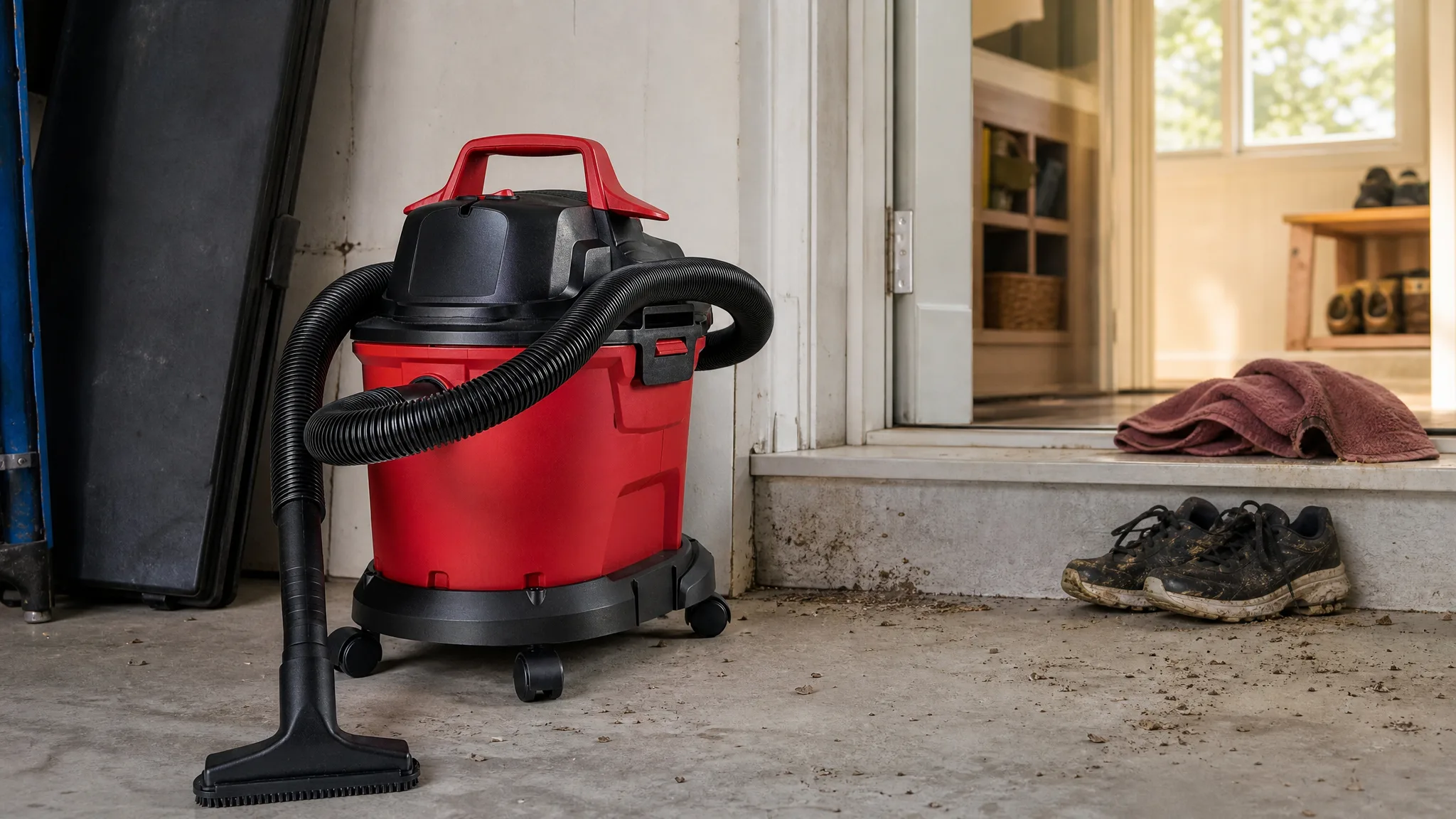
A bag of potting soil splits open in the trunk. The cat knocks her water bowl off the mat by the door. Somebody tracks half the driveway into the back seat. None of that needs a full size shop vac, but a broom will not touch it either. The Vacmaster VHB305M is aimed squarely at that middle ground, and we ran it through our standard testing process for five weeks across a garage, two cars, and a small apartment kitchen.
Verdict: Strong suction and a genuinely small footprint make this a practical grab-and-go vac for everyday messes, as long as you accept that fine dust will choke the filter fast. 8.2/10.
Best for: Quick cleanups in garages, cars, and small apartments where storage space is tight.
Skip if: You routinely deal with drywall dust, ash, or any job that needs to run for a long stretch without filter maintenance.

Vacmaster
Vacmaster 3.2-Gallon* 2.5 Peak HP Wet/Dry Vacuum – VHB305M 1101
Best for
Best for quick cleanups in garages, cars, and small apartments where storage is tight; skip if you routinely deal with fine construction dust or need a vacuum that runs for long stretches without filter maintenance.
Owners agree this compact wet/dry vac delivers strong suction for everyday messes in the garage, car, or home without eating up storage space. The main trade-off is that the filter clogs quickly with fine particles, so you will need disposable bags or frequent cleaning to keep airflow strong.
Loved by buyers
- •Strong suction rivals larger shop vacs for a unit this light and portable.
- •Wheeled base and wall mount make storage and maneuverability genuinely practical in tight spaces.
- •Effective on pet hair and both wet and dry spills, with attachments that cover most small cleanup tasks.
Buyer concerns
- •Filter loads up fast when vacuuming fine dust like drywall or ash, dropping suction noticeably within minutes.
- •Hose can pull loose from the canister during use if you tug from another room.
- •Cleaning the reusable filter kicks up a cloud of dust unless you step outside or use disposable bags.
At a glance
| Specification | Detail |
|---|---|
| Model | VHB305M 1101 |
| Type | Corded wet/dry vacuum, compact canister |
| Tank capacity | 3.2 gallons |
| Motor | 2.5 peak horsepower |
| Wet pickup | Yes, wet and dry in the same tank |
| Blower | Rear blower port for clearing floors and driveways |
| Storage | Wall mount plus a wheeled base |
| Filtration | Reusable filter, with optional disposable bags |
| Attachments | Includes a brush tool that works well on upholstery |
| Noise | Quieter than an older shop vac, still audible across the house |
| Best use | Short cleanups in garages, cars, and tight indoor spaces |
| Owner rating | 4.4 out of 5 |
What we liked
Suction that behaves like a bigger machine
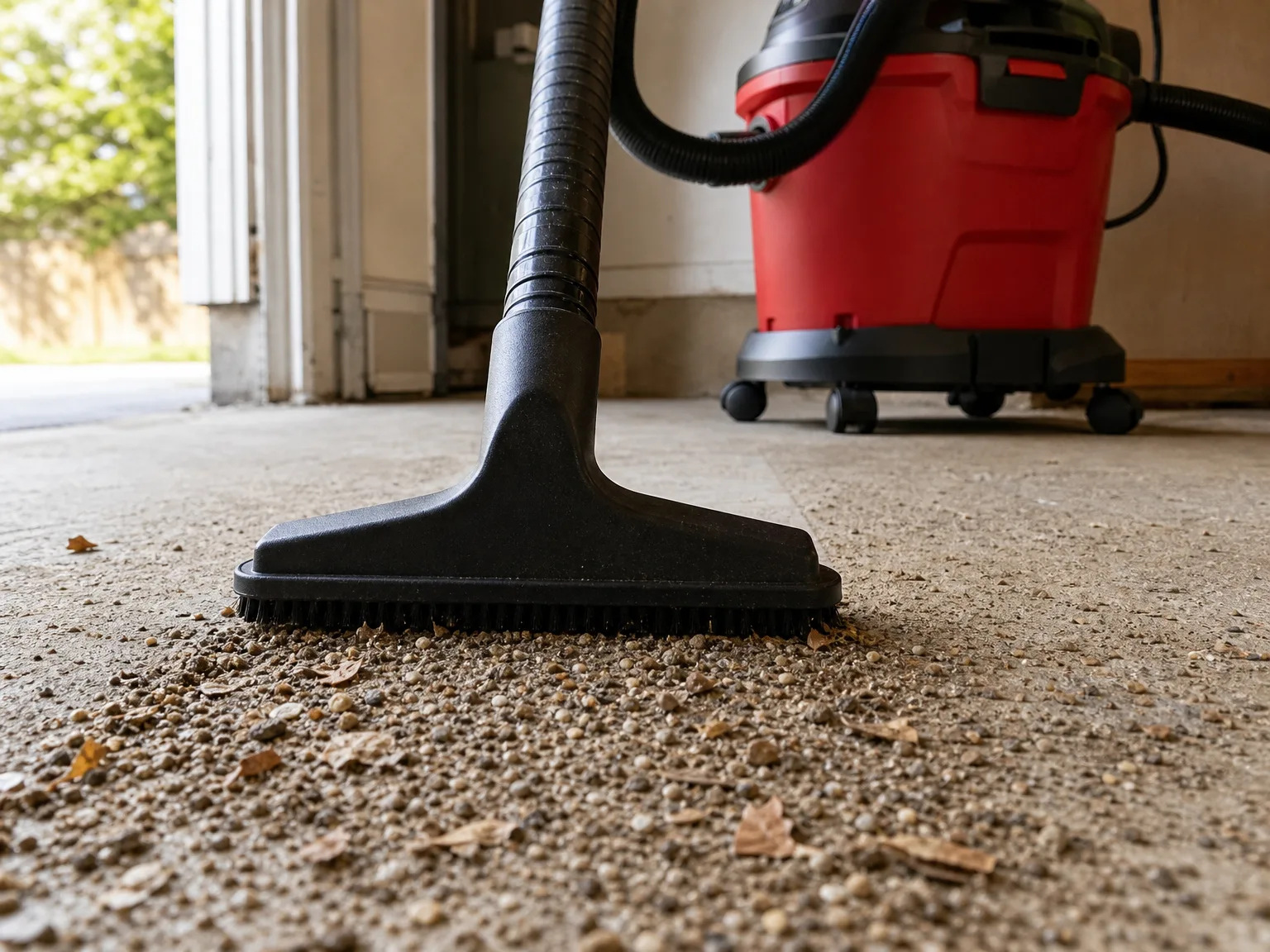
The pattern with compact vacs is that they look capable and then skate over anything heavier than dust. This one does not. Pull the 2.5 peak HP motor onto a patch of garage floor covered in grit, dried leaves, and the sand that falls out of a car mat, and it takes the lot on the first pass. No pre-sweeping, no going back over a line three times.
That single behavior is what decides whether a vacuum gets used. If you have to pile the big pieces up by hand first, the vacuum is a second step you resent. Here you point it at the mess. Five weeks in, the machine had been dragged out for jobs we would previously have handled with a dustpan, which is the clearest evidence we can offer that the suction is real.
It stores in places a shop vac cannot
The unit hangs on a wall bracket, and it also rolls on its own wheeled base, and those two things together solve the problem that kills most wet/dry vacuums in small homes. A full size canister eats a corner of the garage. Hang this one at shoulder height above a workbench and the floor underneath stays usable.
In an apartment the argument is even simpler. A vacuum you have to excavate from the back of a closet is a vacuum you use twice a year. This one is light enough to lift down with one hand, and rolling it to the next room takes no effort. That is the difference between cleaning the entryway tonight and cleaning it eventually.
Wet spills and pet hair on the same machine
You do not swap anything to move between wet and dry, and that flexibility earned its keep during testing. A tipped water bowl, a puddle of melted snow inside the back door, the muddy slurry that forms in a car footwell in February: all of it goes into the same 3.2 gallon tank.
The brush attachment is the piece to reach for on fabric. Owners consistently report it lifting pet hair off sofas and carpet, and our testing matched that. Hair that had been ground into a couch cushion by a cat who considers it her territory came up in a few passes. It is not a dedicated upholstery tool with a spinning roller, so long human hair still needs a couple of runs, but the shed fur most households fight comes away cleanly.
The rear blower port is more useful than it sounds
Flip the hose to the rear port and the vacuum blows instead of sucking. On paper this reads like a spec sheet filler. In practice it changed how we cleaned the garage. Rather than chasing a thin film of dust and leaves across a rough concrete floor with a nozzle, we blew everything toward the open door in about a minute and then vacuumed the small pile that was left.
The same trick works on a driveway, a patio, or the gap under a workbench where a nozzle will not fit. It will not replace a real leaf blower for yard work. For the ten feet of concrete immediately outside your garage door, it is enough.
Where it falls short
Fine dust clogs the filter in minutes
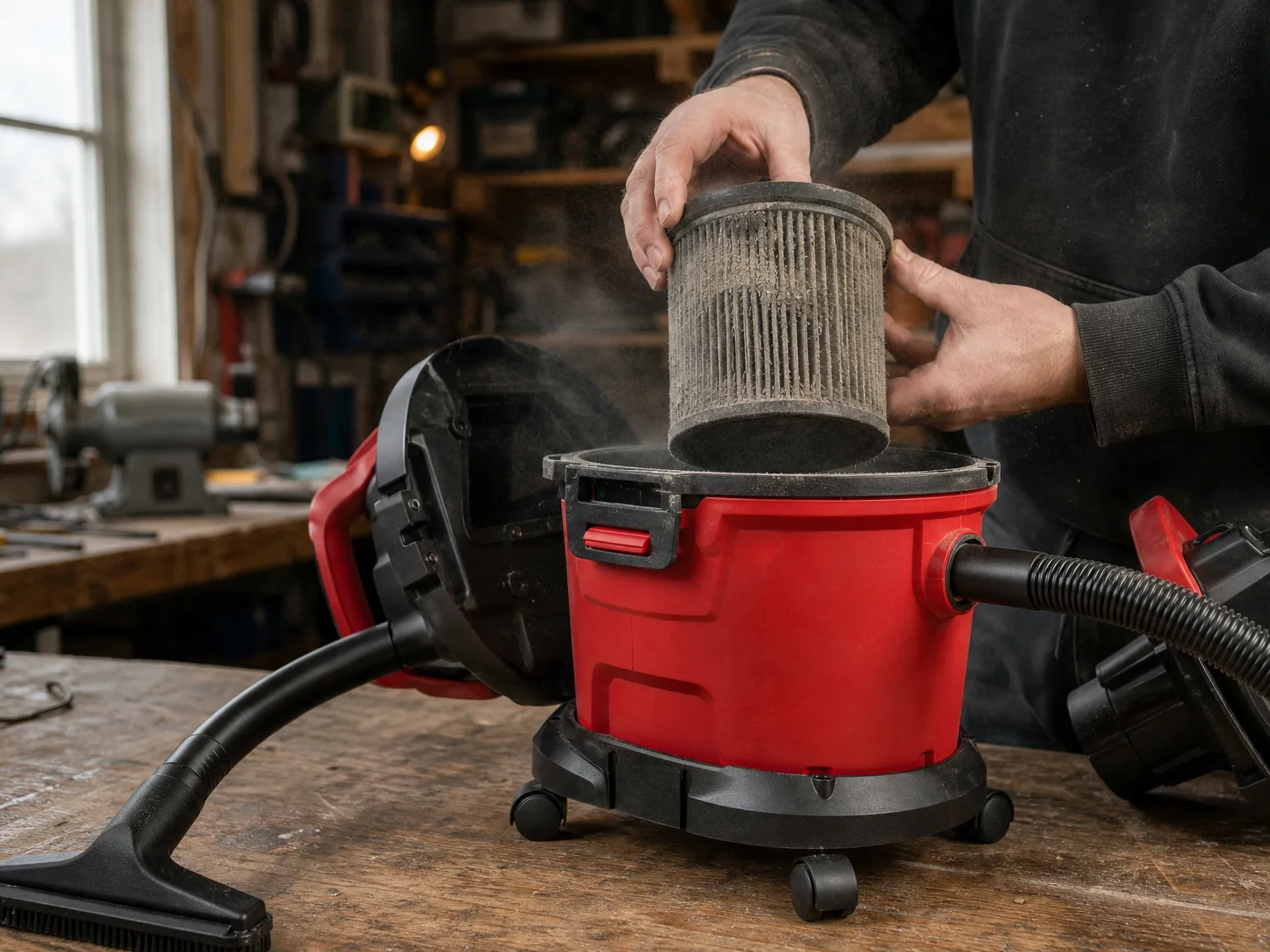
This is the complaint owners raise most often, and it is the one thing that should decide whether you buy this vacuum. Ordinary household and garage debris is fine. Fine particles are not. Sand a patch of drywall or clean out a fireplace and the filter loads up so quickly that you can hear the suction fall off inside the first few minutes of work.
Once it happens you are stopping to knock out the filter, and then stopping again, and a fifteen minute job turns into forty. Disposable bags fix most of this by catching the dust before it reaches the filter media, but they are a running cost and you need to have them on hand before the mess happens. If your regular messes are construction dust or ash, buy a vac built around that job instead. Our Vacmaster VJF607PF review covers a machine with the capacity to absorb that kind of abuse.
The hose pulls out of the canister
The hose connection is friction fit rather than locking, and if you walk into another room and tug, it comes loose. It happened to us twice in the first week, both times while cleaning stairs with the vacuum parked at the bottom. You feel the resistance disappear, look down, and find a bare hose in your hand while the motor runs on happily behind you.
Nothing breaks, and reseating it takes two seconds. It is a rhythm breaker rather than a fault, and you learn to move the canister rather than stretch the hose. Still, it is the kind of thing that reminds you where the price point sits.
Emptying the filter makes a mess of its own
Cleaning the reusable filter releases a visible cloud of dust. Do it in the middle of a garage and you have redistributed the mess you just collected, which is a bleakly funny way to end a cleaning session. The fix is straightforward: take the filter outside, hold it downwind, and tap it out there.
Disposable bags avoid the problem entirely, because you lift the bag out and drop it in the trash without ever disturbing the filter. Between the clogging issue and this one, bags are less an accessory than a part of owning the machine, and we would order a pack alongside the vacuum rather than after.
Real-world performance
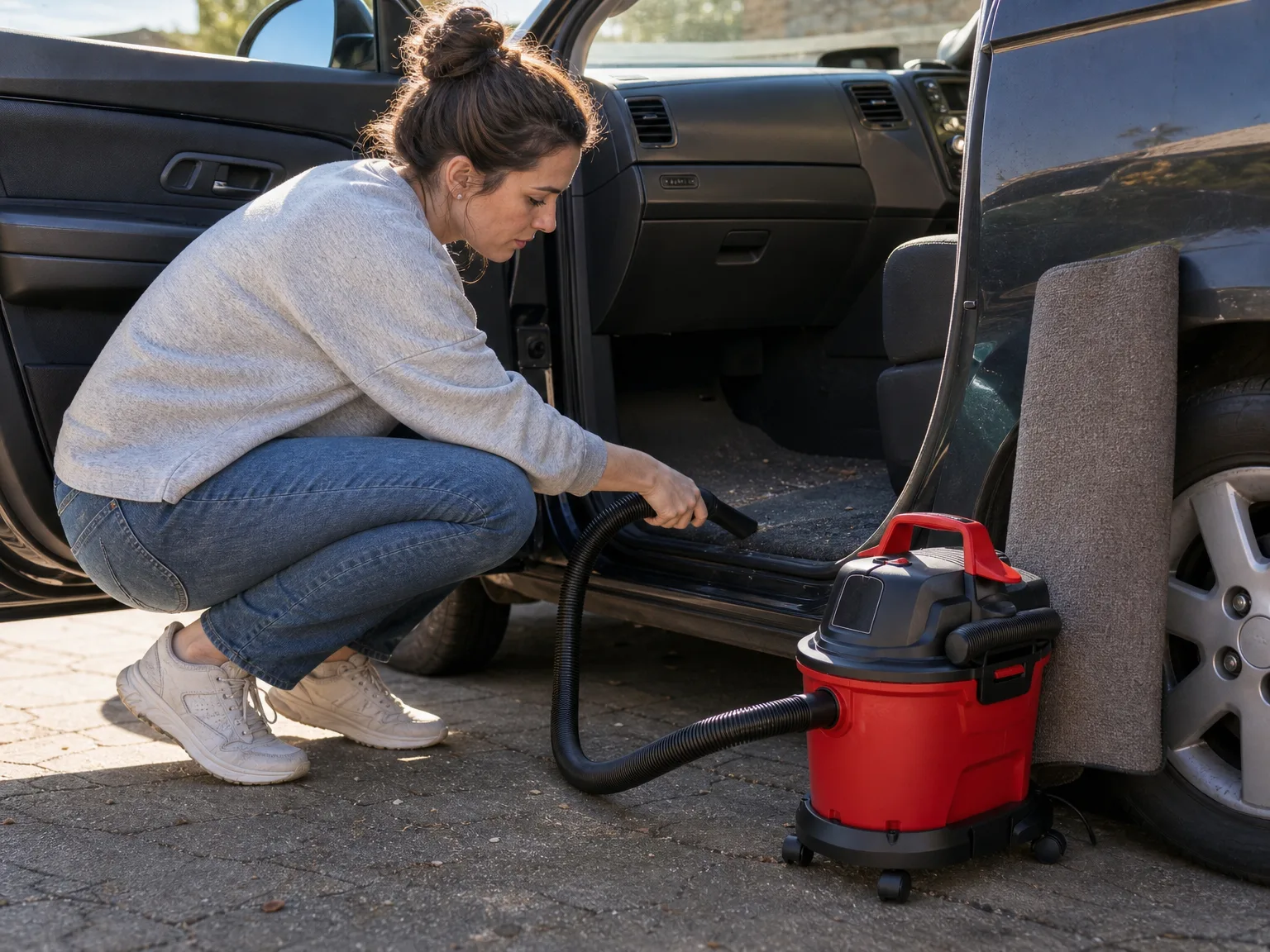
A car interior, front and back. This is the job the vacuum is best at. Grit in the footwells, sand packed into the door tracks, the crumb seam where the seat back meets the cushion: one pass each, no second attempt. Because the base rolls, you park it beside the open door and work around the car rather than carrying it. The only interruption was reseating the hose after leaning too far into the rear bench.
Garage floor after a weekend project. Sawdust from cutting shelving is the borderline case. Coarse chips and offcuts vanish without complaint. The fine powder that settles on everything nearby is where the filter starts to load, and we could hear the pitch of the motor change as it did. With a bag installed the session ran through cleanly. Without one we stopped twice to knock the filter out.
A knocked-over water bowl on tile. Roughly a quart of water on a kitchen floor came up in under a minute with no filter change and no preparation. The 3.2 gallon tank is sized for household spills rather than plumbing failures, which is the honest way to think about the wet half of this machine. A burst pipe in a basement wants a much bigger tank.
Pet hair on a sofa and a stair runner. With the brush attachment, cat hair embedded in upholstery came off in a way a broom or lint roller never manages. The stair runner took longer, mostly because you are working one narrow tread at a time and the canister has to sit somewhere. Setting it two steps below where we were working turned out to be the trick that kept the hose seated.
Noise around the household. It is quieter than the old corded shop vac it replaced, but nobody would call it quiet. You will hear it from the next room, and running it during a nap is not a plan. Outside, in a garage, or during ordinary daytime hours, it is unremarkable and does not require ear protection.
Emptying and upkeep. The tank holds enough that small jobs never came close to filling it, so most sessions ended with a quick dump into a trash can rather than a two-handed wrestle with a heavy canister. Let the tank dry fully after wet pickup before you close it up, or it develops a smell within a few days. Same rule for the filter.
How it compares to alternatives
The closest comparison in our own testing is the WORKSHOP WS0255VA, a 2.5 gallon vac we ran for four weeks on car interiors and kitchen spills. It occupies almost the same slot. The Vacmaster gives you a slightly larger tank, the blower port, and the wall mount, and those three things are the reason we would pick it for a garage over the WORKSHOP.
Stay inside the brand and the Vacmaster VWMB508 is the upgrade for anyone whose main concern is a permanently installed garage vac. It mounts on the wall as its normal state rather than as a storage option, and the long hose means you never move the unit at all. You lose the ability to roll it into the house, so it suits a homeowner with a dedicated garage rather than an apartment.
If wet cleanup is the actual reason you are shopping, the STANLEY SL18115 steps up to five gallons for not much more money and handles standing water at a scale the VHB305M cannot. And if the deciding factor is not having a cord in your way, the ReliaRoads RCSV-20 runs on DEWALT 20V batteries, with the shorter runtime that always comes with that trade.
If fine construction dust is a regular part of your life, get a larger vac with a dust rated filtration system instead. Asking this one to swallow drywall powder week after week is how a good small vacuum earns a bad reputation.
Who should buy it
Buy it if your messes are small, frequent, and varied, and if space is the constraint you actually feel. The people who get the most out of this machine keep it hanging in a garage or a utility closet and pull it down two or three times a week: the car before a road trip, the entryway after a rainy dog walk, the kitchen floor after a spill. For that pattern the compact body, the wheels, and the wall mount matter more than any number on the box.
Look somewhere else if you are a serious hobbyist woodworker, if you are mid renovation, or if you clean out a wood stove regularly. The filter is the limiting part of this vacuum, and those three jobs attack it directly. You should also look elsewhere if you expect to run it for half an hour straight without touching it, because a loaded filter will interrupt you before your arms get tired.
What you get at this price is real suction, wet and dry capability in one tank, a blower you will use more than you expect, and a shape that hangs on a wall. What you give up is the tolerance for fine dust, a locking hose, and a filter you can clean indoors without regretting it.
Frequently asked questions
How loud is it?
Quieter than most older shop vacs, but still loud enough that you will hear it from another room. For garage work and normal daytime cleaning it is unremarkable and needs no ear protection. If your main worry is waking a sleeping baby upstairs, this is not the machine to plan around.
Can it pick up pet hair from furniture?
Yes, and this was one of the stronger surprises in testing. Use the brush attachment on sofas, chairs, and carpet, and shed fur comes up rather than being pushed around. Long human hair takes an extra pass or two because there is no motorized roller to cut it free.
Do I need disposable bags, or can I use it without?
It runs fine bagless for ordinary debris. Bags become close to mandatory once fine dust is involved, because they keep the filter clear and let the vacuum hold its suction through a whole job. They also make emptying cleaner, since you lift the bag out instead of shaking a dusty filter. We would keep a pack on the shelf.
Does it work as a blower too?
It does. A rear blower port lets you move the hose over and push debris instead of pulling it, which is genuinely useful for clearing a garage floor or a driveway apron before you vacuum the remaining pile. Treat it as a convenience feature rather than a substitute for a real leaf blower.
How big is the tank, and how often will I empty it?
The tank holds 3.2 gallons, which is a lot for a vacuum this size. Across five weeks of small jobs we never filled it in a single session. For household water spills it is generous. For a flooded basement it is nowhere near enough.
Will it handle drywall dust or fireplace ash?
Not well, and this is the one honest warning to take seriously. Fine particles load the filter within minutes and suction drops noticeably while you are still working. Disposable bags help a lot, but if this is your regular job rather than an occasional one, buy a vacuum designed for fine dust.
Bottom line
The Vacmaster VHB305M is a small vacuum with a clear idea of who it is for. Suction is strong enough that you stop reaching for a broom first, the wall mount and wheels solve the storage problem that makes most wet/dry vacs annoying to own, and the blower port earns its place. The filter is the ceiling, so order disposable bags with the vacuum and clean the filter outdoors. If your weekends involve sanding, framing, or a wood stove, read the VJF607PF review before you commit to something this compact.
Explore related
In this article
- At a glance
- What we liked
- Suction that behaves like a bigger machine
- It stores in places a shop vac cannot
- Wet spills and pet hair on the same machine
- The rear blower port is more useful than it sounds
- Where it falls short
- Fine dust clogs the filter in minutes
- The hose pulls out of the canister
- Emptying the filter makes a mess of its own
- Real-world performance
- How it compares to alternatives
- Who should buy it
- Frequently asked questions
- How loud is it?
- Can it pick up pet hair from furniture?
- Do I need disposable bags, or can I use it without?
- Does it work as a blower too?
- How big is the tank, and how often will I empty it?
- Will it handle drywall dust or fireplace ash?
- Bottom line
Keep reading
How to Clean Hardwood Floors Without Damaging Them: A Busy Home Guide
Soft rollers, the right suction mode, and barely damp mops keep hardwood safe. Here's the method we use at home, plus three tools that won't scratch sealed wood.
Vacmaster VJF607PF Review: Basement Water and Shop Dust Tested
We tested the Vacmaster VJF607PF 6-gallon wet/dry shop vac on basement water, sanding dust, and a filthy car interior. Strong suction, and a tank you feel every time you empty it.
Armor All AA255W Review: Trunk Wet/Dry Cleanup After Weeks
We tested the Armor All AA255W 2.5-gallon wet/dry vac on trunk spills, car mats, and pet debris. Honest take on cord reach, crevice tools, and who should buy.