MONSGA Robot Vacuum and Mop Review: Pet Hair After 6 Weeks
In this article
- At a Glance
- What We Liked
- The Dock Takes the Dustbin Off Your List
- Pet Hair Comes Up on Hard Floors and Low Rugs
- Quiet Enough to Run While Everyone Is Home
- Enough Runtime and Mapping to Cover a Floor Plan
- Where It Falls Short
- The Mop Wipes, It Does Not Scrub
- The Map Sometimes Forgets Itself
- Support Is Email Only
- Real-World Performance
- How It Compares to Alternatives
- Who Should Buy It
- FAQ
- Bottom Line
Fur comes back fast. You sweep the hallway on Monday, and by Wednesday there are little grey tumbleweeds gathering against the baseboard again. The MONSGA robot vacuum and mop is aimed squarely at that problem, and at the second problem behind it: nobody wants to empty a dustbin every other day. We ran it for six weeks across hardwood, kitchen tile, and two low-pile rugs in a house with two shedding cats, following our how we review process. Two things decide whether you will be happy with it, and only one of them is the vacuum.
Verdict: Quiet, reliable daily pet hair pickup with a dock that swallows months of debris, held back by a mop that only wipes and a map that occasionally forgets itself. 8/10.
Best for: Pet-owning homes with mostly hard floors that want daily fur control without touching a bin
Skip if: You expect real scrubbing, or an occasional remap would ruin your week

MONSGA
MONSGA Robot Vacuum and Mop, 90 Days Self-Emptying with 8000Pa Suction | Dual Anti-Tangle for Pet Hair, Carpet and Hard Floor, LiDAR Navigation, Smart Mapping, 160Mins Runtime, APP & Voice Control
Best for
Pet-owning households with mostly hard floors who want a hands-off vacuum that empties itself and handles daily fur and crumbs without fuss. Skip it if you rely on a robot for deep scrubbing or need flawless, multi-level map persistence without occasional resets.
Most owners find this robot genuinely worth it for daily pet hair and quiet, hands-off cleaning with its self-emptying base. The main trade-off is that you accept a basic mop that won't scrub stuck-on messes and occasional map glitches that may require remapping.
Loved by buyers
- •The self-emptying base holds up to 90 days of debris and lets you adjust how often it empties, cutting daily bin maintenance to nearly zero.
- •It runs quieter than many older robot vacuums, so much so that one owner stopped hearing it from upstairs.
- •Pet hair and everyday floor debris get picked up well on both hard floors and carpet, with no reports of tangled brushes in these reviews.
Buyer concerns
- •Mapping can be unreliable: some owners had maps disappear after internet outages or the quick map function fail completely, forcing a reset.
- •The mopping is a simple static wipe; it won't scrub dried spills and sometimes drags a damp pad over carpet when transitioning between surfaces.
- •Customer support is email-only with one to two day response times, frustrating anyone who wants immediate help.
At a Glance
| Spec | Detail |
|---|---|
| Type | Self-emptying robot vacuum and mop |
| Suction | Rated at 8000Pa by MONSGA |
| Brushes | Dual anti-tangle rollers, for pet hair on carpet and hard floor |
| Navigation | LiDAR with smart mapping |
| Runtime | Up to 160 minutes, per MONSGA |
| Self-emptying base | Holds up to 90 days of debris |
| Bag capacity | 4L, roughly 90 days in an average home |
| Empty frequency | Adjustable, so you can stretch bag life |
| Mopping | Stationary damp pad, no scrubbing action |
| Water tank | Plain water is the safe choice, solution is unconfirmed |
| Control | App and voice |
| Owner rating | 4.6 out of 5 |
What We Liked
The Dock Takes the Dustbin Off Your List
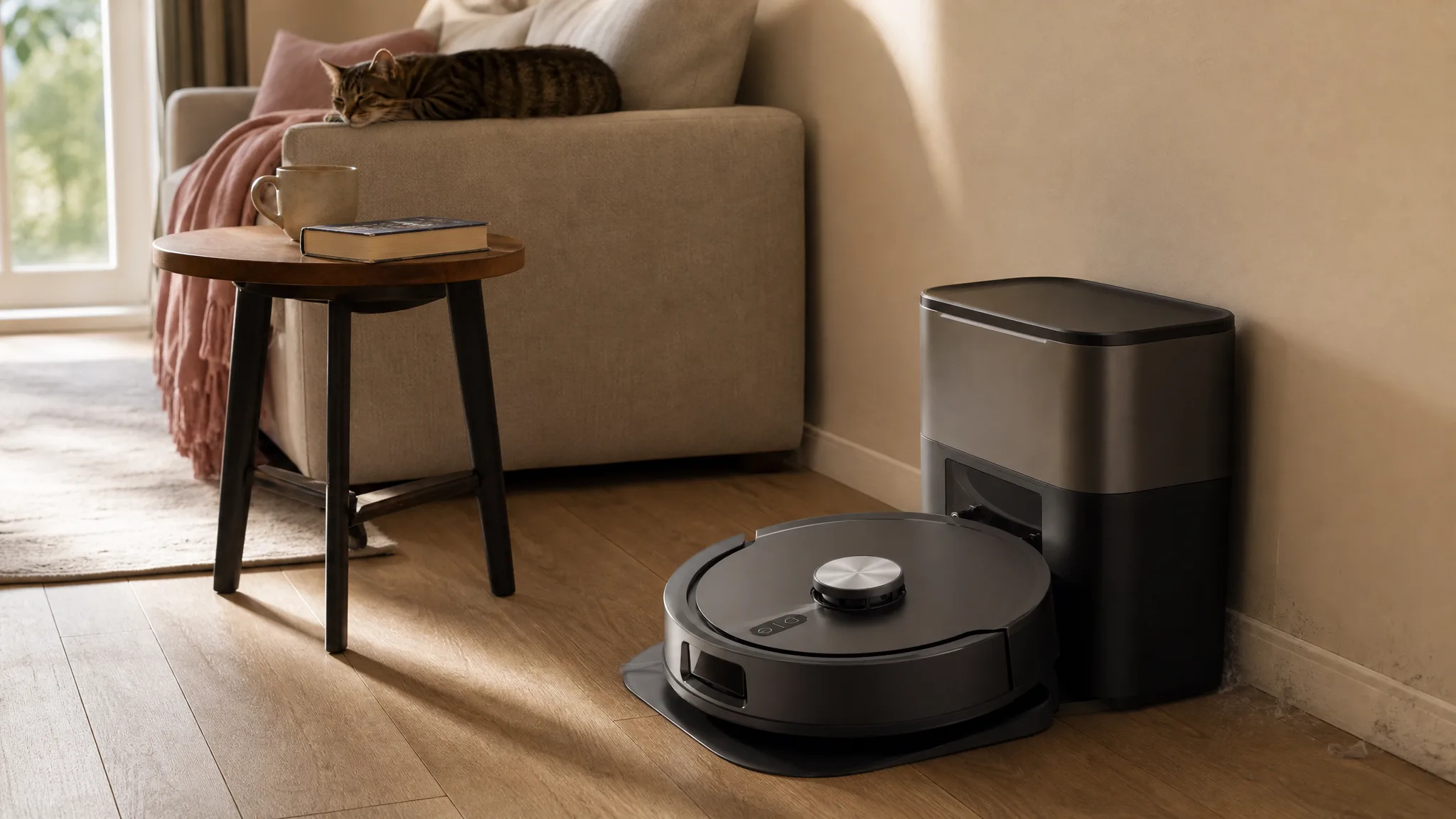
The base is the real reason to buy this robot. MONSGA rates the 4L bag at about 90 days in an average home, and six weeks with two cats did not bring us anywhere near full. The setting that mattered more was the one that controls how often the robot empties into the base, because that number is what decides bag life. On the default it dumps after every run. We moved it to every third run once we saw how little two cats actually produce in a day, and the base still stayed well ahead of us. Owners describe the same result: the chore that quietly kills robot ownership, tapping out a small onboard bin every other day, simply stops existing.
Pet Hair Comes Up on Hard Floors and Low Rugs
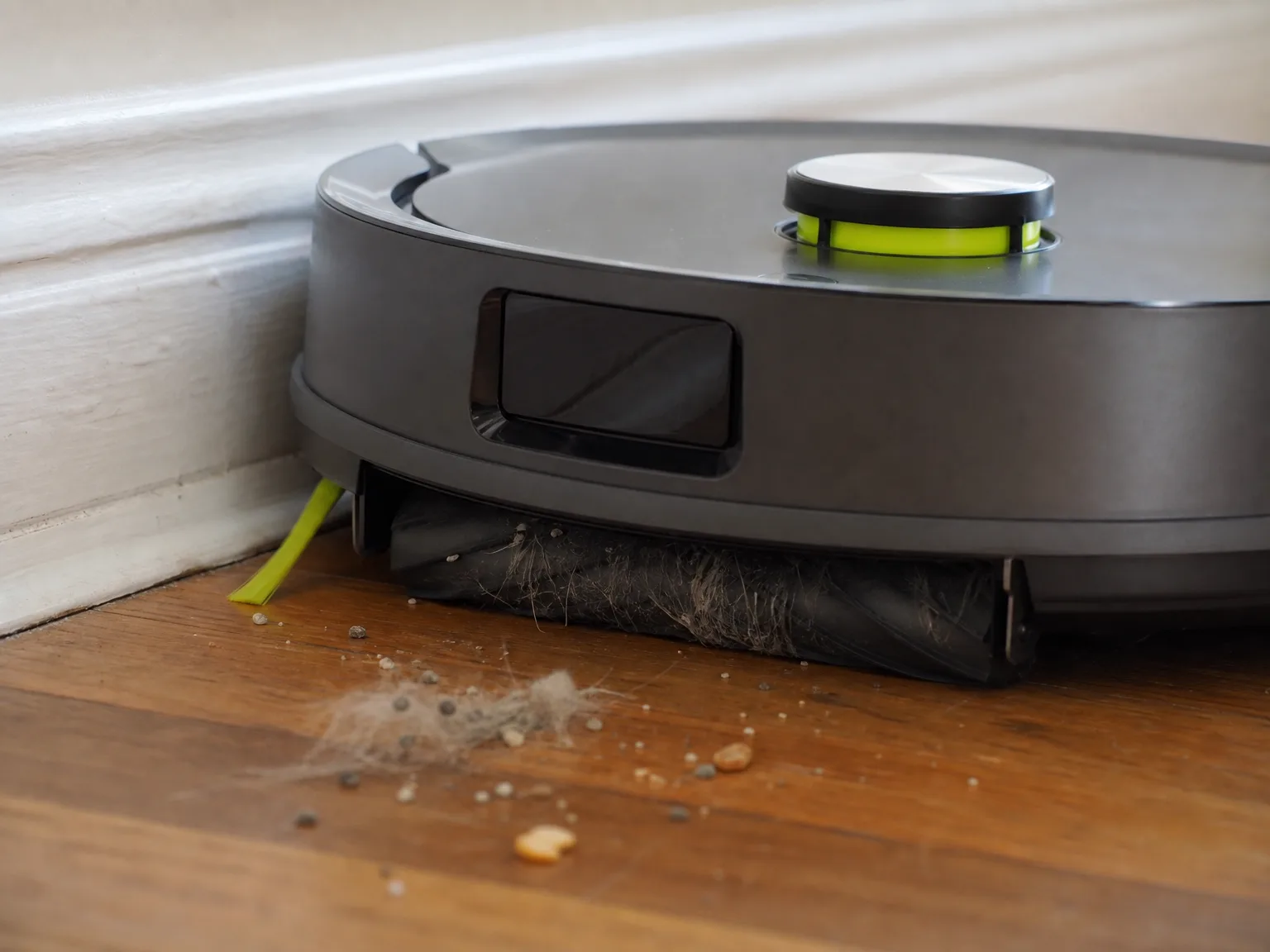
Rated at 8000Pa and fitted with two anti-tangle rollers, this is a machine built for fur rather than fine dust, and daily runs bore that out. Cat hair drifting along baseboards, litter granules tracked out of the tray, breakfast crumbs under the table: all of it went into the bin on the first pass. On our two low-pile rugs it lifted the loose surface layer that a broom just pushes around. Hair pressed deep into a thicker rug is still a job for a cordless stick, and no robot at this tier changes that. What we did not do once in six weeks was flip the robot over to cut hair off a roller. Owner reports line up: no tangled brushes.
Quiet Enough to Run While Everyone Is Home
Older robots announce themselves from two rooms away. This one runs at a level you can talk over, which changes when cleaning is possible in a busy house. We scheduled it for mid-morning and kept working through it, and it ran during a nap upstairs without anyone noticing. One owner reported the same thing more bluntly: they stopped hearing it from the floor above. The base is the exception. When it empties the robot, it is briefly as loud as a regular vacuum, so we set that cycle to run in the middle of the day rather than at 6am. That one scheduling choice is worth making before the first week is out.
Enough Runtime and Mapping to Cover a Floor Plan
MONSGA rates the battery at up to 160 minutes, and LiDAR gives it the methodical back and forth pattern rather than the random bumping of cheaper bots. In practice our single-level layout finished in one run with battery to spare, and the robot returned to the base on its own. Room-by-room control in the app is where the mapping earns its keep: we set the litter tray corner for a daily run and the guest room for once a week. Threshold climbing between tile and hardwood was reliable. For anything above one level, expect to build a map per floor and carry the robot, which is normal at this price.
Where It Falls Short
The Mop Wipes, It Does Not Scrub
The mopping here is a damp pad dragged behind the robot, with no pressure or oscillation behind it. Fresh dust and light footprints come up. Dried coffee splash, a stepped-on jam smear, anything stuck to the floor: those stay exactly where they are, and repeated passes only spread the water around. Owners are consistent on this point and so are we. There is a second wrinkle on mixed floors, because the pad does not lift. When the robot crosses from tile onto a rug it can pull a damp pad over the edge, so we set no-mop zones around both rugs and stopped worrying about it. Treat mopping as a bonus dust wipe, not a floor wash.
The Map Sometimes Forgets Itself
This is the complaint we take most seriously. Several owners have had a saved map vanish after an internet outage, and others report the quick map function failing outright and forcing a full reset. We had one map loss in six weeks, following a router reboot, and rebuilding it took a single unattended mapping run plus about ten minutes of redrawing our no-mop zones. Annoying rather than ruinous, but plan for it. If you have spent an hour dividing a large home into zones with names and schedules, losing that work is a genuine cost, and it is the main reason this robot lands at 8 rather than higher.
Support Is Email Only
There is no phone line. Questions go into an inbox and answers come back in one to two days, which owners find frustrating when a robot is sitting dead in a doorway. In fairness, a one-day reply is not unusual for a smaller brand, and we would rather see honest email support than a phone tree that goes nowhere. Just know what you are buying: if something breaks in week two, the fix starts with a message and a wait. Anyone who wants same-day help on a device this central to their cleaning routine should weigh that against the money saved.
Real-World Performance
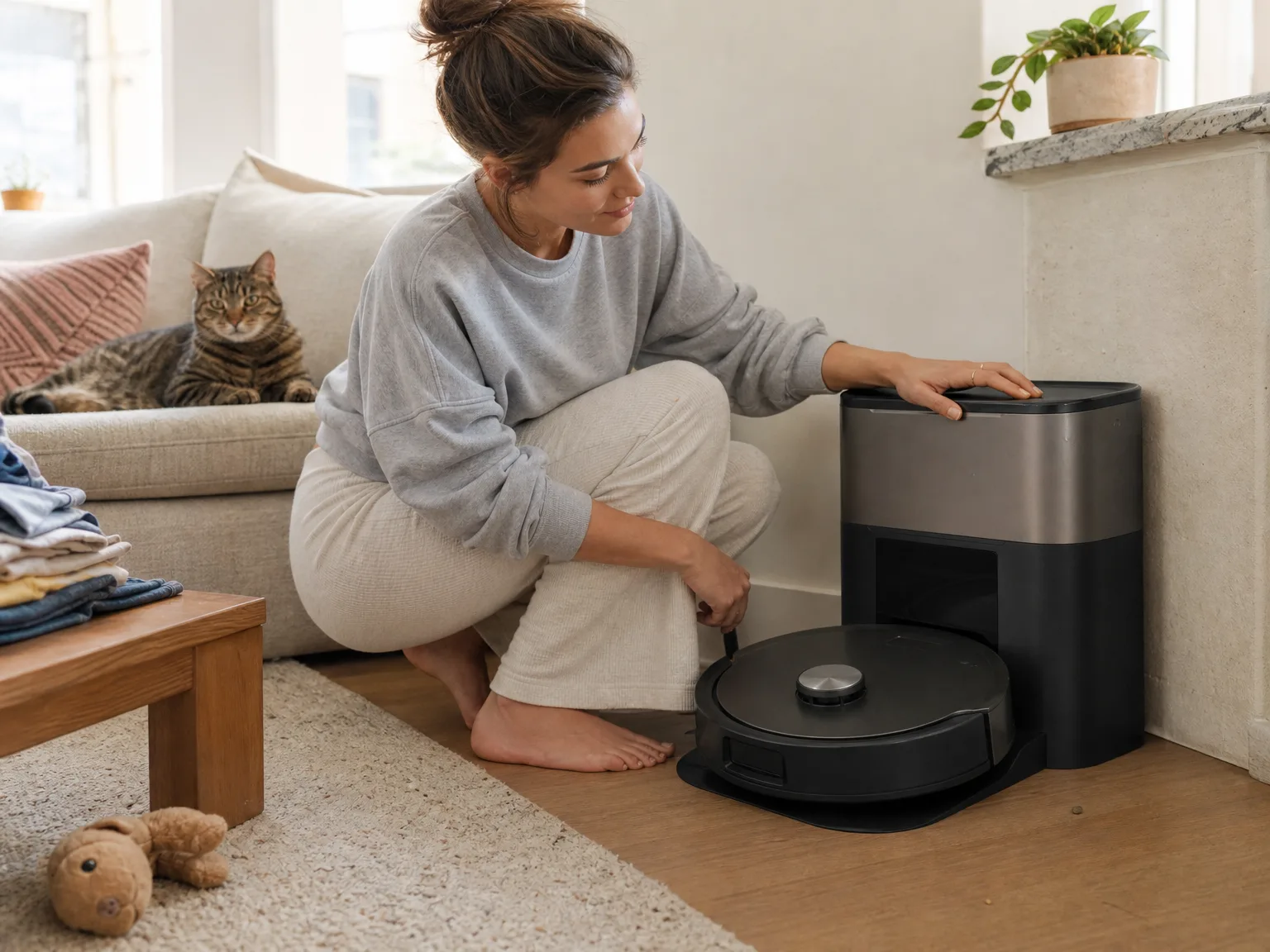
Two cats and mostly hard floors is the exact use case this robot was built for, and six weeks of daily runs settled into a boring routine, which is the best thing you can say about a robot vacuum. It left the base mid-morning, worked the kitchen, hallway, and living room, and was back on the dock before lunch. Fur along the baseboards never got a chance to accumulate into visible drifts. The difference from our previous rhythm was not a cleaner floor on any single day. It was never having a bad floor day at all, which is what daily automation actually buys you.
Bag life turned out to be a setting rather than a spec. Emptying after every run is the safe default and it is also the fastest way to fill a bag, so we changed it to every third run in week two. Six weeks later the 4L bag was maybe a third full, and the base still handled a heavy shedding week without any smell or blockage. If you have a big dog or three cats, expect less than the rated 90 days and set the frequency higher. The base does its loud dumping cycle for a few seconds, then the house goes quiet again.
Rugs are where you have to make a decision. On low pile, the robot climbed on, pulled loose hair off the surface, and climbed off without stalling. With the mop pad attached, though, it happily walked damp cloth onto the edge of a rug, and after the second time we drew no-mop zones in the app and left them there. Deep-set hair in the thicker bedroom rug never came out, which we expected. That is pet hair agitation work, and it belongs to a stick vacuum or an upright, not to a round robot on a schedule.
Noise and mapping shaped how we used it more than suction did. Because it is quiet, we stopped scheduling around the household and just let it run while people were home, including during a nap and through two work calls. Because the map is not bulletproof, we learned to keep the zone setup simple. When our map disappeared after a router reboot, a straightforward layout meant recovery was one mapping run and a few minutes of redrawing. On a heavily zoned, multi-level setup, that same failure would cost you an evening.
How It Compares to Alternatives
The Roborock Q8 Max+ is the pick if your floors lean toward carpet. Its DuoRoller brush pulls long pet hair out of high-pile carpet without tangling, and it pairs with the same kind of auto-empty station, so the hands-off part of the equation is intact. The mopping is no better, still a damp pad on a string, and owners note the dock is loud when it empties. Our Roborock Q10 S5+ review covers how these self-emptying Roborock docks behave over weeks of testing. If carpet is most of your floor plan, get the Q8 Max+ instead.
The Lefant M3 Ultra is the answer if the mop is the part you care about. It washes its pads in hot water and dries them, which keeps them from turning musty, and its 3.2L bag is rated for up to 120 days. It also claims far more suction on paper. The trade-offs are real: owners report pads slipping off during rug transitions, the robot skipping low furniture it could fit under, and about four hours to recharge, so a large home needs more than one session. If you want mop self-care and a longer bag interval, get the M3 Ultra instead.
The iRobot Roomba 105 Combo is worth a look if you want carpet-aware mopping from a brand with a service department. Its dock is rated for 75 days, LiDAR maps a floor quickly, and it detects carpet during mopping runs so rugs stay dry without you drawing zones by hand. Owners with large area rugs still report the mop head catching at rug edges, and battery may need a recharge break above roughly 1,400 square feet. Our Roomba 105 Vac review tests the vacuum-only version of that dock. If automatic carpet detection matters more than price, get the 105 Combo instead.
Who Should Buy It
Buy this if you have pets, mostly hard floors, and a low tolerance for maintenance. A cat owner fighting a litter tray perimeter, a dog household watching fur collect under the dining table, anyone in a single-level home who would rather never see a dustbin: those are the people who get the full value here. The self-emptying base plus adjustable empty frequency is the feature doing the heavy lifting, and it is the reason this robot stayed in service for six weeks instead of becoming a thing we had to remember to attend to.
Look elsewhere if you were hoping to retire your mop, or if your home is heavily carpeted or spread across three floors. Stuck-on messes need pressure and hot water, which means a proper mopping robot with a wash-and-dry dock or ten minutes with a bucket. Deep carpet needs brushroll agitation that no round robot at this tier delivers. And if you keep a complicated multi-floor zone setup that you are not willing to rebuild after a glitch, the mapping reports should give you pause before anything else does.
What you get at this tier is daily fur pickup that works, brushes you never have to cut free, quiet operation you can run at any hour, LiDAR zoning that lets you target the messy corners, and a base that goes months between bag changes. What you do not get is scrubbing, flawless map persistence, or phone support. Those three gaps are knowable in advance, and none of them touch the job most people buy a robot for, which is keeping the floor from ever getting bad.
FAQ
Does the mopping feature deep clean or just surface wipe?
It is a surface wipe. The pad is stationary and damp, so it picks up fresh dust and light marks but will not scrub dried spills or anything stuck to the floor. Keep a real mop for those jobs.
Can I add cleaning solution to the water tank?
The manual does not confirm that solution is safe, so plain water is the risk-free choice. One owner used a small amount without a problem, but until MONSGA says otherwise, we would not put anything but water in it.
How often do I need to change the self-emptying bag?
The 4L bag is rated for about 90 days in an average home. Heavy shedders will get less, but you can also set the robot to empty less frequently, which stretches bag life considerably. We ran ours on every third cleaning cycle.
Is the mapping reliable after initial setup?
Mostly, but not always. Most maps hold, while some owners have lost theirs after an internet drop or a glitch in the quick map function. Plan on an occasional remap and keep your zone setup simple enough to rebuild quickly.
Will it handle pet hair on carpet?
On low-pile carpet and rugs, yes, it lifts the loose surface hair. Fur worked deep into medium or high-pile carpet needs brushroll agitation, so pair the robot with a stick vacuum or an upright for that.
Is it quiet enough to run while the house is awake?
Yes. Cleaning runs are quiet enough to talk over, and we ran it through naps and work calls. The exception is the base emptying cycle, which is briefly as loud as a regular vacuum, so schedule that for daytime.
How long does it run on a charge?
MONSGA rates it at up to 160 minutes, which covered our single-level home in one run with battery left over. Larger or multi-level homes should expect a recharge break, and each floor needs its own map.
Bottom Line
The MONSGA earns its place on the strength of two things: fur pickup that keeps hard floors consistently clean, and a base that makes emptying somebody else's problem for months at a time. The costs are a mop that only wipes and mapping that can drop a saved layout after a network hiccup. If you have pets, mostly hard floors, and you want a hands-off daily vacuum, this is a practical buy at 8 out of 10. If you need real scrubbing or bulletproof multi-floor maps, put the money toward a robot with a wash-and-dry dock instead.
Ready to buy?
MONSGA Robot Vacuum and Mop, 90 Days Self-Emptying with 8000Pa Suction | Dual Anti-Tangle for Pet Hair, Carpet and Hard Floor, LiDAR Navigation, Smart Mapping, 160Mins Runtime, APP & Voice Control
In this article
- At a Glance
- What We Liked
- The Dock Takes the Dustbin Off Your List
- Pet Hair Comes Up on Hard Floors and Low Rugs
- Quiet Enough to Run While Everyone Is Home
- Enough Runtime and Mapping to Cover a Floor Plan
- Where It Falls Short
- The Mop Wipes, It Does Not Scrub
- The Map Sometimes Forgets Itself
- Support Is Email Only
- Real-World Performance
- How It Compares to Alternatives
- Who Should Buy It
- FAQ
- Bottom Line
Keep reading
6 Best Self-Emptying Robot Vacuums for Busy Homes (2026)
We tested six self-emptying robot vacuums that go weeks without a touch. Honest picks for busy homes, from a slim Eufy to a self-washing mop dock from Roborock.
iRobot Roomba 105 Vac Review: What You Give Up When You Skip the Dock
We ran the dockless Roomba 105 Vac for three weeks in a real apartment. The big bin and LiDAR row cleaning impress, but the battery and app hold it back.
iRobot Roomba 675 Review: Pet Hair Tested for 6 Weeks
We ran the iRobot Roomba 675 for six weeks in a home with a shedding cat, across hardwood, tile, and a low-pile rug. Honest take on the bumping and the brush hair.