iRobot Roomba 675 Review: Pet Hair Tested for 6 Weeks
In this article
- At a glance
- What we liked
- It finds dirt you thought you had already cleaned
- You set the schedule once and stop thinking about it
- Edges and corners are better than the price suggests
- The cliff sensors do not gamble with stairs
- Where it falls short
- It bounces around instead of planning a route
- It gets stuck, and you will be the rescue crew
- Long hair wraps the brushes every single week
- It is loud on hard floors
- Real-world performance
- How it compares to alternatives
- Who should buy it
- Frequently asked questions
- Does it work on dark area rugs?
- How often do I need to empty the dust bin?
- How well does it handle pet hair without clogging?
- Can I use it on multiple floors without moving the dock?
- How long does the battery last on one charge?
- Is it worth buying over a mapping robot?
- Bottom line
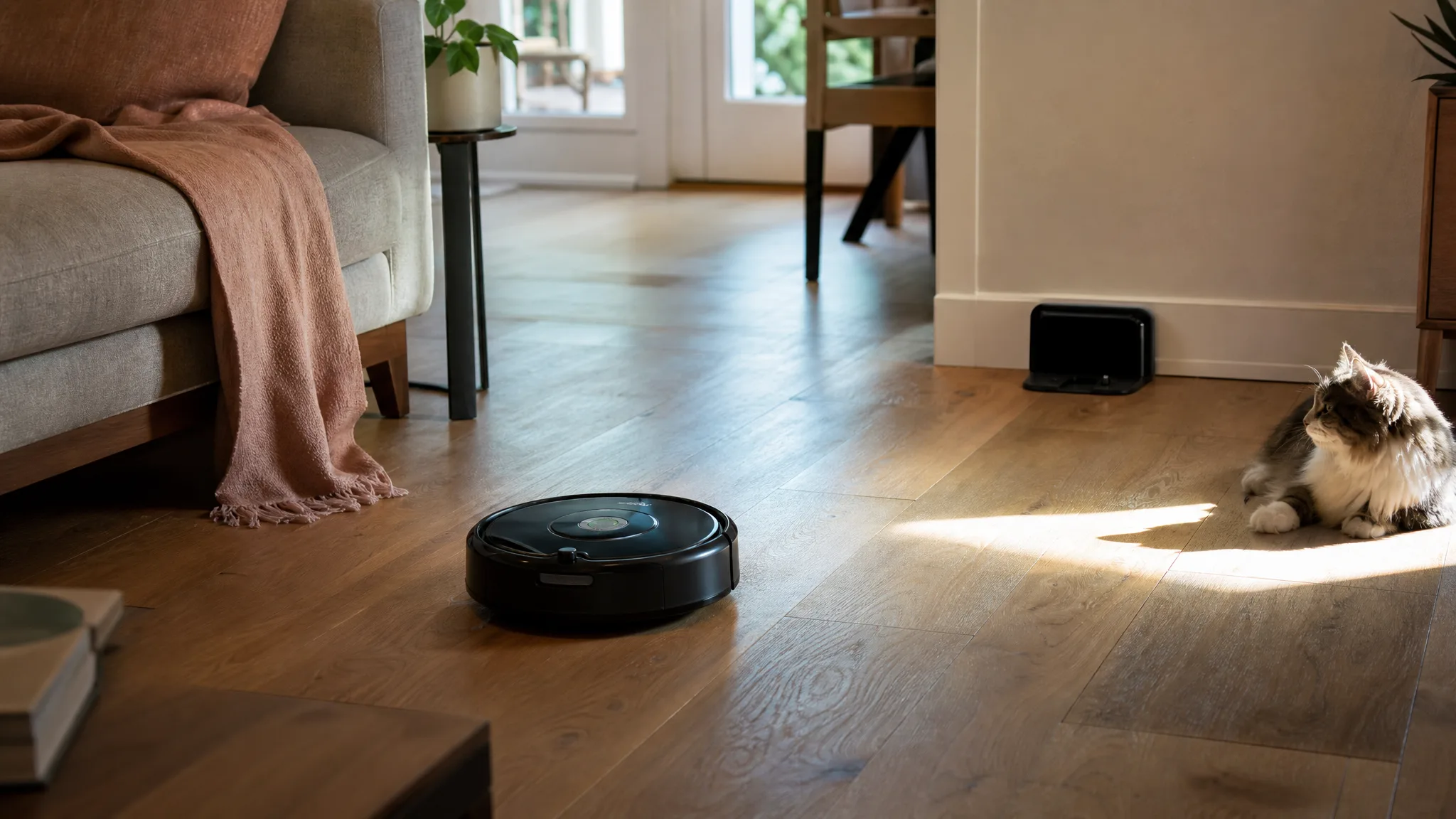
A robot vacuum earns its keep on the days you have no time to clean. Cat hair along the hallway baseboards, crumbs under the kitchen table, a cracker trail from the living room to the back door. The iRobot Roomba 675 is the cheap way into that daily habit. We ran this robot vacuum through our standard testing process for six weeks in a home with a shedding cat, mostly hardwood and tile plus one low-pile rug and a carpeted bedroom.
Verdict: Genuinely good at daily pickup and genuinely dumb about where it goes, which is the trade you accept at this price. 8.0/10.
Best for: Pet owners and busy families with mostly hard floors and low-pile carpet who want maintenance cleaning to happen without them.
Skip if: You want systematic whole-home coverage, or your home has thick rugs and a lot of low-clearance furniture.

Irobot
iRobot Roomba 675 Robot Vacuum - Easy to use, Power-Lifting Suction, Multi-Surface Cleaning, Smart Navigation Cleans in Neat Rows, Self-Charging, Alexa
Best for
A practical pick for pet owners and busy families with mostly hard floors and low-pile carpet who want daily maintenance and can tolerate occasional hijinks; skip it if you need systematic, whole-home cleaning or have thick rugs and lots of low-clearance furniture.
Most owners tell us this robot vac picks up a remarkable amount of everyday grit, pet hair, and crumbs from hard floors and low-pile carpet. The trade-off: its random navigation means you'll need to tidy floors and accept that it may miss a spot here and there in exchange for a lower price tag.
Loved by buyers
- •It pulls up hidden dirt and pet hair we didn't know was there, even after a regular vacuum has run.
- •The app and voice control make scheduling a breeze, so we come home to cleaner floors without thinking about it.
- •Edge-sweeping brush and dual rollers get into corners and along walls better than many budget bots.
Buyer concerns
- •Battery life may not cover a large, open home in one go; expect around 90 minutes of runtime.
- •It gets stuck under low furniture and on high-pile rugs, often needing a rescue.
- •Noticeably loud on hard surfaces, so we avoid running it during naps or TV time.
At a glance
| Detail | What we found |
|---|---|
| Model | Roomba 675 |
| Type | Robot vacuum, self-charging, returns to its dock on its own |
| Navigation | iRobot markets it as cleaning in neat rows. In practice it covers a room by bouncing off things, with no saved map |
| Runtime | Owners consistently report around 90 minutes per charge |
| Brush setup | Two multi-surface rollers plus a side edge-sweeping brush |
| Surfaces | Hardwood, tile, and low-pile carpet. High-pile rugs are where it stalls |
| Cliff sensors | Yes, and they held up all six weeks on a staircase |
| App and voice | Scheduling through the iRobot app, plus Alexa voice commands |
| Dust bin | Small. Plan on emptying after every run, at least at first |
| Noise | Loud enough on hard floors that we schedule around naps |
| Multiple floors | One charging base, so a second floor means carrying it up and back |
| Owner rating | 4.4 out of 5 |
What we liked
It finds dirt you thought you had already cleaned
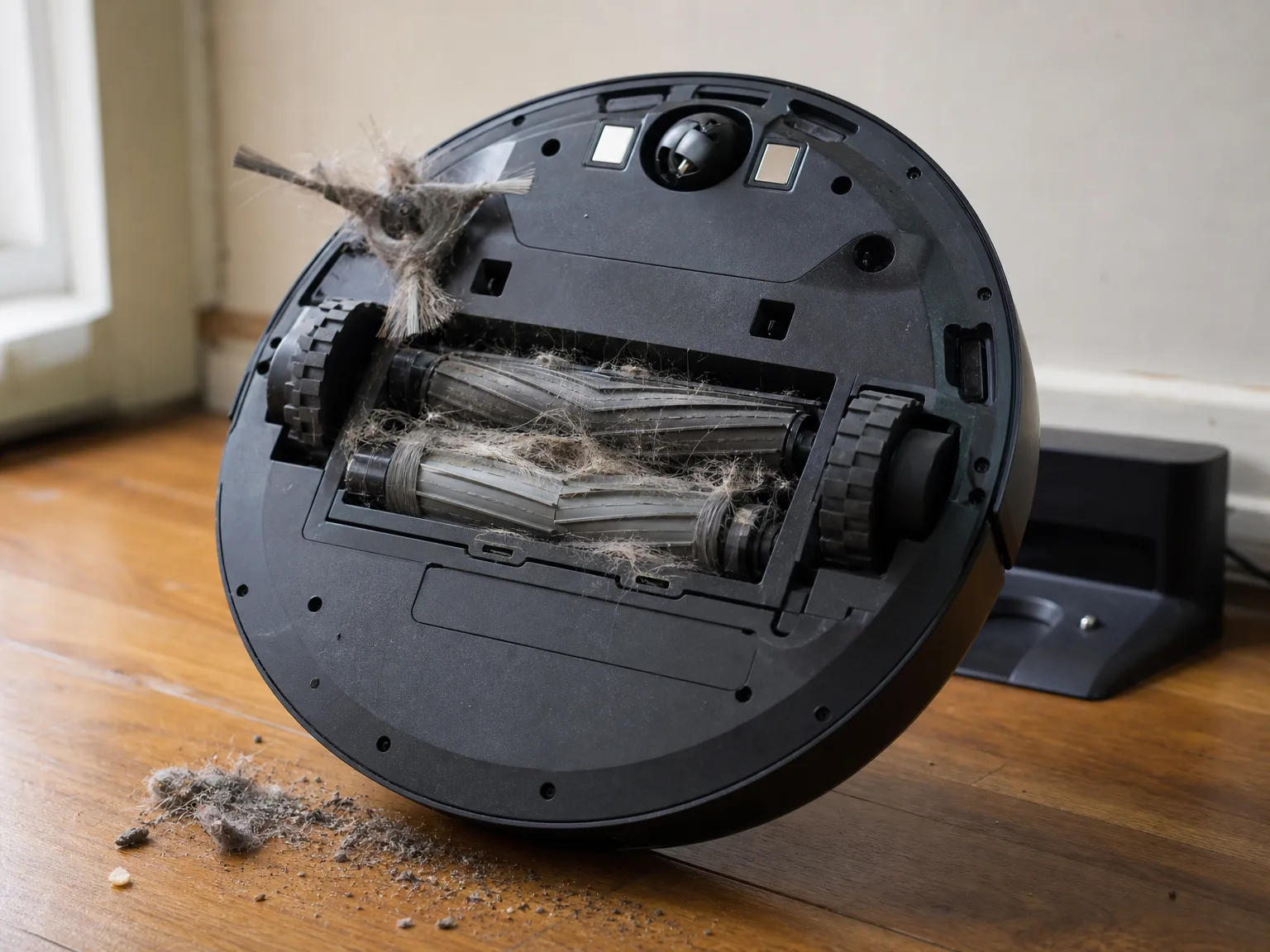
The first week is a little insulting. We vacuumed the hallway properly on a Sunday, sent the Roomba over the same floor on Monday, and the bin came back with a compacted gray wad of fine hair and grit. That happened again the next day, and the day after. Floors that look clean in daylight are not clean, and this machine keeps proving it.
The pickup itself is the part nobody argues about. On hardwood and tile it lifts pet hair and everyday grit rather than pushing it into a corner, and running it daily changes the baseline of the house. You stop noticing dust bunnies against the baseboards, because they never get the two or three days they need to form.
You set the schedule once and stop thinking about it
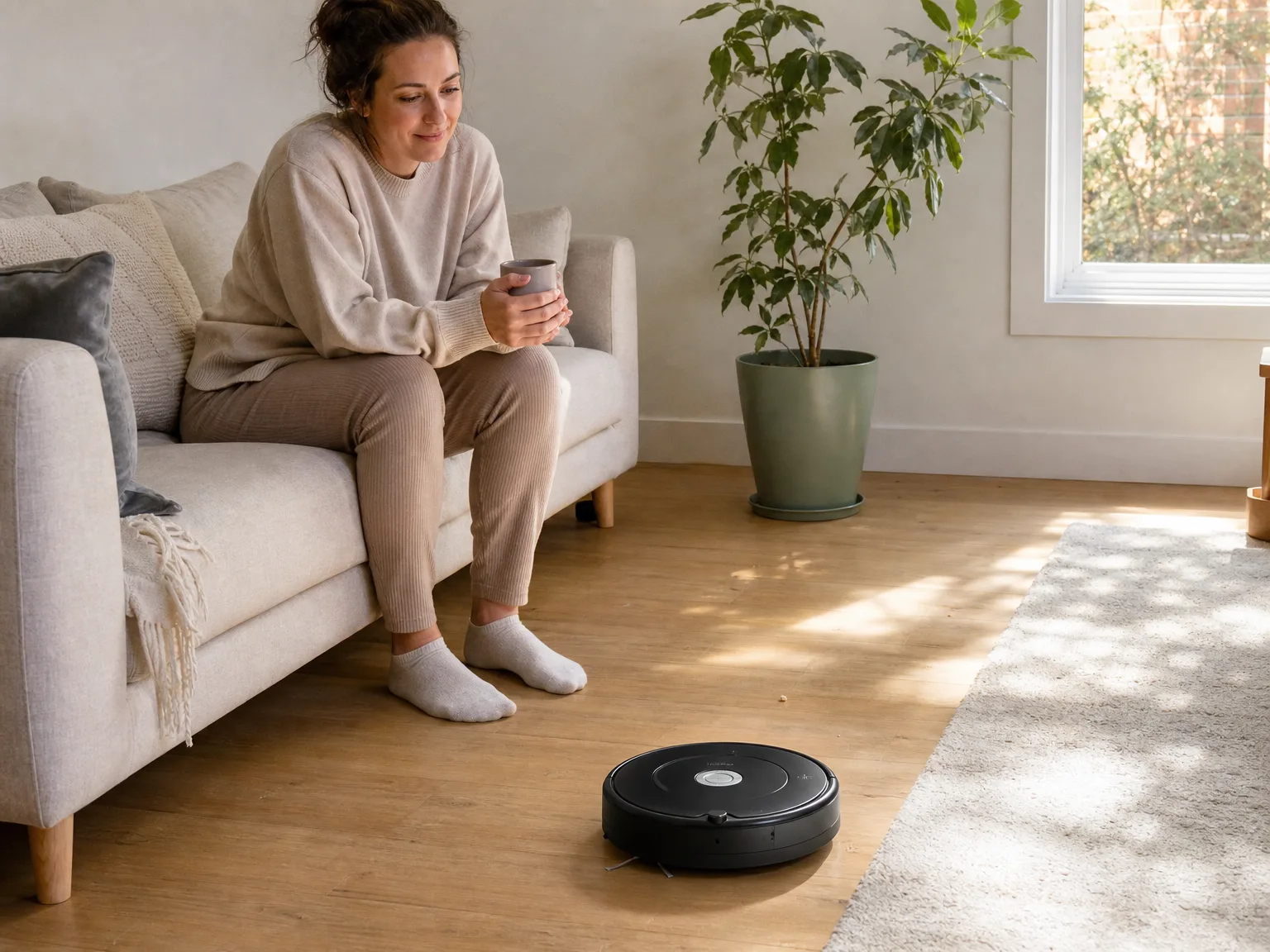
This is the real product. The app takes about five minutes to set up, you pick your days and times, and then floors get cleaned while you are at work or doing something else. Alexa handles the one-off requests, which matters more than it sounds when a bag of cereal hits the kitchen floor and your hands are full.
Six weeks in, the smart control side of it had become invisible in the good way. We stopped opening the app at all. The floors were simply cleaner than they used to be on a Wednesday, which is the whole reason to own one of these instead of just vacuuming harder on weekends.
Edges and corners are better than the price suggests
Plenty of budget bots clean the middle of a room and leave a visible frame of dust around the outside. The spinning side brush on this one flicks debris out of the wall junction and into the path of the two rollers, and the difference shows up along kitchen cabinet toe kicks and under the edge of the sofa skirt.
It is not surgical. Square inside corners still hold a little fluff, since a round robot cannot get its brush fully into a 90 degree angle. But compared with cheaper machines that only sweep what rolls directly under them, the edge work here is a real advantage and it is the reason the daily runs actually keep up.
The cliff sensors do not gamble with stairs
We tested this the paranoid way, letting it run on a landing above an open staircase with nothing blocking the drop. It approached, slowed, and turned away every single time across six weeks. Not one close call.
If you live in a split-level or have an open stairwell, that reliability is the difference between a robot you can leave alone and one you have to supervise. The same sensors cause a separate headache on dark rugs, which we get into below, but on stairs they behave exactly as advertised.
Where it falls short
It bounces around instead of planning a route
iRobot's own product name promises cleaning in neat rows. That is not what we watched. The 675 works a room by driving until it hits something, turning, and driving again, and it has no memory of where it has been. Given enough time it covers most of the floor. Given a normal 90 minute run in a normal house, it leaves patches.
You adapt by lowering your expectations from cleaning to maintenance. Run it every day and the misses average out, because today's skipped square metre gets covered tomorrow. What you cannot do is send it out before guests arrive and trust that the whole floor got done. For that certainty you need a mapping robot, and that is a different budget.
It gets stuck, and you will be the rescue crew
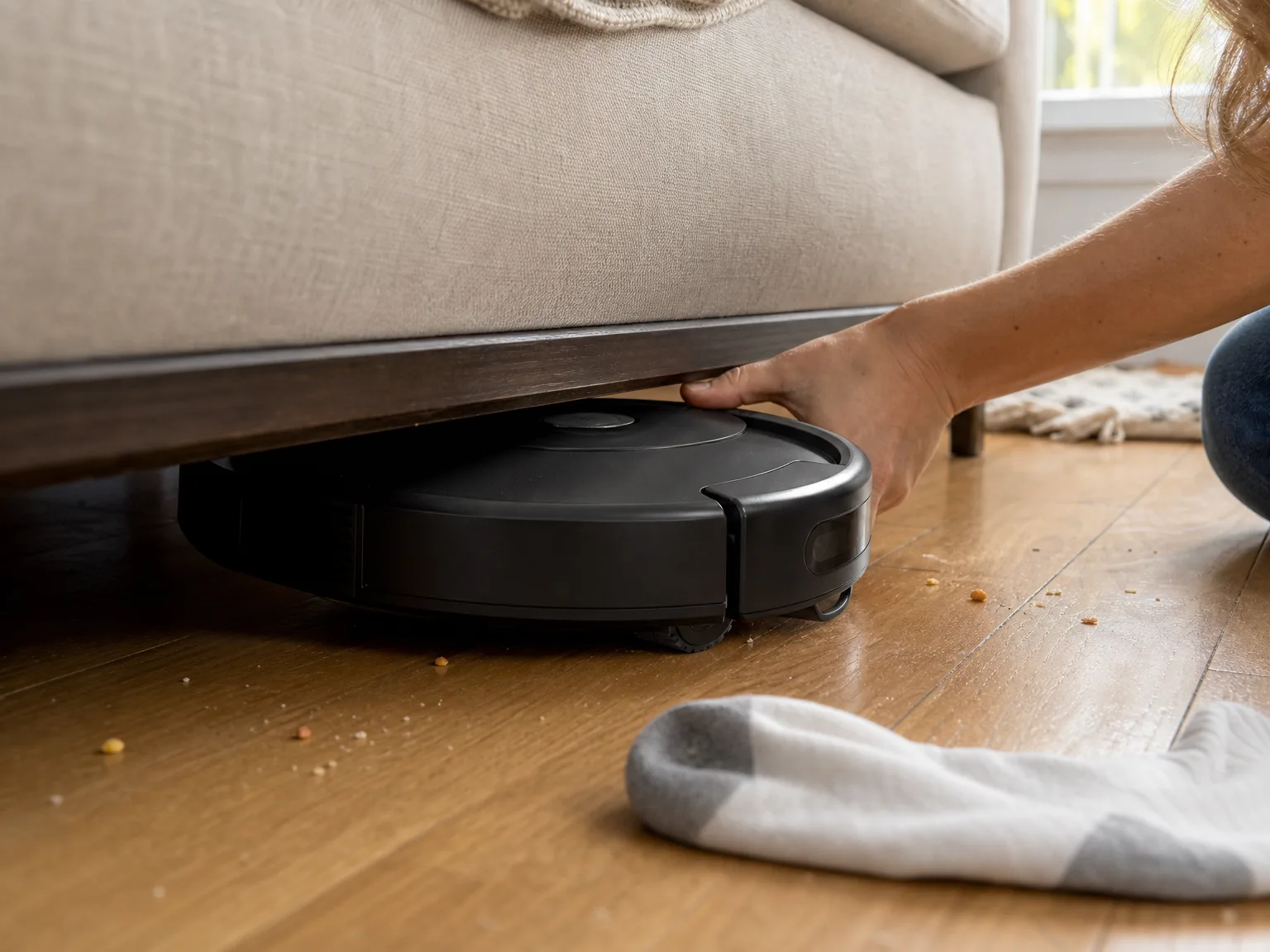
Low furniture is the main culprit. Anything with a clearance just barely taller than the robot invites it in and then traps it, wheels spinning, until you crouch down and pull it out. Our worst offender was a sofa with a low front rail. Three rescues in the first week, then we put a strip of felt bumper along the rail to stop it entering at all.
High-pile rugs cause the other kind of failure. The robot climbs up, the drive wheels lose bite in the deep fibres, and it beaches itself in the middle. Threshold strips and thick rug edges do the same. Expect a few weeks of learning which spots to block off with a chair leg or a shoe, and expect the occasional distress beep from a room you forgot to prepare.
Long hair wraps the brushes every single week
The rollers pick up hair brilliantly, then keep some of it. Long human hair and long pet hair wind tightly around both rollers and, worse, around the axle ends where they meet the bearings. Leave that for a month and suction drops off noticeably, and you will feel the roller drag when you spin it by hand.
The fix is a scheduled ten minute job with a seam ripper or a small pair of scissors. Pop the brush cage, slide the rollers out, cut the wrapped bundles off both ends, clear the side brush too. Do it weekly in a house with long hair and the machine stays as good as new. Skip it and you will decide the robot got weak when really it just got tangled.
It is loud on hard floors
On oak and tile the motor plus the roller noise is enough to talk over rather than through. We stopped running it during a toddler's nap and during anything we wanted to hear on TV, which in practice pushed every cleaning schedule to mid-morning on weekdays.
Carpet muffles it a bit, so a mostly rugged house will find this less annoying. If quiet operation is high on your list, this is not the class of machine to shop in. Robots that share your rooms while you are in them tend to cost considerably more.
Real-world performance
The daily hard-floor run. This is where the 675 is worth the money. A weekday run across hardwood and kitchen tile came back with a full bin of cat hair, sand tracked in from outside, and crumbs we never saw. After a fortnight of daily runs the house had a new normal, and the difference was most obvious in the hallway, which used to show every strand of fur by Thursday.
The low-pile rug. It climbs on and off a low-pile rug without drama and the rollers do reach down into the fibres. Deeply ground-in hair is another matter. The robot takes the loose top layer, and roughly once a month we still went over the same rug with an upright to get what had worked its way down. Treat it as a topping-up tool on carpet, not a replacement.
The dark rug problem. Our charcoal runner confused the cliff sensors, which read very dark flooring as a hole and steer away from it. The robot refused to cross it and the strip stayed dirty. The widely used owner workaround is running white or light-coloured tape along the rug edge so the sensors register a surface, and it did get ours crossing the runner. Worth knowing before you buy if your rugs are dark, because there is no software setting for it.
Under the sofa and the bed. Where clearance is generous, this is the robot's best trick, because it goes to the places you avoid. Where clearance is marginal, it is the robot's worst habit. We ended up blocking two pieces of furniture and leaving the rest open, and after that first fortnight of adjustment the stuck-under-something rescues dropped to about one a week.
One charge across one floor. Around 90 minutes of runtime handled our downstairs, which is a living room, kitchen, hallway, and one bedroom, with battery to spare. A large open plan main floor is a different story: the robot will run flat, dock itself to charge, and you may need a second run to finish the job. Manufacturer runtime figures assume the easiest conditions, and carpet drains it faster than tile does.
The second floor. You can carry it upstairs and start it there, but the dock stays where it is, so the robot cleans until the battery dies and then sits waiting for you. Owners who genuinely clean two floors buy a second charging base. If you did not plan for that, treat the 675 as a one-floor machine.
Maintenance. Empty the bin after every run, especially in the first week when it is still pulling up the backlog. It is small, and a packed bin costs you suction on the next job. Add the weekly brush detangle described above, wipe the cliff sensors when the robot starts behaving oddly near thresholds, and that is the entire routine. Around ten minutes a week, and skipping it is the most common reason people think their Roomba is dying.
How it compares to alternatives
The obvious step up is a mapping machine like the lidar-guided Roborock robot vacuum and mop. It drives in real rows, remembers your floor plan, lets you send it to a single room, and mops. It costs more and it needs a tidier floor to work well, but if the random coverage on the 675 is the thing you cannot live with, that is the fix.
Closer on price, the MONSGA robot vacuum and mop adds a self-emptying dock and a basic mop pad, which suits anyone tired of handling a small bin every day. Its mapping has quirks of its own, so you are trading one set of compromises for another rather than simply buying a better robot.
And if what you actually want is deep carpet cleaning rather than daily floor maintenance, no budget robot will get you there. A cordless stick built for pet hair pulls embedded fur out of rugs in a way the 675 cannot. If your home is mostly carpet, get a cordless vacuum instead and add a robot later for the hard floors.
Who should buy it
Buy the Roomba 675 if your floors are mostly hard surfaces with some low-pile carpet, you live with a shedding pet or messy small humans, and what you want is for the floors to be handled without you thinking about it. It suits the household that would rather have decent cleaning every day than a perfect clean once a week.
Look elsewhere if you need to know for certain that the whole floor got covered, if your home has thick rugs and a maze of low furniture, or if you want a quiet machine you can run in the same room you are sitting in. Two-storey homes need either a second dock or realistic expectations.
What you get for the money is reliable daily pickup on hard floors, edge cleaning that beats its price class, stair sensors you can trust, and scheduling that genuinely takes a chore off your list. What you give up is route intelligence, quiet running, and about ten minutes a week of brush maintenance. Those are honest trade-offs rather than defects, and this is the price at which people make them.
Frequently asked questions
Does it work on dark area rugs?
Often not, at least without help. The cliff sensors can read dark colours as a drop-off, so the robot avoids the rug entirely and leaves it dirty. The common owner workaround is applying white or light tape along the rug's edge so the sensors register a real surface. Our charcoal runner needed exactly that.
How often do I need to empty the dust bin?
After every cleaning run at first. The early days uncover a backlog of hidden debris and the bin is small, so it fills fast and a full bin costs you suction. Once your floors are genuinely caught up you can usually stretch to every other run, though pet households tend to stay on the every-run schedule.
How well does it handle pet hair without clogging?
It lifts pet hair off floors very effectively, and that is the main reason to own it. Long hair, though, wraps tightly around both rollers and the axle ends. Set aside about ten minutes a week to cut the wrapped bundles away. Do that and performance stays consistent, and skip it and you will feel the suction fade.
Can I use it on multiple floors without moving the dock?
You can carry it to another floor and start a clean there, but it cannot dock on a floor with no base. It will run until the battery is empty and then wait for you to bring it back down. Owners who regularly clean two levels buy a second charging base rather than shuttling the original one around.
How long does the battery last on one charge?
Expect around 90 minutes, which covered our downstairs comfortably. A large open main floor can outlast it. The robot returns to the dock to recharge when it runs low, so nothing is stranded, but a big single level may need more than one session to get properly covered.
Is it worth buying over a mapping robot?
It depends on whether you want maintenance or certainty. As a daily robot that keeps hard floors on top of pet hair and crumbs, the 675 does the job for a fraction of the money. If you need to send a machine to one specific room, or want proof that every square metre was cleaned, spend more on lidar mapping instead.
Bottom line
The Roomba 675 buys you a habit rather than a deep clean. Run it daily on hard floors and low-pile carpet and it will pull up more hair and grit than you expect, keep the edges honest, and never threaten your stairs. In exchange you accept a robot that bumps its way around instead of planning, gets itself stuck under the wrong sofa, and needs ten minutes of brush surgery on a Sunday. If your floors are mostly hard and your standard is cleaner rather than perfect, this is an easy recommendation. If random coverage will nag at you, read the Roborock lidar review before you spend anything.
Ready to buy?
iRobot Roomba 675 Robot Vacuum - Easy to use, Power-Lifting Suction, Multi-Surface Cleaning, Smart Navigation Cleans in Neat Rows, Self-Charging, Alexa
Explore related
In this article
- At a glance
- What we liked
- It finds dirt you thought you had already cleaned
- You set the schedule once and stop thinking about it
- Edges and corners are better than the price suggests
- The cliff sensors do not gamble with stairs
- Where it falls short
- It bounces around instead of planning a route
- It gets stuck, and you will be the rescue crew
- Long hair wraps the brushes every single week
- It is loud on hard floors
- Real-world performance
- How it compares to alternatives
- Who should buy it
- Frequently asked questions
- Does it work on dark area rugs?
- How often do I need to empty the dust bin?
- How well does it handle pet hair without clogging?
- Can I use it on multiple floors without moving the dock?
- How long does the battery last on one charge?
- Is it worth buying over a mapping robot?
- Bottom line
Keep reading
6 Best Self-Emptying Robot Vacuums for Busy Homes (2026)
We tested six self-emptying robot vacuums that go weeks without a touch. Honest picks for busy homes, from a slim Eufy to a self-washing mop dock from Roborock.
iRobot Roomba 105 Vac Review: What You Give Up When You Skip the Dock
We ran the dockless Roomba 105 Vac for three weeks in a real apartment. The big bin and LiDAR row cleaning impress, but the battery and app hold it back.
6 Best Vacuums for Long Hair (2026): Tangle-Free Picks Tested
We tested six vacuums against long human hair and pet fur in real homes to find which brush rolls truly resist tangling, from sticks to robots.