Vacmaster VOC812SF Review: 8-Gallon Stainless Tank After 6 Weeks
In this article
- At a Glance
- What We Liked
- Suction That Does Not Flinch
- A Stainless Tank That Survives a Garage
- Seventeen Feet of Reach Covers a Whole Car
- The Blower Replaces a Second Tool
- Where It Falls Short
- The Hose Will Not Store Neatly
- The Latches Fight You Every Time You Empty It
- No Drain Plug Means Lifting Eight Gallons of Water
- Real-World Performance
- How It Compares to Alternatives
- Who Should Buy It
- FAQ
- Bottom Line
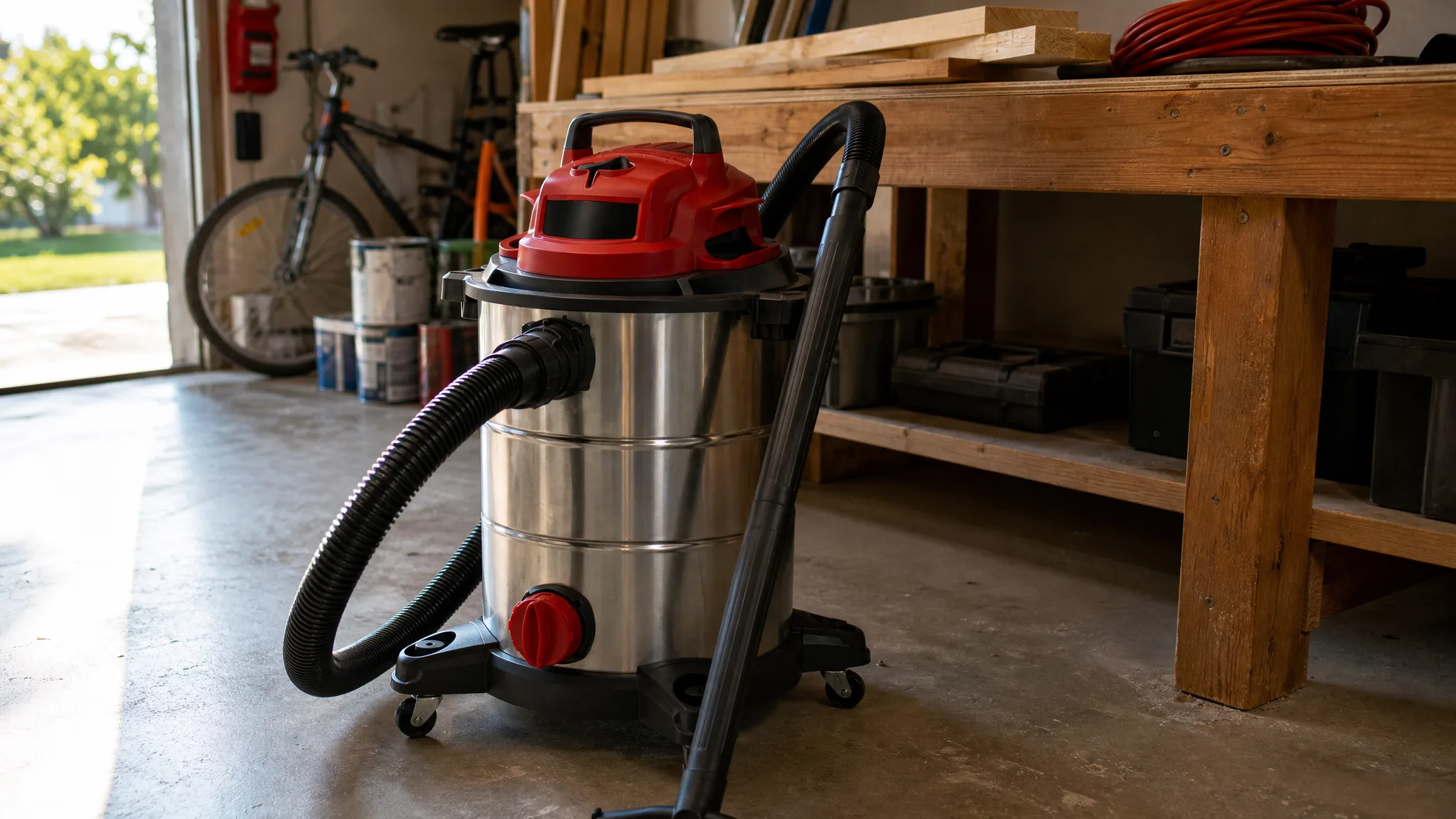
A woodshop floor after a weekend of cutting shelves. A garage corner where road grit and dry leaves pile up against the wall. A laundry room with a couple of gallons of water spreading across it at six in the morning. We spent six weeks pointing the Vacmaster VOC812SF at all three, following our how we review process, to find out whether a stainless steel tank buys you anything real or just adds weight.
Verdict: Relentless suction in a tank that shrugs off garage abuse, held back by clumsy hose storage and stubborn latches. 8/10.
Best for: Messy garages, woodshops, and outdoor cleanups where suction and durability matter more than tidy storage
Skip if: You need a vac that tucks into a tight closet, or you vacuum a lot of water and want a built-in drain

Vacmaster
Vacmaster VOC812SF 1101 8-Gallon Premium Stainless Steel Wet/Dry Vacuum, Red Edition, 8 Gal
Best for
Best for messy garages, woodshops, and outdoor cleanups where strong suction and a tough tank matter more than sleek storage, but skip if you need a compact vac that tucks into a tight closet or if you plan to vacuum lots of water and want a built-in drain.
Most owners agree this shop vac delivers relentless suction for dry debris and water, with a stainless tank that handles workshop abuse without complaint. The trade-off is that the hose storage is awkward and the lid latches require a firm hand, so it trades some everyday convenience for raw, practical power.
Loved by buyers
- •The stainless steel tank resists dents and rust far better than plastic vacs, extending its life in rough garages or job sites.
- •With a 7-foot hose and long cord giving 17 feet of total reach, it cleans a full vehicle or cluttered patio without constant unplugging.
- •Flipping the hose to the exhaust port turns it into an effective blower for clearing sawdust from tools or leaves from driveways.
Buyer concerns
- •The hose does not wrap neatly around the canister and often bulges out, making storage clumsy in small closets or sheds.
- •Stiff latches secure the motor head so tightly that opening it for emptying or filter changes can be a wrestling match.
- •No drain plug means you must lift and tip the heavy 8-gallon tank to empty out water, a messy chore if you frequently vacuum wet spills.
At a Glance
| Spec | Detail |
|---|---|
| Type | Corded wet/dry shop vacuum with a stainless steel tank |
| Tank capacity | 8 gallons |
| Hose | 7 feet |
| Cord | About 10 feet, which works out to roughly 17 feet of reach with the hose attached |
| Blower | Yes, move the hose to the exhaust port |
| Wet pickup | Yes, water and dry debris in the same tank |
| Draining | No drain plug, so you lift and tip the tank |
| Filtration | Reusable cartridge filter included |
| Dust bags | Not included, bought separately for fine dust |
| Noise | Quieter than most shop vacs this size, per owners and our testing |
| Owner rating | 4.5 out of 5 across roughly 3,300 reviews |
| Five-star share | 78 percent of owners |
What We Liked
Suction That Does Not Flinch
Plenty of shop vacs make an alarming noise and move very little air. This one moves air. Sanding dust, wood offcuts, driveway grit, dry leaves blown in under the garage door, and standing water all went up without the motor bogging down or spitting anything back out. The pull also stayed constant through a session rather than fading after the first few minutes, which is usually the first sign a filter is loading up. Owners describe the same thing across thousands of reviews, and after six weeks we read it the same way: this is a vac built around raw pickup, and everything awkward about it is a consequence of that priority.
A Stainless Tank That Survives a Garage
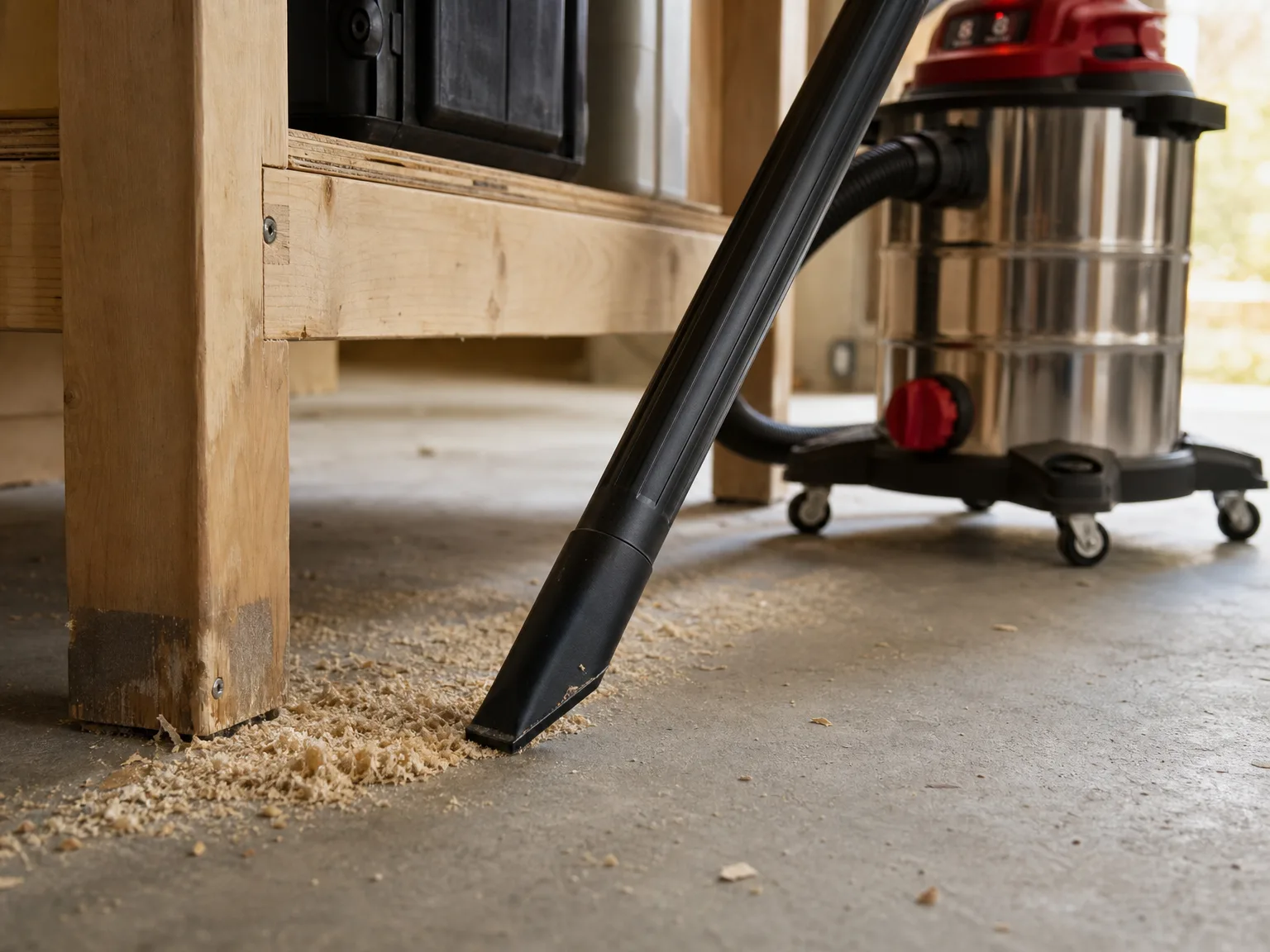
Plastic tanks crack at the rim, scuff into a permanent gray, and dent where you drag them past a trailer hitch. Stainless does none of that. Ours took a full six weeks of being shoved along concrete, knocked into a workbench leg, and left holding water overnight, and it came out looking like a tool rather than something rescued from a curb. Rust is the other half of it. A vac that sits in an unheated garage through winter and regularly holds water is a vac that lives in damp air, and a stainless drum handles that indefinitely. If you have replaced a cheap shop vac because the tank gave up before the motor did, this is the specific problem the VOC812SF solves.
Seventeen Feet of Reach Covers a Whole Car
The 7-foot hose and roughly 10-foot cord give you about 17 feet to work with from one outlet. That sounds modest and turns out to be the difference between finishing a job and unplugging halfway through it. From a single garage outlet we cleaned both rows of seats in a midsize SUV, the trunk, and the footwells, without moving the vac. Same story on a cluttered patio and a two-car garage floor. Most shop vacs in this size class ship a short hose and force you into an extension cord for anything bigger than a workbench, so the extra hose length here quietly earns its keep every time you clean a vehicle.
The Blower Replaces a Second Tool
Pull the hose off the intake, push it onto the exhaust port, and you have a blower. We used it to clear sawdust out of a table saw, blow grass clippings off a driveway, and push leaves out of the corner where a broom just redistributes them. It is not as strong as a dedicated leaf blower and it is tethered to an outlet, so treat it as a bonus rather than a reason to buy. Still, for the ten-second swap it takes, getting a workable blower out of a vac you already own beats storing one more machine in a garage that is probably already full.
Where It Falls Short
The Hose Will Not Store Neatly
There is no satisfying way to put this thing away. The 7-foot hose does not wrap tightly around the canister, so it bulges out and catches on whatever you walk it past. Owners raise this constantly and we found the same. Our workaround was a cheap hook on the garage wall for the hose and letting the vac live underneath it, which took the problem from daily annoyance to solved. If your only storage is a narrow closet or a packed shed, though, this is the trade you are making. The tank is 8 gallons of stainless with a hose that refuses to tuck in, and it needs a corner rather than a shelf.
The Latches Fight You Every Time You Empty It
The latches holding the motor head to the tank are stiff. That is why the seal is good, and it is also why opening the vac for a filter clean or a tank dump can feel like a wrestling match. It gets easier once you learn the angle, and cold hands in an unheated garage make it worse. Two thumbs and a bit of force is what it takes. Nothing broke on ours and we would rather have latches that hold under suction than ones that pop, but if hand strength is limited, this is worth knowing before you buy. You will open this vac after every messy job.
No Drain Plug Means Lifting Eight Gallons of Water
This is the real limitation. There is no drain port, so emptying water means lifting the tank and tipping it, and 8 gallons of water is heavy enough that you will not enjoy doing it at full capacity. Our habit by week two was to stop and empty at roughly half a tank, walk it to the driveway, and pour. That works, and it also means a wet job takes more trips than it should. If you are cleaning up after a burst pipe or you vacuum out a flooding basement every spring, buy a model with a drain hose and save yourself the lifting. For an occasional spill, tipping it is a minor chore.
Real-World Performance
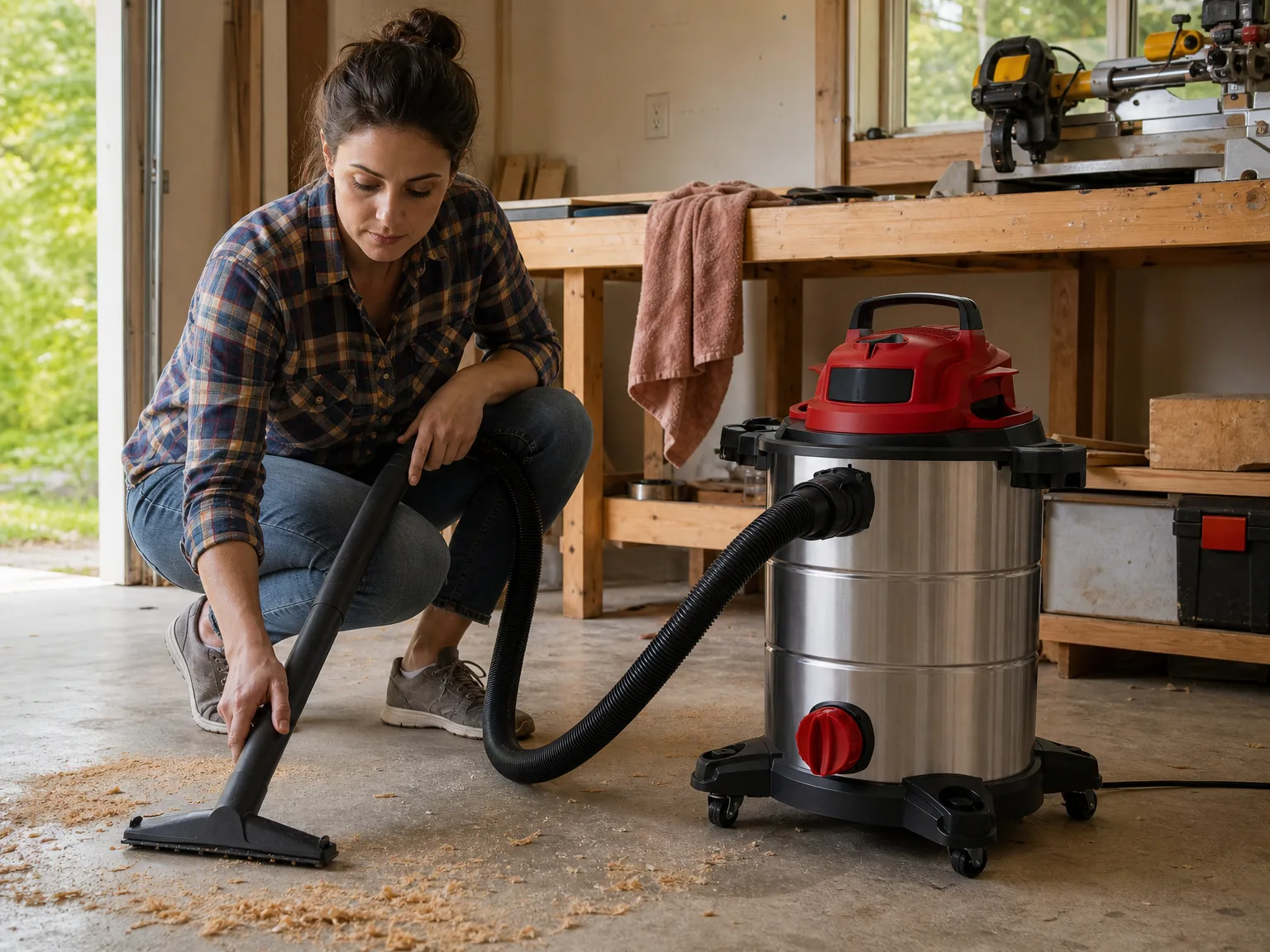
The woodshop is where this vac makes the most sense. Cutting and sanding a set of shelves produced the usual mix of chips, curls, and fine dust that settles on every flat surface, and single passes cleared it. Eight gallons meant we finished a full Saturday of work without stopping to empty. One caution for fine dust specifically: the vac ships with a reusable cartridge filter and no bags, and drywall dust or ash will load a bare filter fast. Buy a pack of compatible bags at the same time as the vac if sanding or ash cleanup is part of your routine, and treat them as a consumable rather than an accessory.
Cars and the driveway are the second strong case, mostly because of that 17 feet of reach. Sand in the seat rails, dried mud on the driver's mat, pine needles in the trunk, and the crumb layer down the side of a console all lifted without repeated passes. We did a full vehicle from one garage outlet and never touched the plug. Then we flipped the hose to the exhaust port and blew the driveway clear. If you only ever clean a car interior and nothing else, a smaller machine like the one in our ZARIMI portable car vacuum review is faster to grab and needs no outlet, but it will not touch water or handle a workshop.
The wet test arrived unannounced, which is the honest way to run one. A washing machine hose let go overnight and left a couple of gallons across a laundry room floor. Check your manual for filter guidance before a wet job, since most wet/dry vacs want any bag removed for water pickup. Set up that way, the vac cleared the floor in minutes with no stalling. Then came the part we already knew was coming: no drain plug, so we carried the tank out and tipped it. It handled the emergency well. It just made us work for the last two minutes of it.
Indoor household cleaning is the weakest use and we want to be direct about it. Cat litter scattered around a box, tracked-in grit by a back door, and cereal under a high chair vanish off hard floors. Carpet is another matter, because there is no powered brushroll, so hair worked deep into a rug stays in the rug. Owners do call it quieter than the shop vacs they are used to and we agree, though quieter than a screaming shop vac is still louder than a household vacuum. If somebody naps in the afternoon, plan around it. This is a garage tool that can help inside, not a replacement for a cordless vacuum you reach for daily.
How It Compares to Alternatives
The closest rival is the DEWALT DXV08S, also 8 gallons with a stainless tank. The two are close enough on capacity, durability, and pickup that the decision comes down to price on the day and which accessories you already own. The Vacmaster answer is the 7-foot hose and the blower function. If reach and the blower do not matter to you, the DEWALT is an easy substitute.
Within the same brand, the honest question is size rather than power. Our Vacmaster 6-gallon detachable blower review covers a lighter machine that is friendlier to carry and store, with a blower that comes off as its own unit, and 6 gallons is enough for a car and a workbench. There is also a 5-gallon Vacmaster with a stainless tank if you want the same rust resistance in something that actually fits on a shelf. Both hold less, which on fine sawdust means one or two more trips to the trash per project.
Going bigger is only worth it if you have somewhere to put it. A 9-gallon or 16-gallon shop vac empties less often and stops being something you carry up stairs. If you regularly deal with standing water, get a model with a drain hose instead of any of these, because tipping a full tank is the one part of owning this vac that never improves. Browse the rest of our wet/dry vacuum reviews if capacity is your deciding factor.
Who Should Buy It
Buy this if your messes are rough and your storage is not precious. The ideal owner has a woodshop or a garage bay, a project going most weekends, at least one vehicle that collects grit, and a wall or corner where a vac can just live. Somebody who has already thrown out a cracked plastic shop vac will appreciate the stainless tank most, because that is the part of a shop vac that usually dies first. The blower and the 17 feet of reach are what turn it from a workshop tool into the machine you also use on the patio and the driveway.
Look elsewhere if storage or water is your main constraint. Anyone working out of a narrow hall closet or a shared apartment storage locker will fight the hose every single time, and a 5-gallon or 6-gallon model is the better answer. Anyone pumping out real volumes of water needs a drain port. And if your actual problem is embedded pet hair on carpet, a household vacuum with a brushroll is the tool for that job, not this one.
What this tier buys you is honest suction that does not fade, a tank that outlives the abuse a garage hands out, enough reach to finish a car from one outlet, and a blower thrown in. What it does not buy you is convenient storage, easy latches, or a drain. Those are inconveniences you meet at the end of a job rather than problems that stop you from doing the job, which is why it still rates well with us and with the 78 percent of owners who give it five stars.
FAQ
How long is the power cord, and is that enough for a garage?
The cord runs about 10 feet, and paired with the 7-foot hose you get roughly 17 feet of working radius. That covers a two-car garage or a full vehicle from one outlet, which is more than most vacs this size manage without an extension cord.
Is this vacuum loud?
Owners consistently describe it as quieter than the shop vacs they are used to, and our testing matched that. It is still louder than a household vacuum, so we would not run it next to a sleeping baby, and we would wear ear protection for an hour of continuous work.
Does it come with dust bags?
No. You get a reusable cartridge filter, but no disposable bags. For fine dust like drywall or ash you will want compatible bags, so order a pack alongside the vac rather than after your first project.
Can it pick up water?
Yes. The stainless tank and the filter are designed for wet pickup, and it cleared a laundry room flood for us without any trouble. Check the manual and remove any bag before wet jobs.
How do you empty the water afterward?
By lifting the tank and tipping it, because there is no drain plug. Eight gallons of water is heavy, so empty at around half a tank and make the extra trip. If you vacuum water often, buy a model with a drain hose.
Does the blower function actually work?
Yes, and it is easier than expected. Move the hose from the intake to the exhaust port and you can clear sawdust off a table saw or leaves off a driveway. It is weaker than a dedicated leaf blower and still needs an outlet, so think of it as a bonus.
Can it replace my household vacuum?
No. There is no powered brushroll, so carpet and embedded pet hair are beyond it. Use it for the messes your everyday vacuum should never see, and keep something lighter for daily floors.
Bottom Line
The Vacmaster VOC812SF gets the parts you cannot fix right. Suction holds steady on sawdust, grit, and standing water, the stainless tank takes garage abuse without complaint, and 17 feet of reach plus a blower covers more ground than the spec sheet suggests. What you accept in exchange is a hose that will not store neatly, latches that need two thumbs, and a tank you have to lift to drain. If you have a corner to keep it in and your wet cleanups are occasional, this is a practical pick. If you fight standing water every spring, buy a model with a drain hose instead.
Ready to buy?
Vacmaster VOC812SF 1101 8-Gallon Premium Stainless Steel Wet/Dry Vacuum, Red Edition, 8 Gal
Explore related
In this article
- At a Glance
- What We Liked
- Suction That Does Not Flinch
- A Stainless Tank That Survives a Garage
- Seventeen Feet of Reach Covers a Whole Car
- The Blower Replaces a Second Tool
- Where It Falls Short
- The Hose Will Not Store Neatly
- The Latches Fight You Every Time You Empty It
- No Drain Plug Means Lifting Eight Gallons of Water
- Real-World Performance
- How It Compares to Alternatives
- Who Should Buy It
- FAQ
- Bottom Line
Keep reading

How to Clean Hardwood Floors Without Damaging Them: A Busy Home Guide
Soft rollers, the right suction mode, and barely damp mops keep hardwood safe. Here's the method we use at home, plus three tools that won't scratch sealed wood.
Vacmaster VJF607PF Review: Basement Water and Shop Dust Tested
We tested the Vacmaster VJF607PF 6-gallon wet/dry shop vac on basement water, sanding dust, and a filthy car interior. Strong suction, and a tank you feel every time you empty it.
Armor All AA255W Review: Trunk Wet/Dry Cleanup After Weeks
We tested the Armor All AA255W 2.5-gallon wet/dry vac on trunk spills, car mats, and pet debris. Honest take on cord reach, crevice tools, and who should buy.