Milwaukee M18 Wet/Dry Vacuum Review: Packout Vac Tested for 6 Weeks
In this article
- At a Glance
- What We Liked
- It Runs on Batteries You Already Own
- Two Power Modes, and Low Handles Most of It
- Fleece Bags and a Packout Base Make the Boring Part Painless
- Quiet Enough to Use Indoors Without Clearing the Room
- Where It Falls Short
- Two Gallons Disappears Faster Than You Think
- It Sits Tippy Unless It Is Locked to a Packout Stack
- High Mode Drains Batteries Quicker Than Expected
- Real-World Performance
- How It Compares to Alternatives
- Who Should Buy It
- FAQ
- Bottom Line
A bag of potting soil splits open in the trunk. Someone knocks a water bottle over in the footwell. Sawdust drifts under the workbench after twenty minutes of cutting. None of those are jobs for the house vacuum, and none of them justify dragging out a full-size drum vac. The Milwaukee M18 wet/dry vacuum is built for exactly that middle ground, and we put it through our how we review process for six weeks to see where the middle ground ends.
Verdict: A genuinely grab-and-go cordless vac that trades capacity for the ability to be wherever the mess is. 8/10.
Best for: Quick, light-duty cleanups in garages, cars, or workshops for anyone already running Milwaukee M18 tools
Skip if: You need a high-capacity primary shop vac for heavy debris or extended wet pickup

Best for
Quick, light-duty cleanups in garages, cars, or workshops for anyone already in the Milwaukee M18 ecosystem. Skip it if you need a high-capacity primary shop vac for heavy debris or extended wet pickup.
This cordless wet/dry vac earns high marks for strong suction and quiet, grab-and-go convenience on small jobs, all while sharing batteries with other Milwaukee tools. The trade-off is its 2-gallon capacity, which means frequent stops to empty and a real need for high-amp batteries if you plan to run it for more than a few minutes at a time.
Loved by buyers
- •It runs on the M18 batteries you probably already own if you have other Milwaukee tools.
- •Fleece bags and Packout integration make emptying and storing the vac genuinely hassle-free.
- •Two power modes let you balance between strong suction on high and longer runtime on low, and low is plenty for most daily messes.
Buyer concerns
- •Without being snapped into a Packout stack, it sits tippy on flat surfaces or in a moving vehicle.
- •The battery drains faster than expected on high mode; having a large-capacity battery is almost a necessity.
- •A 2-gallon bin fills up quickly during bigger cleanups, so it works best as a secondary vac for small jobs.
At a Glance
| Spec | Detail |
|---|---|
| Type | Cordless wet/dry vacuum |
| Battery platform | Milwaukee M18 |
| In the box | Bare tool. Battery and charger sold separately |
| Bin capacity | 2 gallons |
| Power modes | Two, high and low |
| Dust collection | Fleece bags, or run it bagless |
| Storage | Mounts into a Packout stack |
| Wet pickup | Yes, sized for spills rather than floods |
| Noise | Owners consistently report it as quieter than corded shop vacs |
| Battery we recommend | 5.0Ah or larger |
| Owner rating | 4.6 out of 5 across roughly 350 reviews |
| Five-star share | 84 percent of owners |
What We Liked
It Runs on Batteries You Already Own
This is the whole reason the vac exists. If there is an M18 drill or impact driver in your garage, the packs on the shelf power this too, and the cost of adding a vacuum to the collection drops to the price of a bare tool. We rotated the same two batteries between a drill and the vac across six weeks and never thought about it again. The flip side matters just as much: buying into M18 for the sake of a vacuum makes far less sense, because a battery and charger cost more than the vac in most carts.
Two Power Modes, and Low Handles Most of It
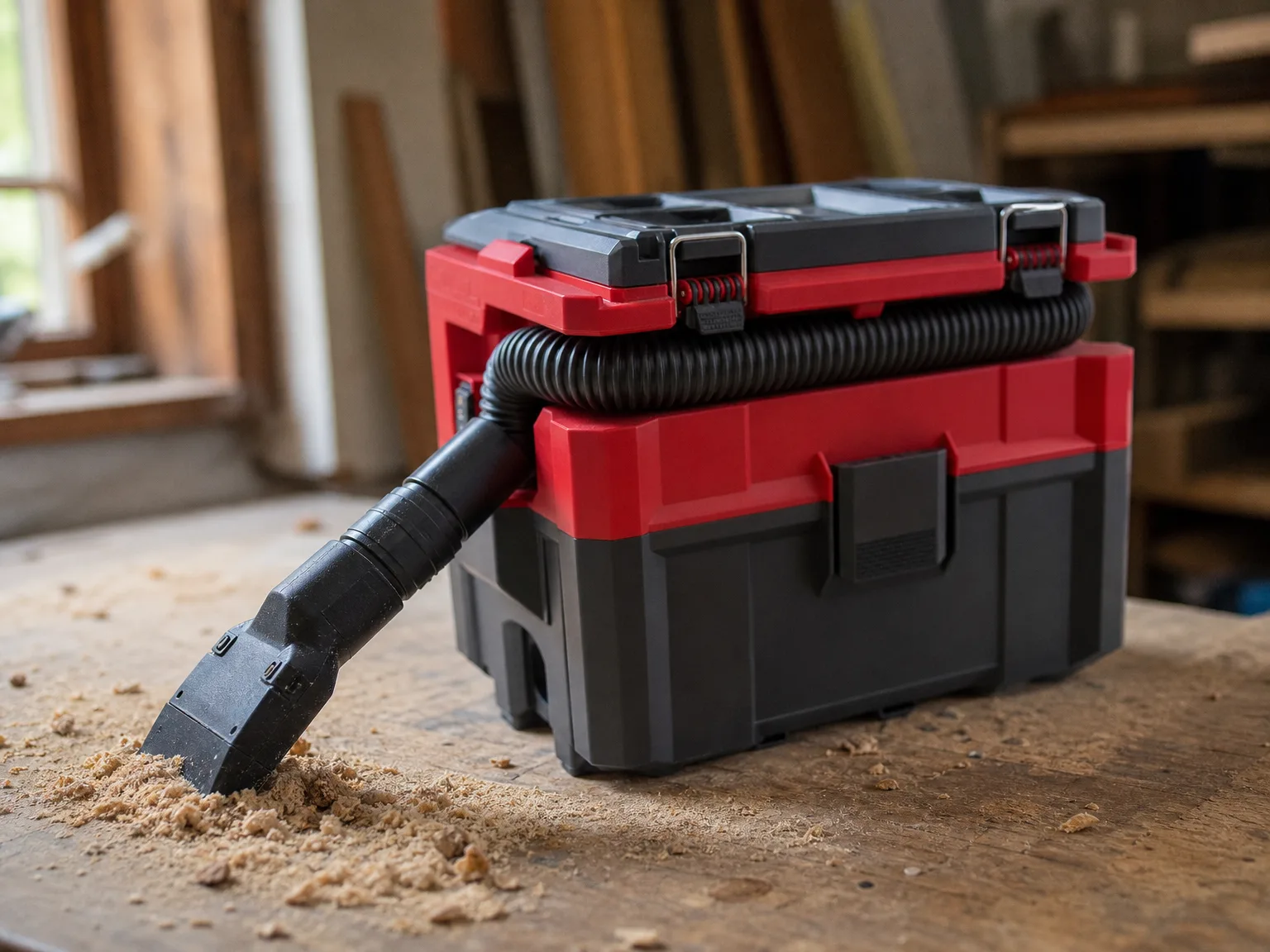
High mode is there for the mess that has been ground into a car mat or a puddle that needs moving in a hurry. Low mode is what you use the other 80 percent of the time, and owners say the same thing we found: it is plenty for crumbs, sawdust, grit, and hair on hard surfaces. Running on low roughly doubles how long a pack lasts, which turns a five-minute tool into something you can work with for a whole afternoon. Start on low, bump it up when a pass fails, and drop back down. That habit changes the machine more than any spec on the box.
Fleece Bags and a Packout Base Make the Boring Part Painless
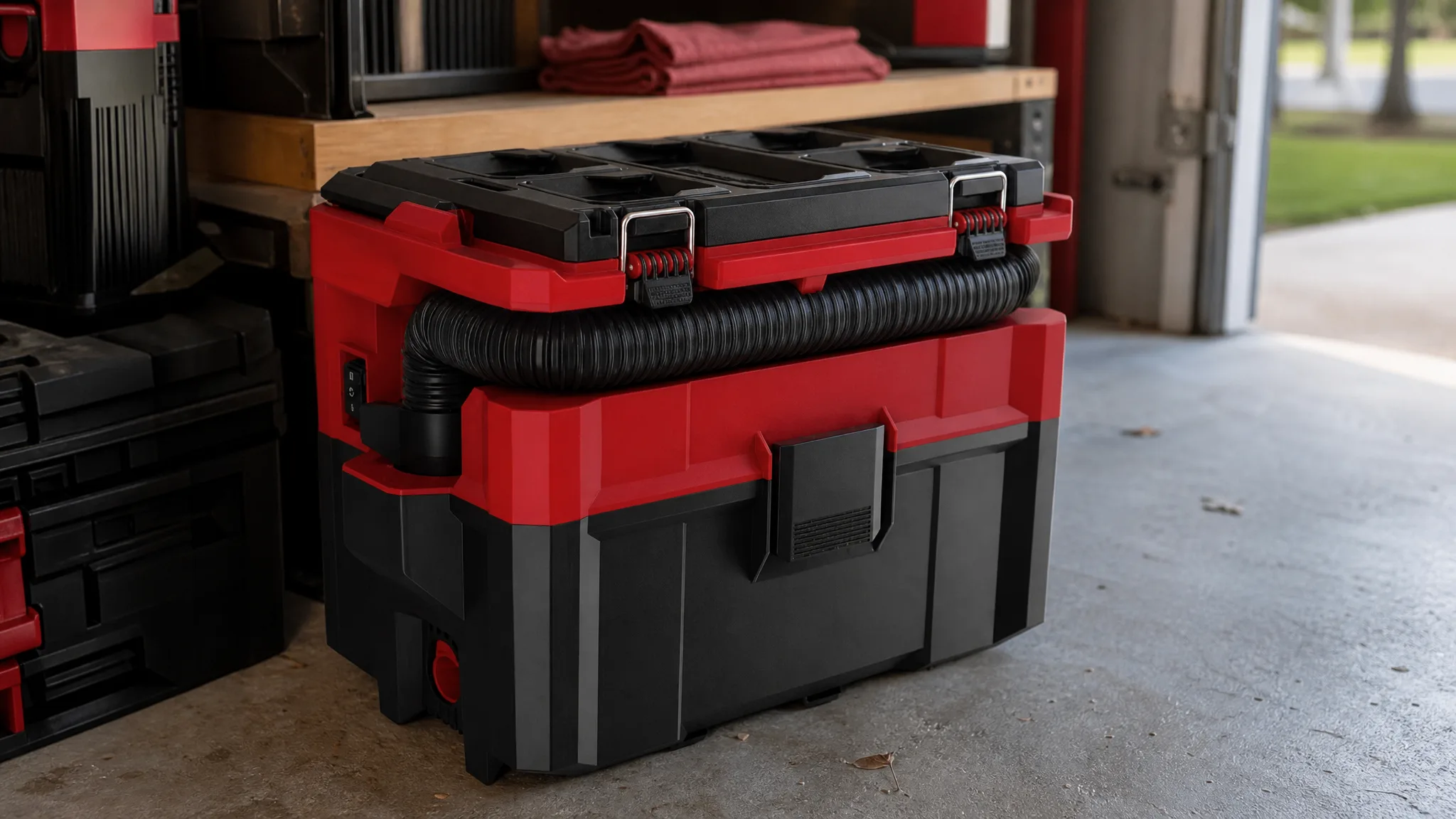
Emptying a shop vac is normally the part where you stand in a driveway getting dust blown back at you. Fleece bags remove that step. You lift the bag out, tie it, drop it in the bin, and the inside of the vac stays clean enough that the next wet job does not turn into mud. The Packout mount is the other half of the appeal. It clicks into a stack with the rest of the tool boxes, which means it stores vertically, travels in a truck bed without sliding, and takes up floor space you were already giving up. Owners bring both of these up constantly, and after six weeks we understand why.
Quiet Enough to Use Indoors Without Clearing the Room
Corded shop vacs are loud in a way that makes people schedule around them. This one is not. Owners describe it as noticeably quieter, and we ran it in a hallway at nine in the evening without anyone upstairs complaining. It is not silent, and low mode is meaningfully quieter than high, but the difference is the gap between a machine you postpone and a machine you just switch on. For anyone whose household runs on nap schedules, that gap is the actual feature.
Where It Falls Short
Two Gallons Disappears Faster Than You Think
The bin is the defining limit of this vacuum, and it shows up first on wet work. A tipped bucket or a damp footwell is fine. Anything approaching a real puddle means walking outside to empty partway through, sometimes twice. Dry debris lasts longer, though a garage floor covered in leaves and grit will still fill it in one session. Owners land on the same conclusion we did: this works as a secondary vac for small jobs, not as the machine that handles a renovation cleanup. Buy it knowing that, and the capacity stops feeling like a flaw.
It Sits Tippy Unless It Is Locked to a Packout Stack
Standing on its own on a flat floor, the vac is top-heavy enough that a tug on the hose can put it on its side. In a moving vehicle it is worse, and more than one owner has arrived somewhere to find it lying down in the back. Snapped into a Packout stack it is completely stable, which tells you what the design assumes about how you store it. If you do not own Packout boxes, plan on wedging it somewhere for transport, and pull the hose toward yourself rather than sideways when working.
High Mode Drains Batteries Quicker Than Expected
Run this on high with a 2.0Ah pack and you will get through part of a car interior before the battery quits. That is the most common complaint owners raise, and it is fair. A 5.0Ah battery or larger is close to mandatory if you want to finish a job in one go, which quietly adds to the real cost for anyone whose M18 collection is all compact packs. We kept a large pack reserved for the vac and a small one on the drill, and the problem went away. It should not require that kind of planning, but it does.
Real-World Performance
Workshop cleanup is where it feels most at home. After an afternoon of cutting, the bench top and the floor beneath cleared in a few minutes on low, with high reserved for the packed sawdust in the corners where the wall meets the slab. The fleece bag came out full and the inside of the bin was still clean. What made the difference was not suction so much as proximity: the vac was already hanging on the Packout stack two steps away, so the cleanup happened right then instead of next Saturday.
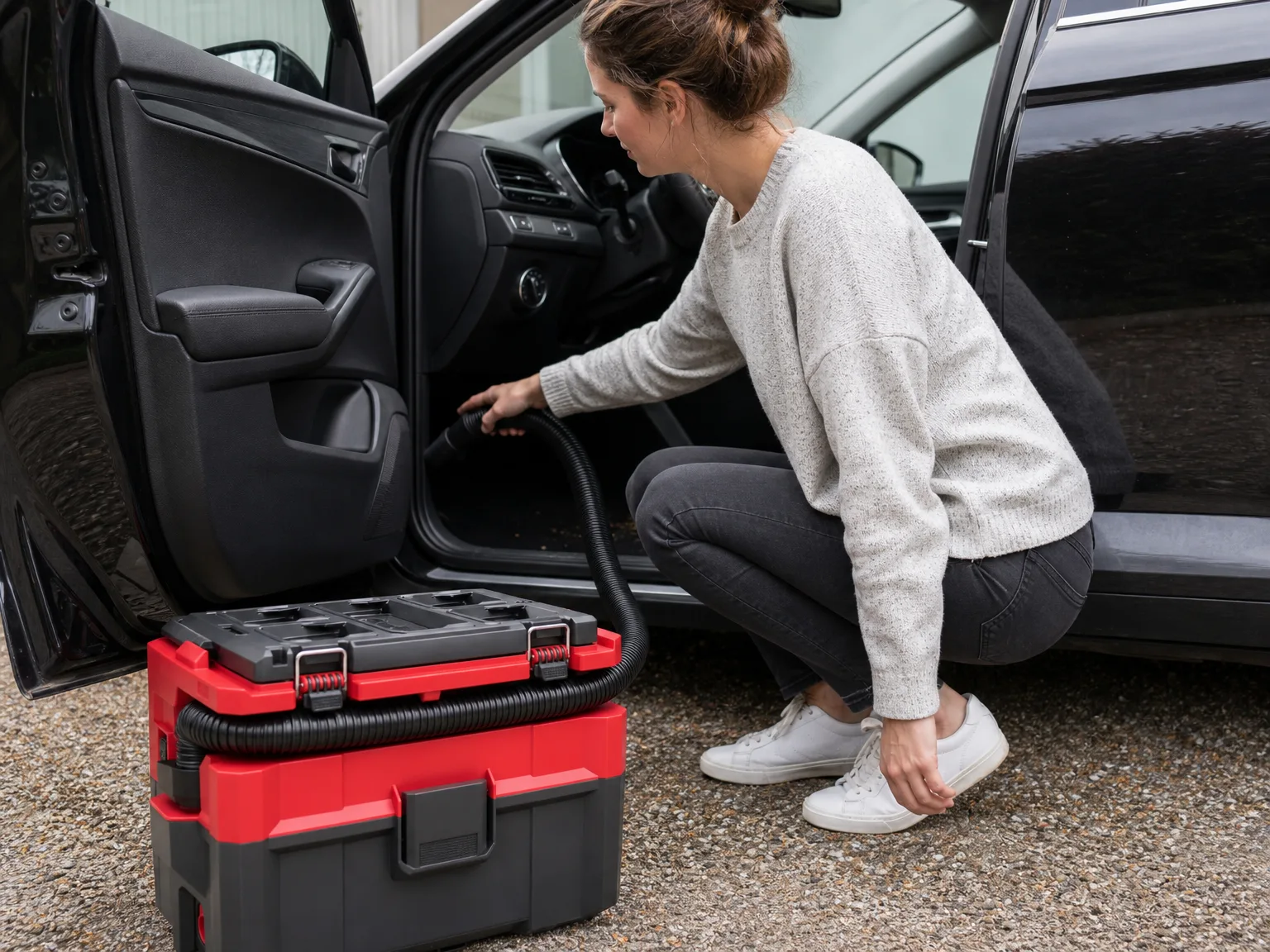
Car interiors went nearly as well, with one caveat. Grit under the seat rails, crumbs in the console, and sand in the footwell mats came up on the first pass, and having no cord to route through a door made walking around the car genuinely easy. Cargo mats with hair pressed into the pile needed high mode and slow passes, and that is where the battery drain became obvious. A full interior on a 5.0Ah pack was comfortable. The same job on a compact battery was not.
The wet test was a knocked-over mop bucket in a laundry room, maybe a gallon across tile. The vac took it without hesitating, and the floor was dry enough to walk on in under two minutes. Then came the part nobody mentions: the bin was heavy, awkward to carry through a doorway, and emptying it outside took longer than the cleanup did. It handled the spill. It would not have handled the same spill twice in a row without a break.
Everyday household messes were the surprise. Tracked-in sand at an entryway, dried mud off boots, dust along a baseboard after drilling into a wall. Because the machine is quiet on low and light to carry, those got dealt with immediately rather than waiting for a proper vacuum session. It has no powered brushroll and no interest in carpet, so this does not replace a stick vac. For the messes a household vacuum should not touch, though, it changes how quickly they get cleaned up.
How It Compares to Alternatives
Against a full-size corded shop vac, the trade is capacity for freedom. Our Vacmaster 6-gallon wet/dry review covers a machine with three times the bin and a detachable blower for clearing a garage floor, and for a renovation or a flooded basement it is the correct tool. It also stays in the corner it lives in, needs an outlet within cord reach, and is loud enough that indoor use gets scheduled. If your cleanups are big and stationary, get the bigger vac.
Against a handheld car vacuum, the Milwaukee wins on wet pickup and loses on speed of access. The ZARIMI portable cordless car vacuum we tested lives in a glovebox and takes four seconds to deploy on crumbs, which is faster than anything with a hose and a bin. It will not touch a spill, and its runtime is measured in minutes. If your messes are dry, small, and confined to a car, a handheld vacuum is the cheaper and more convenient answer.
Against the rest of the cordless field, the deciding factor is which batteries you already own. Almost every tool brand now sells a small wet/dry vac on its own platform, and none of them are different enough to justify buying into a second battery system. If you run Makita or DeWalt, buy theirs. If your garage is Milwaukee red, this is the one that fits the shelf, the charger, and the Packout boxes you already have.
Who Should Buy It
Buy this if you already run M18 tools and your messes move around. A woodworker who wants the bench clear before dinner, someone who details their own car in the driveway, or anyone maintaining a garage where the nearest outlet is behind a shelving unit gets real value here, because the expensive part of the system is already paid for. Add a 5.0Ah battery to the setup if you do not have one, and the vac becomes something you reach for daily instead of occasionally.
Look elsewhere if capacity is the point. Renovation debris, a flooded utility room, or a workshop that produces bags of waste per session all want a drum vac with a drain port, and no amount of convenience makes two gallons stretch. First-time Milwaukee buyers should also do the math honestly, since a battery and charger on top of a bare tool costs more than a capable corded machine. For daily floors inside the house, a cordless stick vacuum is still the right tool.
What this tier buys you is cordless wet and dry pickup, two power modes, fleece bag collection, and a body that stores in a Packout stack and carries with one hand. What it does not buy you is capacity, a powered brushroll, or long runtime on high. That trade is clear and, for the right garage, correct.
FAQ
Is the battery included?
No. It is sold as a bare tool, so you supply an M18 battery and charger unless you already own them. Check your cart before ordering, because this catches first-time buyers out regularly.
How much runtime can I expect?
It depends on the pack and the mode. Owners recommend a 5.0Ah battery or larger and using low power for most tasks, which stretches runtime considerably. High mode on a compact pack will not get you through a full car interior.
Is it quieter than a typical plug-in shop vac?
Yes. Owners consistently report it running much quieter than corded vacs, which makes it practical for indoor jobs or late-evening cleanups. Low mode is quieter still.
Can I use it to pick up water?
Absolutely. It handles wet messes like spills or a damp basement floor, though the small bucket means emptying it frequently during bigger water pickups.
Do I have to use the fleece bags?
No, you can run it bagless. Bags are worth it for dry debris because they make emptying clean and keep the inside of the bin usable, but wet pickup is a job for the bare bin.
Do I need Packout boxes to use it?
No, but stability improves a lot with them. Without being snapped into a stack it sits tippy on flat surfaces and in a moving vehicle, so plan on securing it during transport if you do not own Packout.
Will it handle pet hair?
On hard floors, car seats, and mats it lifts hair fine, especially on high. There is no motorized brush, so fur worked deep into carpet or woven upholstery needs loosening with a rubber brush first.
Bottom Line
This is the wet/dry vac you carry to the mess rather than the one you drag the mess toward. Fleece bags, a Packout mount, two power modes, and quiet operation on low make it the machine that actually gets used, and sharing M18 packs keeps the cost of entry low for anyone already in the system. Two things to accept before you buy: the 2-gallon bin fills quickly, and high mode wants a 5.0Ah battery or larger. If those fit how you clean, this is an easy pick. If you need a primary shop vac for heavy debris, put the money into a bigger corded machine instead.
Explore related
In this article
- At a Glance
- What We Liked
- It Runs on Batteries You Already Own
- Two Power Modes, and Low Handles Most of It
- Fleece Bags and a Packout Base Make the Boring Part Painless
- Quiet Enough to Use Indoors Without Clearing the Room
- Where It Falls Short
- Two Gallons Disappears Faster Than You Think
- It Sits Tippy Unless It Is Locked to a Packout Stack
- High Mode Drains Batteries Quicker Than Expected
- Real-World Performance
- How It Compares to Alternatives
- Who Should Buy It
- FAQ
- Bottom Line
Keep reading
How to Clean Hardwood Floors Without Damaging Them: A Busy Home Guide
Soft rollers, the right suction mode, and barely damp mops keep hardwood safe. Here's the method we use at home, plus three tools that won't scratch sealed wood.
Vacmaster VJF607PF Review: Basement Water and Shop Dust Tested
We tested the Vacmaster VJF607PF 6-gallon wet/dry shop vac on basement water, sanding dust, and a filthy car interior. Strong suction, and a tank you feel every time you empty it.
Armor All AA255W Review: Trunk Wet/Dry Cleanup After Weeks
We tested the Armor All AA255W 2.5-gallon wet/dry vac on trunk spills, car mats, and pet debris. Honest take on cord reach, crevice tools, and who should buy.