Milwaukee 0960-20 M12 FUEL Review: Car Cleanups After 5 Weeks
In this article
- At a glance
- What we liked
- Suction that does not feel like a 12V tool
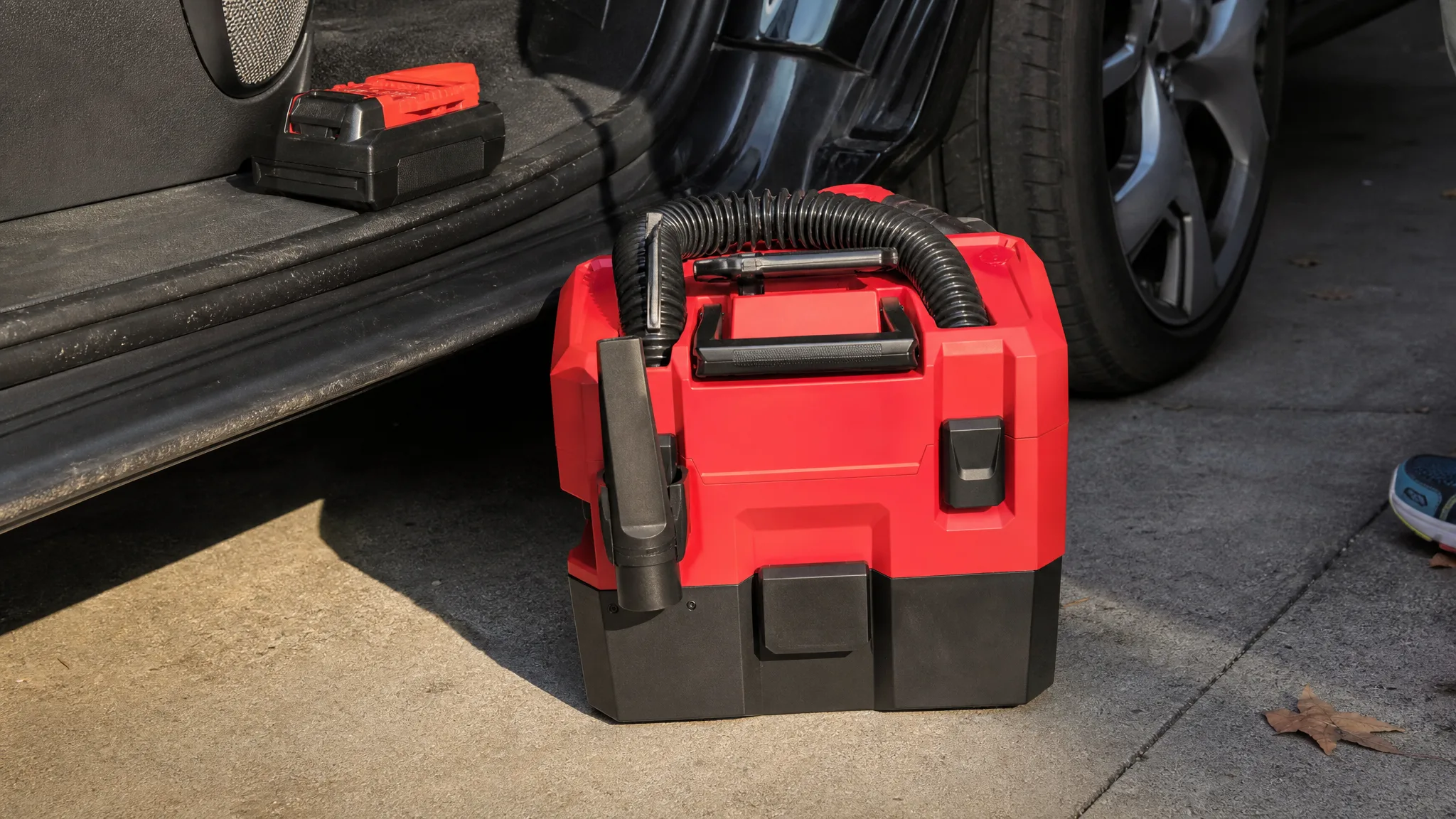
- It is small enough to live where the mess happens
- Low speed is quiet enough for indoor use
- The attachments stay clipped to the machine
- Where it falls short
- The hose is short, and you feel it constantly
- Battery life is the real ceiling
- Wet pickup needs a filter that is not in the box
- It does not lock into Packout
- Real-world performance
- How it compares to alternatives
- Who should buy it
- Frequently asked questions
- How long does the battery last on a full charge?
- What filter do I need to vacuum water?
- Does it come with a battery and charger?
- Is it loud?
- Can it replace a full size shop vacuum?
- Does it fit the Packout system?
- Bottom line
The messes that actually wreck a week are small and specific. Cereal ground into a car seat rail, sawdust drifted across a workbench, a knocked-over water bowl by the back door. The Milwaukee 0960-20 M12 FUEL is built for exactly that size of job and nothing bigger. We ran it through our standard testing process for five weeks across two cars, a garage bench, and a mudroom floor.
Verdict: Genuinely strong suction in a body small enough to grab without thinking, held back by a hose and a battery that both run out sooner than you want. 8.0/10.
Best for: Quick car interior spruce-ups and workbench touch-ups where grab-and-go speed beats runtime.
Skip if: You need to clean large areas without stopping to swap batteries.

Milwaukee
Milwaukee 0960-20 M12 FUEL Brushless Lithium-Ion Cordless 1.6 gal. Wet/Dry Vacuum (Tool-Only)
Best for
Quick car interior spruce-ups and workbench touch-ups where grab-and-go speed beats runtime needs; skip it if you need to vacuum large areas without swapping batteries.
Most owners agree this vacuum packs genuinely strong suction into a compact body that's easy to grab for small messes, but battery life is short. The trade-off: you get a portable spot cleaner, not a cordless replacement for full-size shop vacs.
Loved by buyers
- •Strong water lift for a 12V vac, handling dry debris and light wet spills without feeling underpowered.
- •Compact, stackable shape that tucks into crowded truck cabs or closets.
- •On-board accessory clip keeps both tools from wandering off between jobs.
Buyer concerns
- •The short hose forces you to pick up the unit and move it often during use.
- •Battery drains faster than many expect; even 5.0Ah packs give only brief runtimes.
- •The fuzzy filter required for wet pickup costs extra and isn't mentioned clearly on the box.
At a glance
| Specification | Detail |
|---|---|
| Type | Cordless wet/dry vacuum, sold as tool only |
| Battery platform | Milwaukee M12, brushless FUEL motor |
| In the box | Vacuum, hose, and two attachments. No battery, no charger |
| Tank capacity | 1.6 gallons |
| Dry filtration | HEPA filter included |
| Wet pickup | Needs the fuzzy filter, model 49-90-2016, sold separately |
| Speeds | Two, low and high |
| Noise | Quieter than a corded shop vac. Low speed is fine indoors without ear protection |
| Hose | Short, which is the main reason you reposition the unit mid-job |
| Accessory storage | On-board clip holds both included tools |
| Stacking | Compact stackable shape, but no Packout compatibility |
| Owner rating | 4.5 out of 5 |
What we liked
Suction that does not feel like a 12V tool
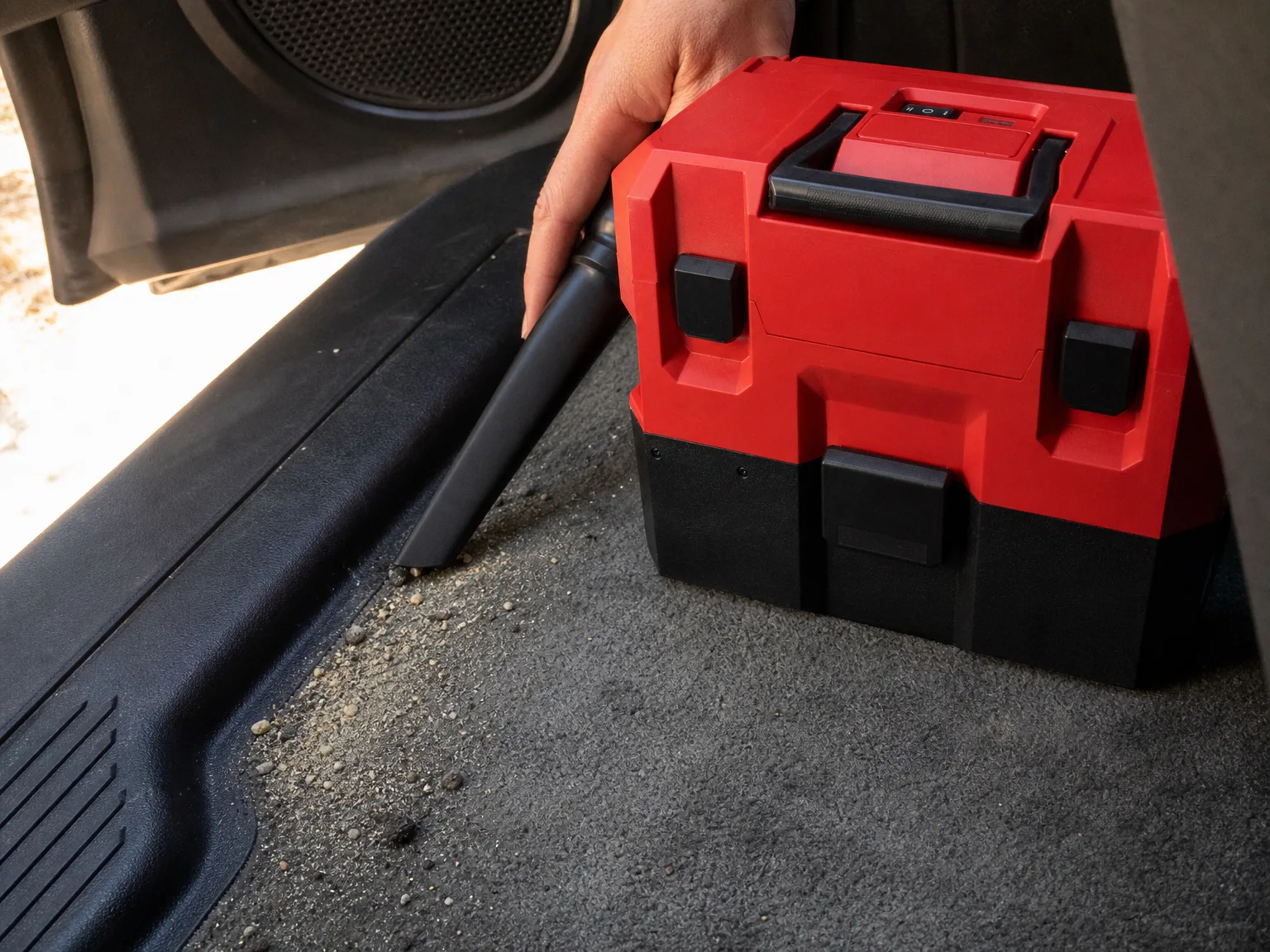
The thing most people expect from a compact battery vacuum is disappointment. This one avoids it. Water lift is strong for a 12V machine, and dry debris goes up without the motor bogging down or the nozzle skating over anything heavier than dust. Coffee grounds, dried mud off boots, the layer of grit that collects in a driver's side footwell: all of it goes on the first pass.
The practical result is that you stop pre-sweeping. On weaker handhelds you push the big pieces into a pile first, because you know the vacuum will only take the fine stuff. Here you point the nozzle at the mess and it goes. That one behavior change is most of what separates a tool you actually use from one that sits on a shelf.
It is small enough to live where the mess happens
The body is compact with a flat, stackable shape, and that geometry decides where it ends up living. It fits behind the seats of a crowded truck cab, on a shelf above a workbench, or in the awkward gap in a hall closet that nothing else fits into. A full size shop vac lives in the garage and you go to it. This one comes to you.
If you are in an apartment or a townhouse without a garage, the storage footprint is the whole argument. A wet/dry vacuum you cannot keep within arm's reach of the car is a vacuum you use twice a year. Park this one by the door and the car interior gets cleaned on a Saturday morning instead of never.
Low speed is quiet enough for indoor use
Corded shop vacs are loud in a way that ends conversations and wakes anyone sleeping upstairs. This runs noticeably quieter. On low speed you can clean an entryway without ear protection and without apologizing to the room. High speed is louder, but you only need it for wet pickup and heavier debris.
That matters more than a decibel figure suggests if you clean around a napping toddler or a nervous dog. Most small messes worth vacuuming happen at inconvenient times: a spilled snack during nap, litter tracked across tile at six in the morning. A vacuum you can run at those moments is a vacuum that gets used at those moments.
The attachments stay clipped to the machine
An on-board clip holds both included tools on the body. Small thing, real problem solved. Crevice tools disappear. They end up in a kitchen drawer, wedged under a car seat, or in a toolbox nobody remembers filling, and then the one time you need to reach between the seat and the console you spend ten minutes hunting.
Keeping them attached means the vacuum is complete every time you pick it up. Paired with the cordless design, grabbing it is a one-handed motion with nothing left behind. That is the difference between a two minute cleanup and a small project.
Where it falls short
The hose is short, and you feel it constantly
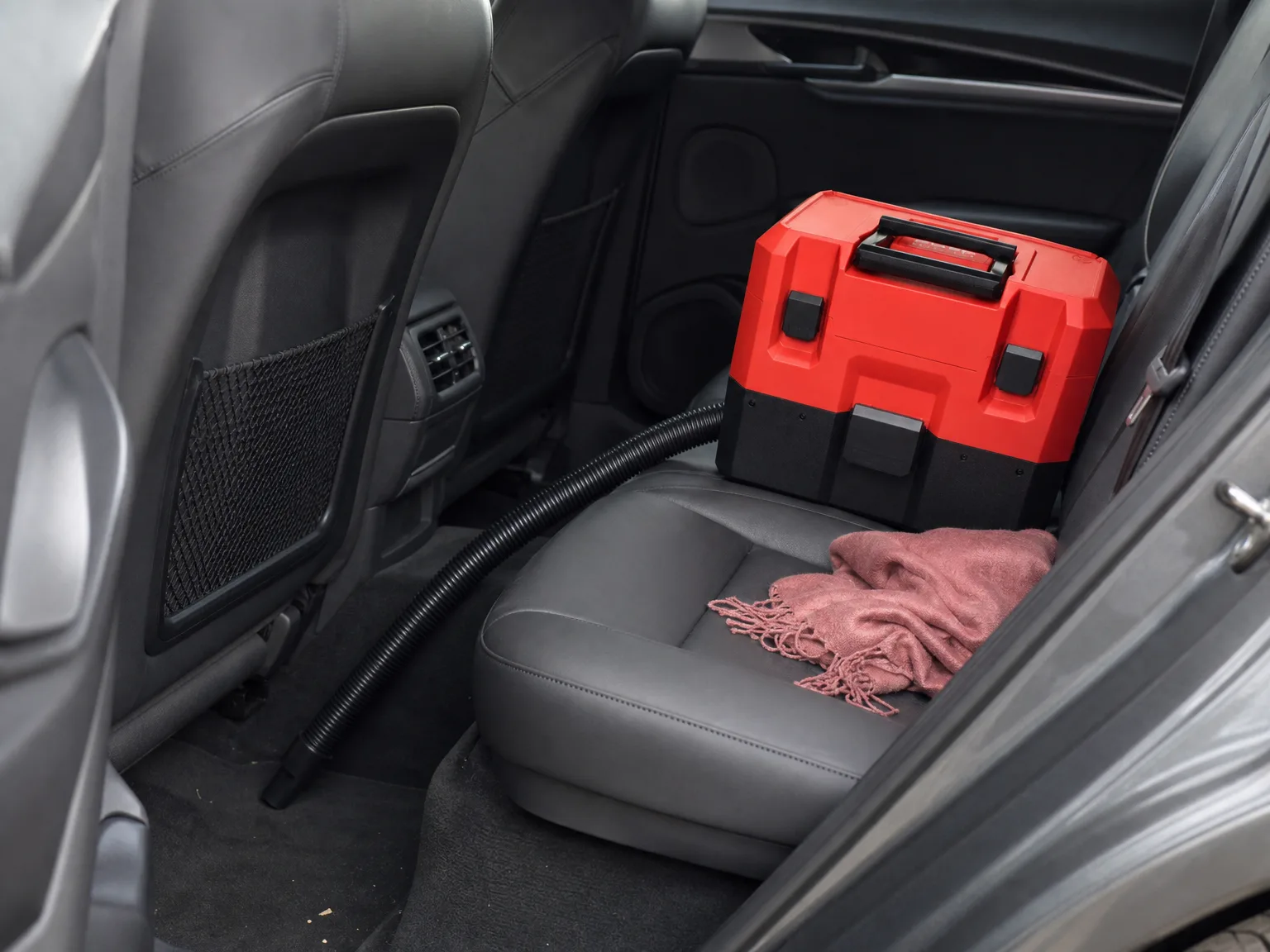
This is the complaint owners raise first, and five weeks in we understand why. The hose does not reach far enough to let the vacuum sit in one place while you work. You clean the driver's footwell, then lift the unit onto the seat. You clean the seat, then lift it again to reach the rear bench. One car interior involves more repositioning than vacuuming.
Because the machine is light, moving it is not hard. It is just a rhythm breaker. Every time you set it down you re-aim the nozzle and find your place again, and that friction adds up on the jobs it is supposedly best at. A longer hose would fix the single most annoying thing about owning it.
Battery life is the real ceiling
Runtime depends entirely on the pack you hang off it, and the honest numbers are short. Owners report a 2.0Ah pack dying in under ten minutes of continuous running. Even a 5.0Ah pack gives you brief sessions rather than an afternoon. People who detail a whole vehicle say they go through two or three 8.0Ah packs per car.
If you already own M12 tools and have a shelf of charged batteries, this is a non-issue. You swap and keep going. If this vacuum would be your entry into the platform, budget for the batteries honestly, because a single small pack turns a capable machine into a ten minute toy. Buy big packs or buy several.
Wet pickup needs a filter that is not in the box
The vacuum ships with a HEPA filter, which is the right filter for dust and the wrong one for water. It clogs quickly once things get wet. To vacuum liquid you swap in the fuzzy filter, model 49-90-2016, which is sold separately and is not made obvious on the packaging.
Several owners found this out the hard way, standing over a spill with the wrong filter installed. It is a small extra purchase, but it is a purchase, and a wet/dry vacuum that cannot do the wet half on day one is a fair thing to be annoyed about. Order the fuzzy filter at the same time as the vacuum.
It does not lock into Packout
Milwaukee's stacking storage system is a large part of why people commit to the brand, and this vacuum sits outside it. The shape stacks and stores neatly on its own, but it will not click onto a Packout tower or ride a rolling box out to a job. You carry it separately.
For home use this barely registers. For anyone who has organized a truck bed or a garage wall around Packout, it is a genuine gap in an otherwise well judged tool, and it is worth knowing before you buy rather than after.
Real-world performance
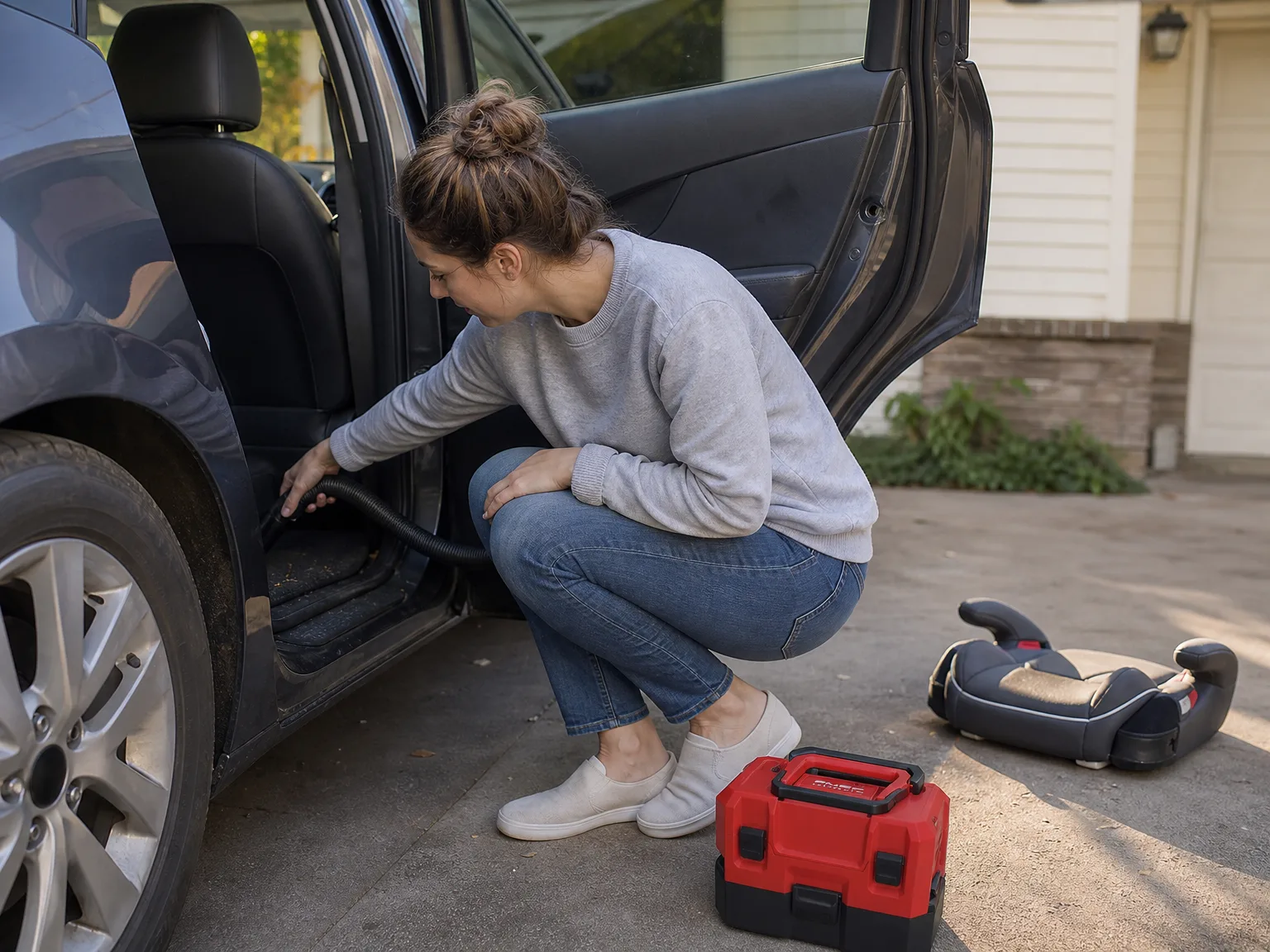
A full car interior, front to back. This is the job the vacuum is sold for, and it does it well right up until the battery quits. Footwell grit, sand in the door tracks, the crumb seam where the seat back meets the cushion: the suction handles all of it without a second pass. What it will not do is finish an entire vehicle on one small pack. Plan on swapping, or plan on doing the front seats today and the back tomorrow.
The workbench after a project. Sawdust and fine debris off a bench and the floor around it took a couple of minutes. The HEPA filter matters here, because the alternative is a cheap vac that pulls dust in one end and puffs it back out the other. Low speed was enough for the bench surface. High speed cleared the corners where dust packs into the joint between the bench and the wall.
A wet spill by the back door. With the fuzzy filter swapped in, a tipped water bowl and a puddle of melted snow came up without drama. The 1.6 gallon tank is plenty for household-scale liquid, which is to say a spill, not a flooded basement. Anything larger than a few bowls of water and you are emptying the tank more than you are cleaning.
Car seats and the crumb layer. Anyone hauling kids knows the archaeology under a car seat. Lift the seat out, run the crevice tool along the rails, and the accumulated snack layer is gone in about ninety seconds. Being able to do this in the driveway with no extension cord is the entire reason to own a cordless model rather than a corded one.
Noise around the household. We ran it indoors on low during a nap without waking anyone, which is not something we would try with a corded shop vac. High speed is a different story, so save it for the garage or for jobs where nobody is sleeping.
Emptying and maintenance. The tank pops open and dumps into a trash can. Tap the HEPA filter out regularly, because a loaded filter costs you suction long before it looks dirty. Let the fuzzy filter dry completely after wet use before it goes back in storage, or it will smell within a couple of days.
How it compares to alternatives
The obvious comparison is one platform up. Our Milwaukee M18VC2-0 review covers a 7.5 liter, 69 decibel vacuum on the M18 batteries, and the differences are exactly what you would guess. Bigger tank, longer runtime from bigger packs, more machine to carry and store. If you already own M18 tools, that is the one to buy. If your battery shelf is M12, the 0960-20 lets you skip a second platform entirely.
Milwaukee's M18 FPOVCL is the other in-house option, with a 2.5 gallon tank and Packout compatibility, at 87 decibels. It is louder and larger, and it fixes the stacking complaint. Owners use it for car detailing and RV cleanups where the extra capacity earns the extra bulk.
Outside Milwaukee, the ReliaRoads RCSV-20 runs a 2.6 gallon tank on DEWALT 20V batteries, which is the sensible pick if your cordless tools happen to be yellow rather than red. And if you want a corded machine that never needs a battery conversation at all, the WORKSHOP WS0255VA covers similar territory for less money as long as an outlet is nearby.
If you need to clean a whole vehicle or a full garage floor in one uninterrupted session, get one of the larger tanks instead. The 0960-20 is a spot cleaner, and asking it to be a shop vac is how people end up disappointed with a good tool.
Who should buy it
Buy it if you already own M12 batteries and you want a vacuum that lives in the car, the hall closet, or above the workbench. The people who love this machine are the ones who use it in short bursts: a footwell before a school run, a bench after a weekend project, a spill before it soaks into the grout. For that pattern the compact body and the instant grab-and-go beat every spec on the sheet.
Look elsewhere if you would be buying into M12 just for this, or if the jobs you have in mind are large. Vacuuming a big area means swapping batteries, and swapping batteries you had to buy separately makes an inexpensive tool an expensive one. Bigger rooms and bigger messes want a bigger tank and a longer hose.
What you get here is a compact vacuum with suction that punches above its voltage, filtration good enough for fine dust, quiet operation on low, and a shape that stores anywhere. What you give up is runtime, hose reach, Packout stacking, and the ability to do wet pickup until you buy one more filter.
Frequently asked questions
How long does the battery last on a full charge?
It varies more than most spec sheets admit, because runtime is set by the pack rather than the tool. A 2.0Ah battery can run out in under ten minutes of continuous use. Owners detailing a whole vehicle report going through two or three 8.0Ah packs per car. Treat large capacity batteries as part of the purchase, not an upgrade.
What filter do I need to vacuum water?
The fuzzy filter, model 49-90-2016, which is sold separately. The HEPA filter that comes in the box clogs quickly once it gets wet, so swap it out before any liquid cleanup and keep the two filters stored apart so you never grab the wrong one.
Does it come with a battery and charger?
No. This is the tool-only listing, so you supply your own M12 battery and charger. Kit versions that bundle them exist if you are new to the platform, and buying the kit is usually cheaper than buying the pieces separately.
Is it loud?
Noticeably less than a corded shop vac. Low speed is quiet enough for indoor cleanup without ear protection, which is what makes it usable during a nap or early in the morning. High speed is louder, and you generally only need it for wet pickup and heavier debris.
Can it replace a full size shop vacuum?
No, and it is not trying to. The 1.6 gallon tank, the short hose, and the battery runtime all point at the same use case: fast cleanups in small spaces. Keep a corded shop vac for garage floors, project cleanup, and anything involving real volumes of water.
Does it fit the Packout system?
It does not. The shape is compact and stacks reasonably on a shelf, but it will not lock into a Packout stack or ride on a rolling box. If organized transport matters to you, look at the M18 FPOVCL instead.
Bottom line
The Milwaukee 0960-20 M12 FUEL is a good spot cleaner that knows what it is. Suction is strong enough that you stop pre-sweeping, the body stores where you actually need it, and low speed is quiet enough to use inside a sleeping house. Go in expecting short sessions, buy the largest M12 packs you can and the fuzzy filter alongside the vacuum, and it will earn its place. If your jobs are whole cars or whole garages in one go, read the M18VC2-0 review before you decide.
Ready to buy?
Milwaukee 0960-20 M12 FUEL Brushless Lithium-Ion Cordless 1.6 gal. Wet/Dry Vacuum (Tool-Only)
Explore related
In this article
- At a glance
- What we liked
- Suction that does not feel like a 12V tool
- It is small enough to live where the mess happens
- Low speed is quiet enough for indoor use
- The attachments stay clipped to the machine
- Where it falls short
- The hose is short, and you feel it constantly
- Battery life is the real ceiling
- Wet pickup needs a filter that is not in the box
- It does not lock into Packout
- Real-world performance
- How it compares to alternatives
- Who should buy it
- Frequently asked questions
- How long does the battery last on a full charge?
- What filter do I need to vacuum water?
- Does it come with a battery and charger?
- Is it loud?
- Can it replace a full size shop vacuum?
- Does it fit the Packout system?
- Bottom line
Keep reading

How to Get Pet Hair Out of Carpet and Upholstery: A Pet Parent's Guide
Cat and dog hair woven into the rug and sofa never fully comes out on the first pass. Here is the step-by-step routine we tested in real homes to fix that.
How to Clean Hardwood Floors Without Damaging Them: A Busy Home Guide
Soft rollers, the right suction mode, and barely damp mops keep hardwood safe. Here's the method we use at home, plus three tools that won't scratch sealed wood.
BLACK+DECKER Handheld Review: Wall Dock Ready After Kitchen Weeks
We tested the BLACK+DECKER cordless handheld with wall mount on hallway crumbs and kitchen spills. Honest take on the always-ready dock, hold-down button, and who should buy.