How to Get Pet Hair Out of Carpet (A Pet Parent's Guide)
In this article
- Quick Answer
- Before You Start
- Step-by-Step: Getting Embedded Pet Hair Out of Carpet
- 1. Loosen the hair before you vacuum
- 2. Vacuum wall-to-wall carpet with a corded upright
- 3. Keep up with daily passes on rugs and hard floors
- 4. Go wet when hair is bonded to a stain or odor lingers
- 5. Let everything dry fully and brush the pile back into place
- 6. Set a weekly rhythm instead of chasing single deep cleans
- Common Pitfalls
- Skipping the pre-loosen step
- Using too much water on carpet
- Ignoring the brush roll
- Rushing with one fast pass
- Matching the wrong tool to the carpet type
- FAQ
- How often should I deep-clean carpet in a home with pets?
- Can I use a wet/dry vacuum directly on thick carpet?
- Why does hair reappear on my carpet after vacuuming?
- Is a bagged or bagless vacuum better for pet hair?
- Do robot vacuums pick up embedded pet hair from carpet?
- Will baking soda help loosen embedded pet hair before vacuuming?
- Final Thoughts
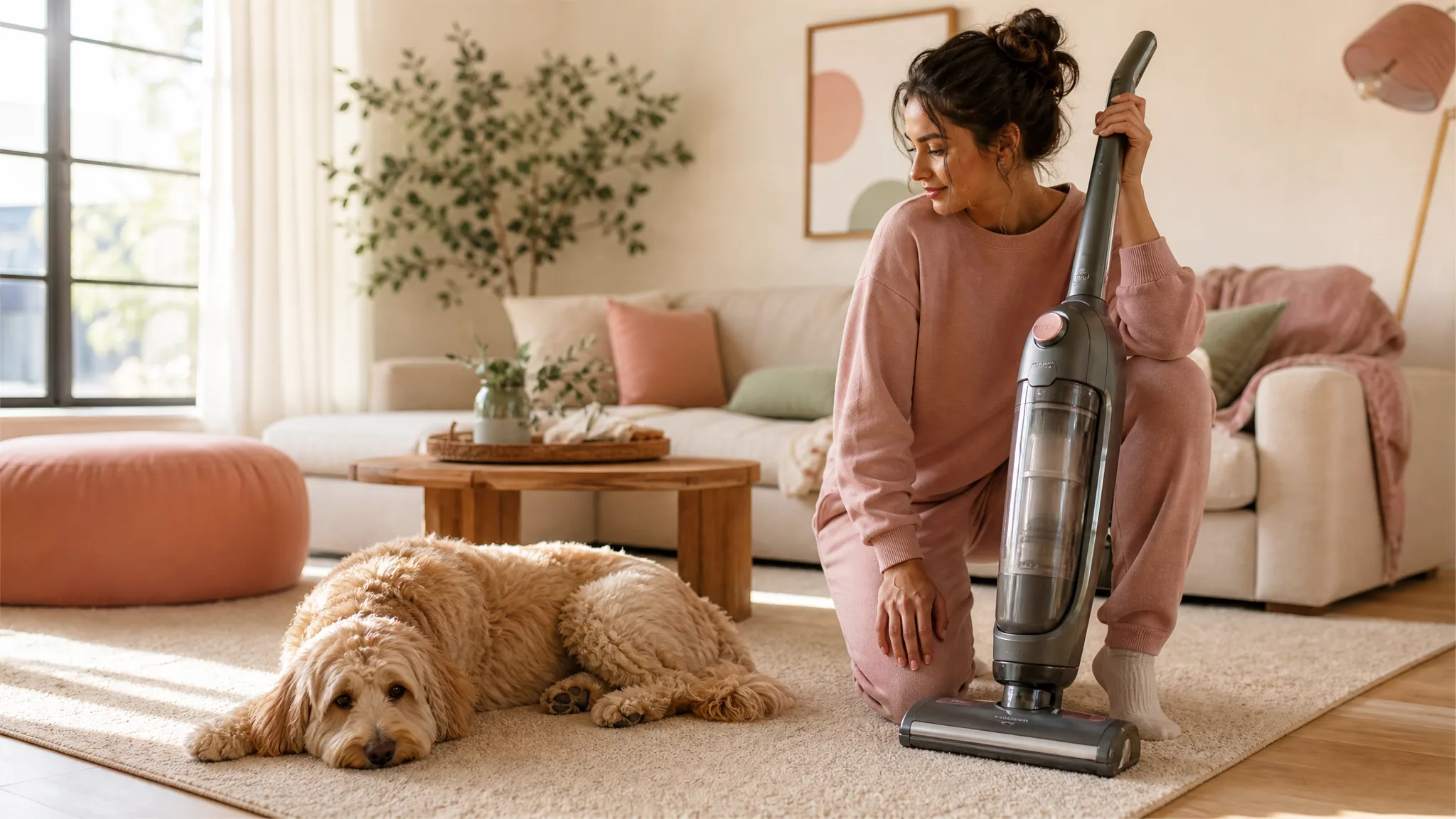
You vacuum the living room, stand back, and the carpet still looks dusted with dog hair. That is not a machine problem so much as a physics one: loose hair on top of carpet lifts easily, but hair that has worked down into the pile wraps around individual fibers and locks in place. A single fast pass barely grazes it.
Homes with shedding pets have found that dry methods combined with wet ones in a specific order actually clear wall-to-wall carpet and area rugs effectively.

Quick Answer
- Loosen embedded hair first with a rubber squeegee or a slightly damp rubber glove before you vacuum at all.
- A corded upright with a de-tangling brush roll pulls buried hair out of thick, wall-to-wall carpet best.
- Save a cordless stick for quick daily passes on rugs and hard floors, not deep-pile carpet.
- Wet extraction helps on area rugs and hard floors, but it is not a substitute for carpet shampooing.
- Clear the brush roll and empty the bin often. Suction drops fast once hair wraps around the bristles.
Before You Start
You do not need a full closet of gear, just the right tool for each surface. Keep a rubber squeegee or a damp rubber glove on hand for the loosening step below. For the actual pickup, a corded upright vacuum with a motorized brush bar handles thick carpet better than most cordless models. A lightweight cordless stick earns its keep for the daily touch-ups between deep cleans, and a wet/dry vacuum is worth having if hair keeps bonding to a stain or a lingering pet odor. An old dry towel and a stiff carpet brush round out the kit for the last step.
Step-by-Step: Getting Embedded Pet Hair Out of Carpet
1. Loosen the hair before you vacuum
Run a rubber squeegee or a slightly damp rubber glove across the carpet in one direction, using light pressure. Rubber grips hair that suction alone cannot reach because the strands are still wrapped around carpet fibers, not sitting loose on top. This loosens deeply set fur more effectively than an extra vacuum pass.

2. Vacuum wall-to-wall carpet with a corded upright
After loosening, use a corded upright with a de-tangling brush bar, moving in slow, overlapping passes rather than one quick sweep. The Dyson Ball Animal 3 is known for its Motorbar head; owner feedback describes it as staying clear through extended use and pulling dander and buried hair out of thick pile that looks clean from the top. This vacuum is recommended specifically for wall-to-wall carpet rather than quick daily passes. Owner feedback notes that ball steering makes it easy to maneuver around furniture, though its weight can strain shoulders during long sessions, and the hose is somewhat stiff when sliding it back into the body.

Dyson
Dyson Ball Animal 3 Upright Vacuum, Corded, 290AW, De-tangling Motorbar Cleaner Head for All Floors, 3 Suction Modes
Best for
Pet owners and long-haired households who want top-tier upright suction and a truly tangle-free brush roll; skip if you need a lightweight vacuum, a retractable cord, or easy stair-hose work without the fight.
The Motorbar head genuinely stays tangle-free through months of long human and pet hair, and the suction pulls dirt from carpets that looked spotless. The trade-offs are weight that strains shoulders on plush carpet, a stiff hose that resists sliding back into place, plastic bin-release and cord hooks that feel thin at this price, and a cord you wind by hand every single time.
Loved by buyers
- •Motorbar cleaner head stays free of wrapped hair even with two long-haired people and shedding dogs
- •suction pulls buried dirt and dander from thick rugs on the first pass
- •stair tool cleans carpeted steps without lifting the whole vacuum
Buyer concerns
- •heavy to push on plush carpet, with several owners reporting neck and shoulder pain after a full session
- •wand and hose are stiff and jam when sliding back into the body
- •bin-release mechanism and cord hooks are thin plastic that does not match the price
3. Keep up with daily passes on rugs and hard floors
A corded upright is not ideal for daily use, so a cordless stick vacuum fills the gap between deep cleans. The Shark Stratos, with its dual roller head, is cited in owner feedback for picking up kibble and hair in one pass without scattering it, and published specs describe a Clean Sense IQ sensor that increases suction only where dirt is detected. This vacuum is best suited for hard floors and low-pile area rugs, not thick wall-to-wall carpet. Owner feedback puts real runtime closer to 35 minutes than the advertised 60, so a quick recharge may be needed for larger areas.

Shark
Shark Stratos Cordless Vacuum with Clean Sense IQ and Odor Neutralizer, DuoClean Powerfins HairPro, MultiFLEX®, Includes Crevice Tool & Anti-Allergen Brush, Up To 60 Minute Runtime, Ash Purple, IZ862H
Best for
Hard-floor homes with pets that want a daily cordless with smart suction and a fresh scent; skip for wall-to-wall carpet, large homes needing 60-plus minutes, or if battery replacement cost bothers you.
The Stratos wins over hard-floor households with dual rollers that grab Cheerios and pet hair in one pass and a Clean Sense mode that saves battery by only ramping up where dirt actually hides. Real runtime is closer to 35 minutes, OEM batteries can fail completely within a year, and the nearly identical fold and empty buttons lead to accidental dust dumps on the floor.
Loved by buyers
- •dual roller head picks up kibble, litter, and hair on tile and hardwood without scattering
- •Clean Sense IQ infrared sensor boosts suction only on dirty patches, stretching battery life
- •MultiFLEX wand bends to reach under low couches and folds flat for closet storage
Buyer concerns
- •real runtime is 35 to 40 minutes, not the advertised 60
- •OEM battery can die completely within a year and quality replacements are pricey
- •fold button and dust cup release are nearly identical and easy to press by mistake
4. Go wet when hair is bonded to a stain or odor lingers
Dry vacuuming will not remove hair matted into spills or old accident spots. A wet/dry vacuum like the Bissell CrossWave Pet Pro is, per published specs, meant for tile and bound-edge area rugs, with a built-in hair strainer that owner feedback says keeps the roller clear even during heavy shedding. However, it is not a carpet shampooer and is designed for hard floors and area rugs, not thick wall-to-wall carpet. Owner feedback notes it leaves about an inch of gap along baseboards that requires manual wiping, and the tank, roller, and filter need rinsing after each use to prevent odors.

Bissell
Bissell Crosswave Pet Pro Wet Dry Vacuum and Mop, Tangle-Free Brush Roller for Pet Hair, All-in-One Deep Cleaning for Hard Floors and Area Rugs, 2306A
Best for
Pet owners with mostly hard floors who want to combine daily vacuuming and light mopping into one pass, not for anyone expecting carpet shampooing or wanting minimal post-cleanup.
This CrossWave moves the stick vacuum needle for multi-pet tile and laminate homes by combining a vacuum and mop pass in one go, with a hair strainer that keeps the roller clear even in German Shepherd households. The mop function fades relative to a traditional mop for weekly deep scrubs, and the machine demands a thorough multi-step rinse after every single use.
Loved by buyers
- •Combines vacuuming and mopping in one pass, cutting daily floor time roughly in half for hard-floor pet homes
- •Tangle-free roller and built-in hair strainer handle heavy shedding without stopping to clear jams
- •25-foot cord and swivel head cover kitchen, dining, and living room without re-plugging
Buyer concerns
- •Roller cannot reach the last inch at baseboards; a separate cloth pass along edges is still needed
- •Every session ends with a multi-step cleanup of tanks, roller, and filter or the machine smells and struggles next time
- •Going too fast leaves streaks; the dirty brush can fling muddy water back onto clean floors during a heavy session
5. Let everything dry fully and brush the pile back into place
If a wet method was used on a rug, allow it to air dry completely before walking on it again. Trapped moisture in a rug pad can cause odors and mildew, and using a small fan or opening a window can speed drying. Finish by running a stiff carpet brush against the grain to lift the flattened pile back into shape, which improves the look and feel beyond vacuuming alone.
6. Set a weekly rhythm instead of chasing single deep cleans
One thorough session resets a room, but shedding continues daily. A short daily or every-other-day pass with a cordless stick on high-traffic rugs, combined with the full loosen-and-vacuum routine once a week on carpeted rooms, helps prevent hair buildup. Homes with multiple shedding pets may need this weekly session every four or five days, especially during spring and fall shedding seasons.
Common Pitfalls
Skipping the pre-loosen step
Vacuuming without loosening hair first means fighting fibers still wrapped tightly around carpet strands, often requiring multiple passes for results that loosening achieves in one.
Using too much water on carpet
Oversaturating carpet, even with a wet/dry vacuum meant for hard floors, pushes moisture into the pad where it cannot evaporate, leading to musty odors or mold. Using less water with more passes is safer.
Ignoring the brush roll
A brush bar wound tight with hair loses suction quickly, sometimes within a single room. Regularly removing and clearing the roller by hand is important for heavy shedders.
Rushing with one fast pass
Slow, overlapping passes allow the brush roll and suction to lift hair out of the pile instead of skimming the surface.
Matching the wrong tool to the carpet type
Low-pile carpet and thick shag require different tools. Cordless sticks designed for hard floors skim over deep pile without engaging it, while heavy corded uprights can be difficult to push on thin, tightly woven rugs. Matching the vacuum's power and tool to pile depth is essential.
FAQ
How often should I deep-clean carpet in a home with pets?
Once a week for the full loosen-and-vacuum routine is realistic for most shedding dogs and cats. High-traffic rooms or homes with multiple pets may need it every four or five days during heavy shedding seasons.
Can I use a wet/dry vacuum directly on thick carpet?
Most wet/dry vacuums, including the CrossWave Pet Pro, are designed for hard floors and area rugs, not deep-pile carpet. Using one on thick wall-to-wall carpet risks trapping water in the pad, so dry methods are recommended there.
Why does hair reappear on my carpet after vacuuming?
Static electricity in carpet fibers pulls loose hair back down after vacuuming, and hair wrapped around fibers below the surface works its way back up as you walk on it. The pre-loosen step reduces this by pulling hair out from the root of the fiber instead of just skimming the top.
Is a bagged or bagless vacuum better for pet hair?
Either works if the brush roll and filtration are designed for pet hair. Bagless models make it easier to see when the bin is full and suction is reduced, which is important for daily use.
Do robot vacuums pick up embedded pet hair from carpet?
Most robot vacuums handle surface hair on low-pile carpet and hard floors well but rarely match the suction of a corded upright on thick, embedded fur. Robots are best for maintenance between deeper weekly cleans, not replacements.
Will baking soda help loosen embedded pet hair before vacuuming?
Baking soda absorbs odor but does not loosen hair wrapped around carpet fibers. The rubber squeegee or damp glove method is more effective for loosening hair, while baking soda is better used separately for odor control.
Final Thoughts
Removing pet hair fully from carpet depends more on matching the method to the surface than on buying one perfect machine. Loosen hair first, use a corded upright with a de-tangling brush bar on thick carpet, reserve the cordless stick and wet/dry vacuum for hard floors and rugs, and clean the brush roll regularly. For a broader lineup of picks by budget and floor type, see the roundup of cordless vacuums for pet hair.
Ready to buy?
Dyson Ball Animal 3 Upright Vacuum, Corded, 290AW, De-tangling Motorbar Cleaner Head for All Floors, 3 Suction Modes
In this article
- Quick Answer
- Before You Start
- Step-by-Step: Getting Embedded Pet Hair Out of Carpet
- 1. Loosen the hair before you vacuum
- 2. Vacuum wall-to-wall carpet with a corded upright
- 3. Keep up with daily passes on rugs and hard floors
- 4. Go wet when hair is bonded to a stain or odor lingers
- 5. Let everything dry fully and brush the pile back into place
- 6. Set a weekly rhythm instead of chasing single deep cleans
- Common Pitfalls
- Skipping the pre-loosen step
- Using too much water on carpet
- Ignoring the brush roll
- Rushing with one fast pass
- Matching the wrong tool to the carpet type
- FAQ
- How often should I deep-clean carpet in a home with pets?
- Can I use a wet/dry vacuum directly on thick carpet?
- Why does hair reappear on my carpet after vacuuming?
- Is a bagged or bagless vacuum better for pet hair?
- Do robot vacuums pick up embedded pet hair from carpet?
- Will baking soda help loosen embedded pet hair before vacuuming?
- Final Thoughts
Keep reading
5 Best Lightweight Cordless Vacuums for Small Homes (2026)
We compared five lightweight cordless vacuums in apartments, dorms, and single-level homes to find the ones that clean fast, store small, and are actually worth the money.
Dyson V8 vs V11 Origin: Is the Upgrade Worth It?
The V11 Origin promises more suction and double the run time over the V8. We compared both head to head on real owner data to see if the step-up price is worth paying.
5 Best Budget Cordless Vacuums Under $200 (2026)
We compared five solid cordless stick vacuums under $200 based on owner feedback with pets and kids to find the ones worth buying without the flagship price.