DEWALT 20V MAX Hand Vacuum Review: Car and Workshop Messes Tested
In this article
- At a glance
- What we liked
- The suction holds instead of fading
- Wet and dry with nothing to swap
- The hose gets into places the body cannot
- It runs on batteries you probably own
- Where it falls short
- A small battery makes it a ten-minute vacuum
- The half-gallon tank fills fast with liquid
- Side exhaust can scatter what you are trying to collect
- The wet filter question
- Real-world performance
- How it compares to alternatives
- Who should buy it
- Frequently asked questions
- How long does it run on a single charge?
- Does it come with any attachments?
- Can the filter handle wet debris without losing suction?
- Does it include a battery and charger?
- Is it loud?
- Will it clean up a large spill?
- Bottom line
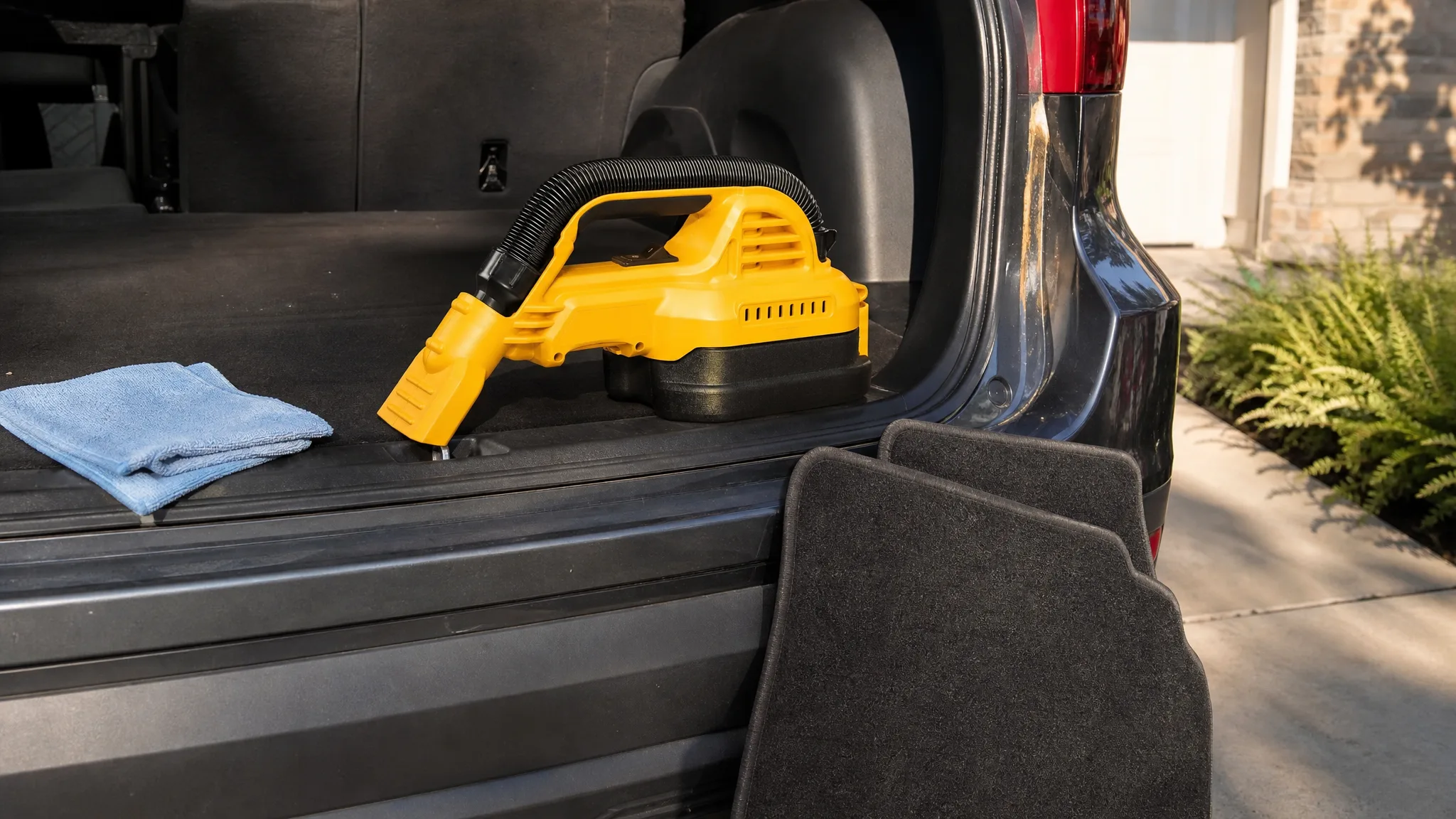
A travel mug tipped over in the passenger footwell on a Tuesday morning. That is the mess a stick vacuum cannot touch and a full-size shop vac is too much trouble to drag out for. The DEWALT 20V MAX hand vacuum lives in that gap: a cordless wet/dry handheld that runs on the same batteries as your drill. We put it through car interiors, workbench sawdust, and rug spills using our standard testing process.
Verdict: A compact shop vac in handheld form, with strong sustained suction on dry mess and small spills, as long as you feed it a large battery. 8.3/10.
Best for: Quick car cleanups and small workshop messes, especially if you already own DEWALT 20V tools.
Skip if: You want a lightweight whole-house stick vacuum, or you mop up large liquid spills often.

DEWALT
DEWALT 20V MAX Hand Vacuum, Cordless, for Wet or Dry Surfaces, 1/2-Gallon Tank, Washable Filter, Portable, Bare Tool Only (DCV517B)
Best for
Great for quick car cleanups and small workshop messes, especially if you already use DeWalt 20V tools; skip it if you need a lightweight, whole-house stick vacuum or deal with large liquid spills often.
It pulls strong, sustained suction that handles dry messes and small spills with authority. The main compromise you’ll make is its heft and battery thirst; it works best with larger batteries and feels more like a compact shop vac than a grab-and-go dust buster.
Loved by buyers
- •Clears sawdust, pet hair, and lady bugs without losing suction.
- •The detachable hose reaches tight spots like between car seats.
- •Wet/dry capability handles a spilled drink on the rug or dry crumbs on the workbench equally well.
Buyer concerns
- •Side exhaust vents can scatter light dust if you hold it at the wrong angle.
- •Smaller 2Ah batteries drain in about 10 minutes; you'll want at least 5Ah for practical runtime.
- •The half-gallon tank fills fast with liquids, making it awkward for larger spills.
At a glance
| Specification | Detail |
|---|---|
| Model | DCV517B |
| Type | Cordless handheld rated for wet or dry pickup |
| Battery platform | DEWALT 20V MAX, sold separately (bare tool) |
| Tank | 1/2 gallon, same tank for wet and dry |
| Filter | Washable HEPA filter included |
| Runtime with 2Ah | Around 10 minutes |
| Runtime with 5Ah | Close to 45 minutes |
| Runtime with 9Ah | Roughly an hour |
| Hose | Detachable, reaches into narrow gaps |
| Attachments | None in the box. Standard 1.2 inch shop vac accessories fit |
| Exhaust | Side vents |
| Owner rating | 4.5 out of 5 |
What we liked
The suction holds instead of fading
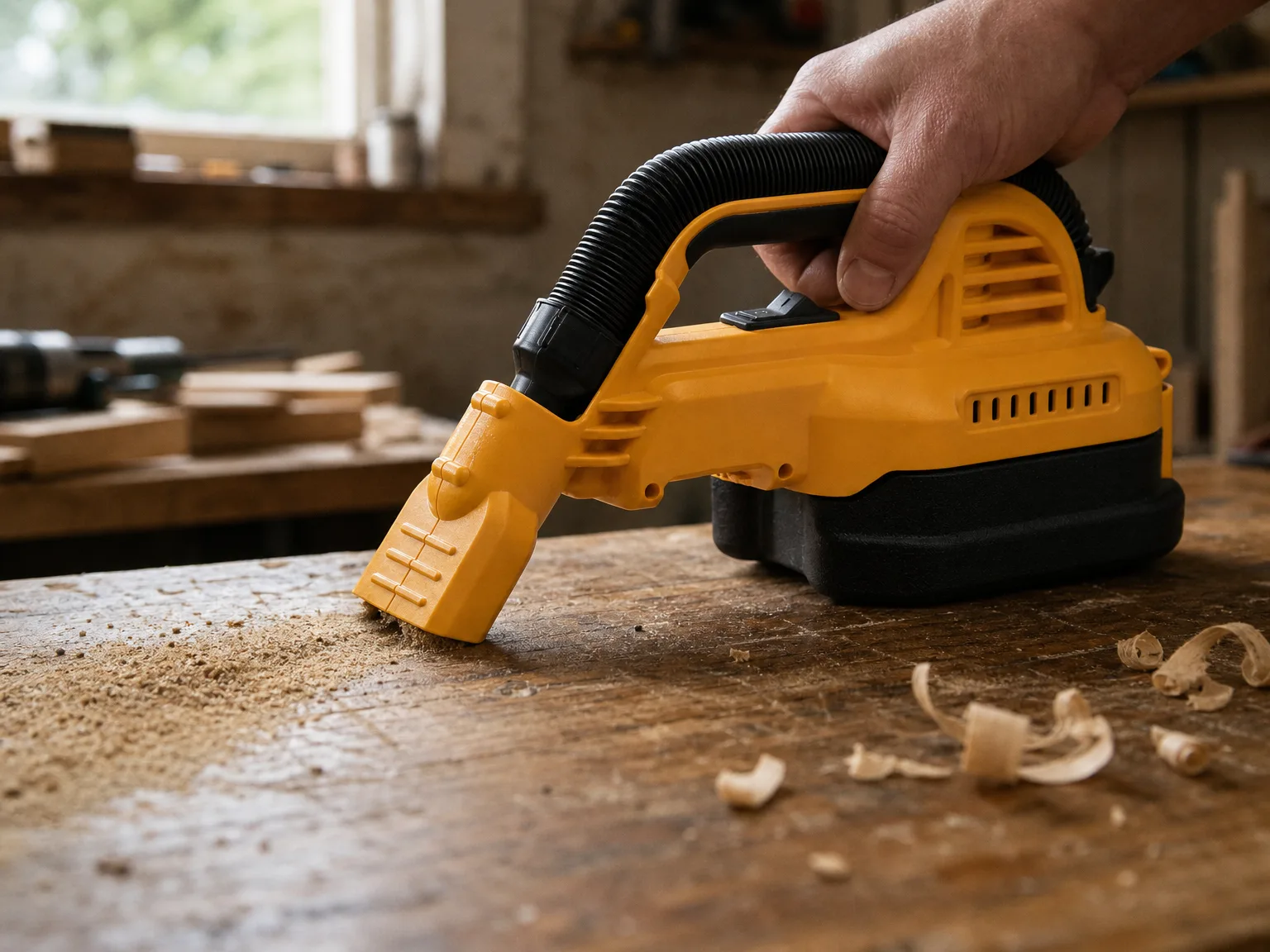
Plenty of handhelds start strong and give up once the bin is a third full. This one keeps pulling. Sawdust off a workbench, pet hair worked into a car seat, and the small dead bugs that collect on a windowsill all went in at the same rate whether the tank was empty or nearly full.
The reason is that this is built like a small shop vac rather than a scaled-up dust buster. There is no thin brush roll or narrow airway to choke. You get raw airflow through a wide port, which is why it handles the gritty, heavy debris that makes lighter handheld vacuums stall out.
Wet and dry with nothing to swap
A spilled drink on a rug and crumbs on the counter are the same job here. You do not change a filter, empty a chamber, or flip a switch between them. That matters more than the spec sheet suggests, because the reason spills sit there for an hour is usually that dealing with them requires setup.
We used it on a knocked-over water glass, a puddle in the car footwell, and a trail of potting soil in the same afternoon. The tank took all three. Liquid volume is where the limits show up, and we get into that below, but for the size of spill that happens in a normal kitchen, it is genuinely one grab and done.
The hose gets into places the body cannot
The hose detaches, and that single feature is what makes this work in a car. The gap between a seat and the center console, the rails under the seat, the seam where the cushion meets the backrest: those are the spots that stay dirty for years because nothing reaches them. A flexible hose does.
It also changes how you hold the tool during long jobs. Instead of carrying the whole vacuum at arm's length into an awkward corner, you set the body down and steer the hose. Your wrist notices the difference after ten minutes under a dashboard.
It runs on batteries you probably own
If there is already a DEWALT 20V charger on your garage shelf, this is the rare cordless vacuum that adds nothing to the clutter. No proprietary pack, no dedicated dock, no extra wall wart. It shares the same batteries as the drill and the impact driver, and it charges on the same base.
That also means the runtime is whatever you decide to pay for. A big pack turns it into an hour-long tool. It is a sensible arrangement, and it is also the thing that makes the buying math complicated for anyone starting from zero.
Where it falls short
A small battery makes it a ten-minute vacuum
Put a 2Ah pack on it and you get about ten minutes. That is enough for one car seat, not enough for a car. The motor pulls hard and it drinks accordingly, so the compact battery that feels fine on a drill is the wrong choice here.
Plan on a 5Ah at minimum, which gets you close to 45 minutes and covers a full interior detail with margin. If you already keep a 9Ah around for outdoor tools, use that and stop thinking about runtime altogether. Owners who report disappointment with battery life are almost always the ones running the smallest pack they own.
The half-gallon tank fills fast with liquid
Dry debris compacts. Liquid does not. Half a gallon sounds reasonable until you are pulling up a spill that has spread across a rug, and then you are stopping to empty the tank partway through, which means carrying an open container of dirty water to a sink.
For a knocked-over glass, a wet footwell, or a pet accident on tile, the capacity is fine. For a leaking dishwasher or a flooded basement corner, this is the wrong tool and no technique fixes that. Keep a real shop vac for those and let this one handle the small stuff.
Side exhaust can scatter what you are trying to collect
The vents sit on the side of the body, and if you hold the vacuum at the wrong angle over fine dry dust, the exhaust blows a little of it back across the surface. It is the sort of quirk you learn in about two minutes and then compensate for without thinking.
The fix is simply keeping the vent side turned away from the pile. Worth knowing before you point it at a shelf of drywall dust and wonder why the cloud got bigger.
The wet filter question
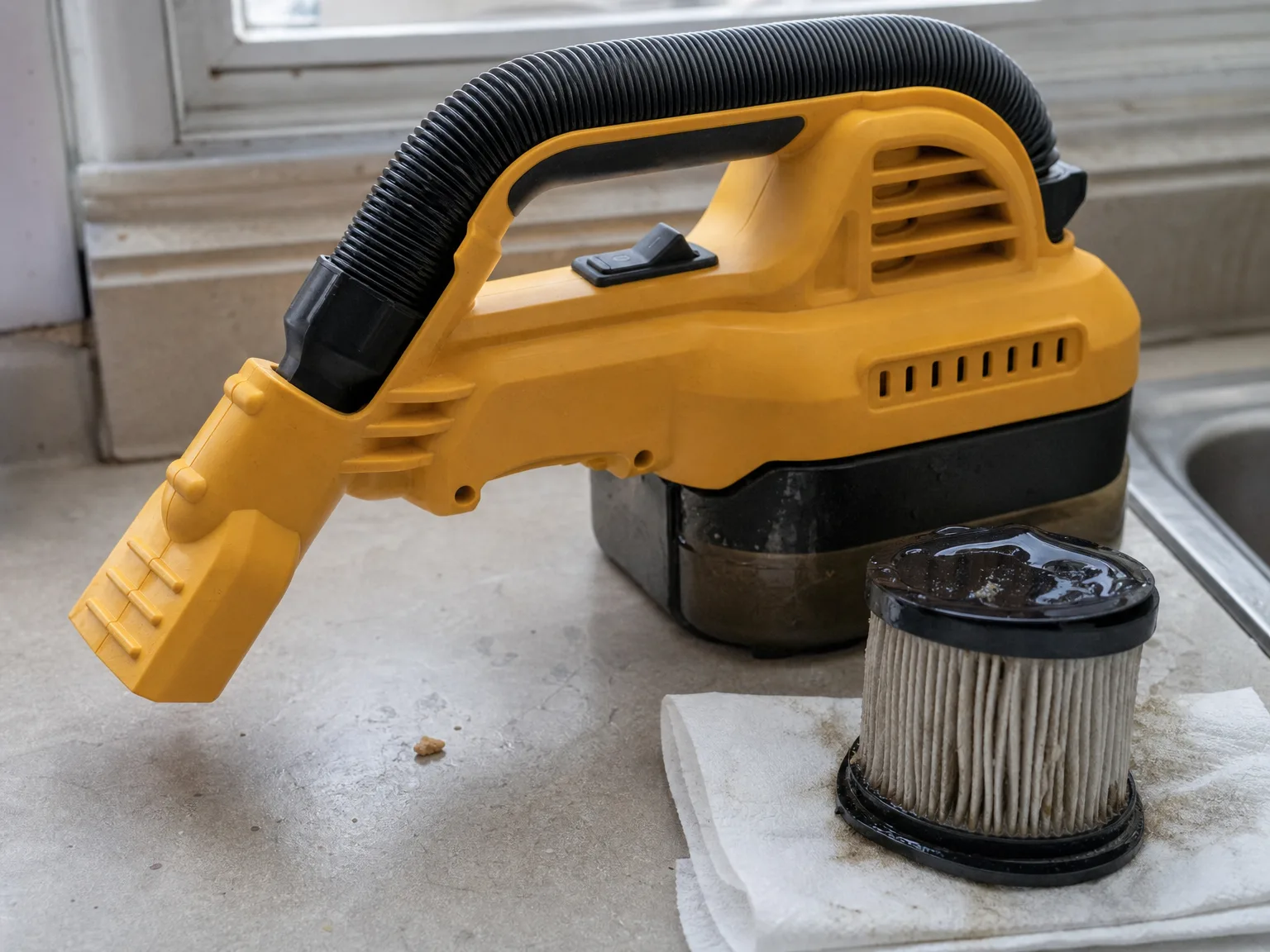
The included HEPA filter handles light wet pickup, but it saturates. Once it is soaked, airflow drops and you feel the suction go with it. Owners who use the vacuum for liquids regularly tend to buy a third-party foam filter for wet work and keep the HEPA element for dry jobs.
Nothing here is broken. It is the standard compromise of a single-tank wet/dry design, and the filter is washable, so the maintenance cost is your time rather than money. Just do not expect one filter to be optimal at both jobs.
Real-world performance
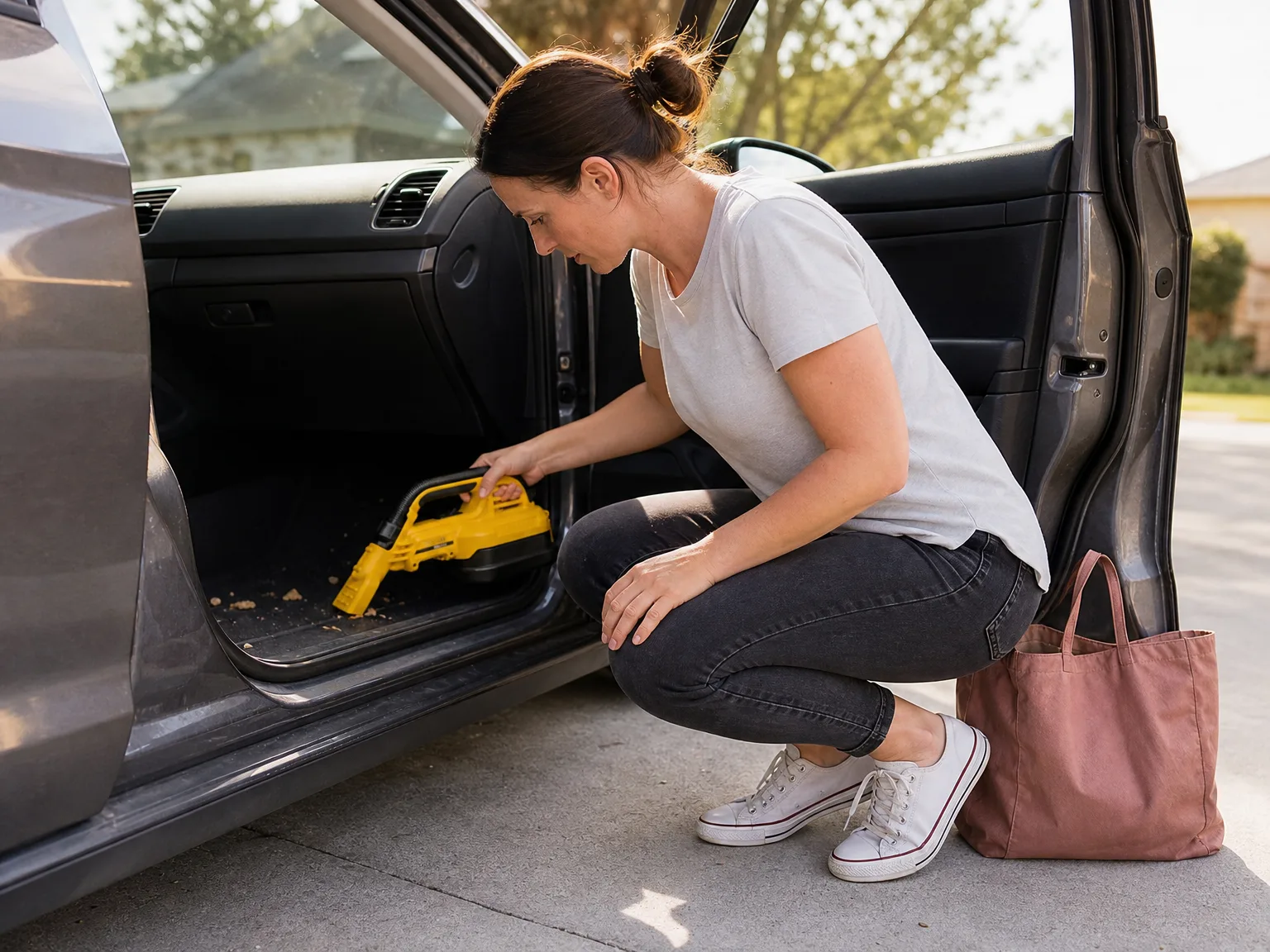
The car after a week of school runs. Crushed crackers in the seat seams, sand in the footwell, and fur on the upholstery from a dog who rides in the back. With a 5Ah pack we did both rows and the trunk on one charge without hurrying. The hose did the seat rails, the bare port did the carpet, and the tank came out about half full of grit.
Sawdust at the workbench. This is the job it was designed around and it shows. Fine dust from a sander and coarser shavings from a saw both went in without the airflow dropping off. Cleaning between cuts stopped feeling like an interruption, which is the honest test of whether a shop tool gets used.
A spilled drink on a rug. Roughly a glass of juice on a low-pile rug. Slow passes pulled most of the liquid out of the fibers, and the rug went from soaked to damp in a couple of minutes. Blotting with a towel afterward still helps, but the vacuum did the part your arms would otherwise be doing.
Pet hair on upholstery. Without a motorized brush head it will not strip fur that has been ground into a fabric couch for months. Loose surface hair on car seats, stairs, and a pet bed comes up readily. Owners describe the same split, and it is the fair way to think about it: strong airflow, no agitation.
Noise in an occupied house. Loud vacuums wake kids and send pets under the bed, so this matters. The motor sits higher-pitched than a full-size shop vac without being punishing, and it is roughly what other powerful handhelds sound like. We would run it in the garage during a nap. Not in the next room.
Emptying and upkeep. Dry debris dumps straight out. After wet work, rinse the tank and let the filter dry completely before it goes back in, because a damp filter costs you suction and starts to smell within a day. The half-gallon tank means you do this often, which is the trade-off for a body small enough to carry in one hand.
How it compares to alternatives
If your main problem is volume rather than portability, a corded shop vac wins on capacity every time. Our Vacmaster 6-gallon wet/dry review covers that side of the trade: twelve times the tank, a blower function, and a cord that follows you everywhere. It cleans a garage properly. It also stays in the garage, which is exactly the reason people buy a handheld instead.
For a car-only tool, something lighter is easier to live with. The ZARIMI portable car vacuum weighs a fraction as much and stores in a door pocket, though it has nowhere near the airflow and no wet capability. If pet hair on upholstery is the real job, the motorized brush on the RELIDOL 20000Pa handheld does the agitation this DEWALT deliberately leaves out.
If you need one machine to clean an entire house, get a stick vacuum instead. This is a spot-cleaning tool with a half-gallon tank, and asking it to do floors is asking for the wrong thing.
Who should buy it
Buy it if you already own DEWALT 20V batteries and you want one tool for the car, the garage, and the spills that happen on the way between them. That is the household this makes obvious sense for: the batteries are sitting there, the charger is on the shelf, and the vacuum is the cheapest useful thing you can add to the platform. Pair it with a 5Ah or larger and it stops having a runtime problem.
Look elsewhere if you are starting from no batteries at all, because a bare tool plus a pack plus a charger changes what you are actually spending. Look elsewhere too if you want something light enough to hold overhead comfortably, or if large liquid spills are a regular event in your home. This one is heavier than a dust buster and its tank is small.
What you get for the money is a genuine shop vac motor in a body you can carry to the driveway with one hand, a tank that takes wet and dry without any swapping, a filter you wash instead of replace, and a hose that reaches the places that stay dirty for years. What you give up is light weight, capacity, and any pretense of whole-house cleaning.
Frequently asked questions
How long does it run on a single charge?
It depends entirely on the battery. A 2Ah pack gives around ten minutes, a 5Ah gets close to 45 minutes, and a 9Ah runs about an hour. For anything beyond a single quick cleanup, a 5Ah or larger is the practical pick.
Does it come with any attachments?
No, it ships bare with the hose and nothing else. Standard 1.2 inch shop vac accessories fit, and most owners end up adding a crevice tool early, since that is what does the real work in car seams and along baseboards.
Can the filter handle wet debris without losing suction?
For light wet pickup, yes. The included HEPA filter saturates during heavier liquid work and airflow drops as it does. If you plan to vacuum liquids regularly, a third-party foam filter keeps air moving longer and lets you save the HEPA element for dry messes.
Does it include a battery and charger?
No. This is a bare tool, which is a good deal if you own DEWALT 20V gear and a considerably worse one if you do not. Factor the pack and charger into the price before you compare it against handhelds that arrive ready to use.
Is it loud?
It is not quiet. The motor runs higher-pitched than a full-size shop vac but is not painful to be around, and most owners rate the noise as normal for a handheld this powerful. Treat it as a garage and driveway tool rather than something to run near a sleeping child.
Will it clean up a large spill?
Only in stages. The half-gallon tank fills quickly with liquid, so a big spill means stopping to empty it more than once. It is built for a knocked-over glass or a wet footwell, not for a burst pipe.
Bottom line
The DEWALT 20V MAX hand vacuum is a small shop vac that happens to fit in your hand, and it earns its place if the DEWALT batteries are already in your garage. Suction stays strong as the tank fills, the detachable hose reaches into car seams that nothing else touches, and wet or dry makes no difference to it. Run at least a 5Ah pack, keep the exhaust vents turned away from fine dust, and add a foam filter if you vacuum liquids often. If you want one machine for the whole house instead, start with our cordless stick vacuum reviews before you spend anything here.
Ready to buy?
DEWALT 20V MAX Hand Vacuum, Cordless, for Wet or Dry Surfaces, 1/2-Gallon Tank, Washable Filter, Portable, Bare Tool Only (DCV517B)
In this article
- At a glance
- What we liked
- The suction holds instead of fading
- Wet and dry with nothing to swap
- The hose gets into places the body cannot
- It runs on batteries you probably own
- Where it falls short
- A small battery makes it a ten-minute vacuum
- The half-gallon tank fills fast with liquid
- Side exhaust can scatter what you are trying to collect
- The wet filter question
- Real-world performance
- How it compares to alternatives
- Who should buy it
- Frequently asked questions
- How long does it run on a single charge?
- Does it come with any attachments?
- Can the filter handle wet debris without losing suction?
- Does it include a battery and charger?
- Is it loud?
- Will it clean up a large spill?
- Bottom line
Keep reading
How to Clean Hardwood Floors Without Damaging Them: A Busy Home Guide
Soft rollers, the right suction mode, and barely damp mops keep hardwood safe. Here's the method we use at home, plus three tools that won't scratch sealed wood.
BLACK+DECKER Handheld Review: Wall Dock Ready After Kitchen Weeks
We tested the BLACK+DECKER cordless handheld with wall mount on hallway crumbs and kitchen spills. Honest take on the always-ready dock, hold-down button, and who should buy.
BLACK+DECKER dustbuster Cordless Review: Trunk vs 12V After Weeks
We tested the BLACK+DECKER dustbuster cordless on trunk grit and kitchen crumbs. Honest take on short runtime, wall-dock habits, and when a 12V plug-in wins instead.